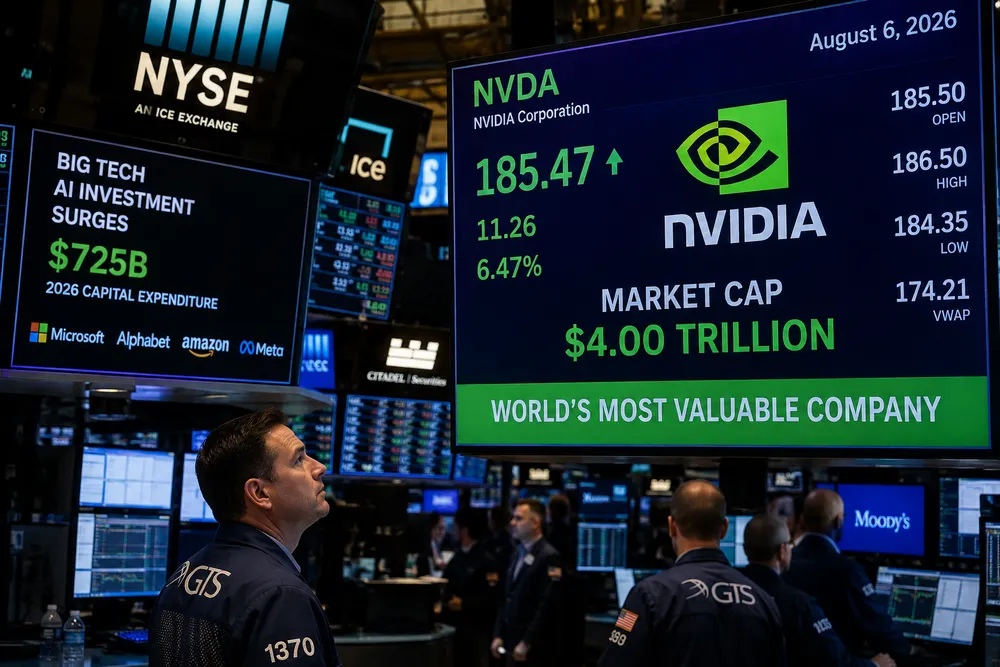
The U.S. labor market delivered its sharpest surprise of the year on Friday: nonfarm payrolls unexpectedly fell by 23,000 in July, far short of the roughly 80,000-job gain economists had forecast, while combined revisions to May and June wiped out another 103,000 jobs from prior estimates. Rather than spook investors, the soft reading revived hopes that the Federal Reserve will hold interest rates steady rather than raise them in September, and stocks rallied into the close: the S&P 500 finished at a record 7,757.64, the Nasdaq Composite jumped roughly 1.3%, and all three major indexes logged their best weekly performance since April.
A Labor Market Losing Momentum, Not Collapsing
The headline payroll decline was the first monthly drop since February, and it was broad enough to catch nearly every forecaster off guard. Government employment shed 53,000 positions, while retail trade, leisure and hospitality, and financial activities also contracted; healthcare, construction, and professional services posted modest gains that weren't enough to offset the losses. The unemployment rate ticked down to 4.1% from 4.2%, but economists were quick to note that the improvement reflected people leaving the workforce rather than more hiring — the labor force participation rate slipped to 61.4%, its lowest level in more than five years. Wage growth also cooled, with average hourly earnings rising just 3.2% year-over-year, the weakest annual pace since 2021 and now trailing inflation. One research note observed that the employment-to-population ratio fell to 58.9%, a level not seen since 2014, underscoring how much of the "improvement" in unemployment is a function of fewer people participating rather than stronger demand for workers.
Corroborating data from earlier in the week painted a similarly mixed picture: July ADP private payrolls rose just 44,000, the weakest since January, and June JOLTS job openings came in below expectations with a downward revision to May's figure. Not every signal pointed downward, though — the Challenger report showed layoff announcements fell 27% in July even as hiring plans jumped, and Q2 productivity rose a stronger-than-expected 1.4%, suggesting firms are getting more output from a smaller workforce rather than an economy in outright distress.
Markets Read Weak Data as Fed-Friendly
Investors' reaction illustrated the now-familiar "bad news is good news" dynamic that governs a market fixated on interest-rate expectations. Immediately after the report, futures tied to the Dow, S&P 500 and Nasdaq all moved higher, and the 10-year Treasury yield fell to roughly 4.60% from just below 4.68% beforehand. The CME FedWatch tool showed the odds of a September rate hike dropping toward the low-40% range that morning, a sharp retreat from over 54% earlier in the week, though probabilities continued to shift throughout the session as traders digested the report alongside separate reporting that Fed Chair Kevin Warsh had signaled openness to a hike if inflation data runs hot. By the close, the S&P 500 was up 0.62% for the day and 3.6% for the week, the Dow rose roughly 3%, and the Nasdaq gained about 5.2% on the week — the strongest five-day stretch for equities in months.
The rate-path debate remains genuinely unsettled among professional forecasters. J.P. Morgan Wealth Management strategists this week shifted their base case to expect a 25-basis-point September hike, citing Middle East-driven supply disruptions and questions about Fed credibility, even as the jobs data cut against that view. That tension traces back to the Fed's July 29 meeting, where the committee voted 9-to-3 to hold its policy rate at 3.50%-3.75%, with three regional bank presidents dissenting in favor of a hike — an unusually public split that has left markets guessing about Warsh's intentions heading into the September 15-16 meeting.
Geopolitics and Inflation Complicate the Fed's Calculus
The jobs report did not arrive in isolation. Crude oil prices swung sharply this week on reports that Iran struck "hostile targets" in the Strait of Hormuz even as Tehran and Oman worked toward a partial deal to reopen the critical shipping route; West Texas Intermediate traded above $78 a barrel at points during the week before easing on hopes that an agreement was close. Energy-driven inflation risk is precisely why some officials are wary of reading the jobs report as a green light to hold rates — a supply shock from the Gulf could push prices higher even as hiring slows, a combination that would leave the Fed with an uncomfortable choice between supporting growth and containing inflation.
Separately, the U.S. and Japan conducted a rare coordinated intervention to support the yen after it weakened to roughly 40-year lows, the first joint yen-buying operation between the two countries since 2011 — another reminder that currency and rate dynamics are increasingly intertwined across major economies this summer.
What Comes Next
The path forward hinges on data still to come. July's Consumer Price Index lands August 12, followed by producer prices on August 13, and the next payrolls report will arrive before the Fed's September decision. J.P. Morgan and other strategists now put the odds of a September hike at roughly 65%, while CME FedWatch pricing has swung within a wide band — from the mid-50s to the low-40s — over just the past several sessions. That volatility in rate expectations, layered on top of falling participation, cooling wages, and an unresolved energy-security risk in the Gulf, means Friday's rally reflects relief more than resolution: markets are betting the softer labor market buys the Fed room to wait, but the underlying signals about the health of the U.S. economy remain genuinely mixed.