Britain says it now has “strong indications” that Iran played a role in the suspected security plot near RAF Fairford, the U.K. air base used by American bombers during the war with Iran, marking the government’s strongest public attribution since five men were arrested there Sunday.
Prime Minister Andy Burnham disclosed the assessment Wednesday while stressing that the evidence remains under investigation. He said British officials are working closely with the United States, but he did not identify the intelligence behind the government’s conclusion or say whether investigators believe Tehran directed the men, used intermediaries or merely influenced their actions. Iran has denied involvement.
The statement materially advances the case since TAQ reported the arrests on Sunday. At that point, police had not publicly connected the incident to any foreign government. Britain’s new assessment makes the episode a direct test of security around a strategically important American operating location, while leaving the suspects’ intent and any operational link to Iran unresolved.
What Britain now says
Burnham told the BBC that there were “strong indications” Iran “played a part” in the episode, according to separate accounts by AP and Reuters. He described the inquiry as complex and serious and promised further updates. The wording goes beyond the earlier police position, which treated foreign-state involvement as one of several possible lines of inquiry.
The five men, all British nationals in their 20s who live in London, were arrested near the base on suspicion of explosives offenses and later on suspicion of preparing a terrorist act. They were released on strict bail Monday and remain under investigation. Arrest and bail do not establish guilt, and authorities have announced no charges.
Police found gasoline in the three vans associated with the men but no improvised explosive device, the latest account said. Burnham did not say whether the government’s Iran assessment arose from communications, surveillance, financial records, intelligence shared by the United States or another source. That undisclosed basis is the central limitation on what can presently be concluded.
A strategic American operating location
RAF Fairford is British-owned but supports U.S. Air Force operations and has hosted American B-1 and B-52 bombers. The base is about 100 miles west of London and has been used for U.S. missions during the current conflict with Iran. Britain’s government previously confirmed in a military update that it had authorized specific U.S. use of British bases for operations it characterized as defensive action against Iranian missile facilities.
That role gives the suspected incident immediate American significance. The U.S. Air Force has said its personnel remain vigilant while declining to discuss force-protection measures, and the U.S. Embassy has advised Americans in Britain to remain alert, AP reported. President Donald Trump said the suspects had intended to do “big damage,” while Secretary of State Marco Rubio said the case appeared to involve a foreign actor; neither official publicly disclosed supporting evidence.
Iran’s Revolutionary Guards had earlier described bases used for strikes on Iranian territory as legitimate targets. That threat provides context but is not proof of involvement in the Fairford episode. The Iranian Embassy in London has categorically rejected the allegation, according to AP reporting.
What investigators have confirmed
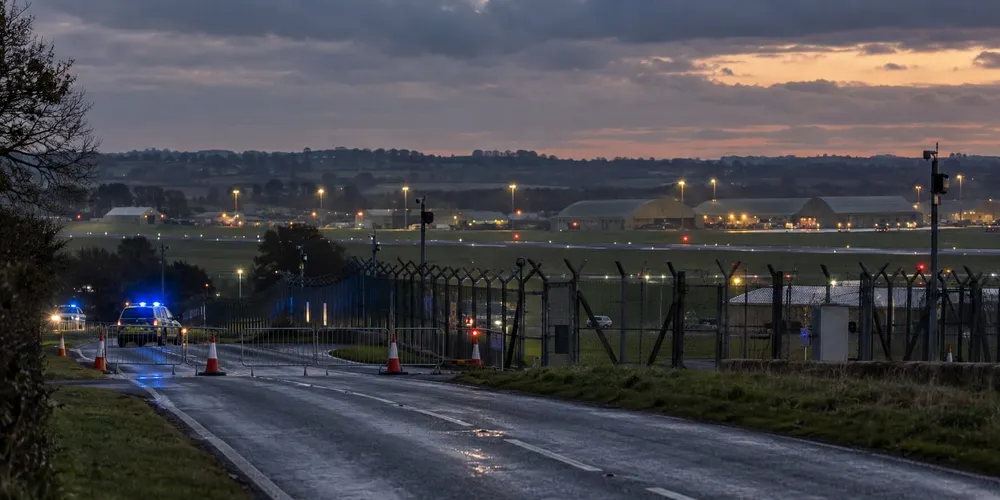
The incident began shortly after midnight Sunday when police received a report that three suspicious vehicles were moving toward the airfield. Armed officers arrested the five men in nearby Whelford, and the initial statement said authorities established a 400-meter cordon while an Army explosive-ordnance team examined the vans.
About 85 households were evacuated as a precaution. Residents were later allowed home, though the vehicles remained within the cordon as investigators continued their work, according to a subsequent police update. No completed attack occurred, and officials have not said that any suspect entered the base perimeter.
Britain’s counterterrorism chief, Laurence Taylor, has said investigators are examining whether individuals knowingly or unknowingly acted for a foreign state. That distinction matters: a government-directed operation, an intermediated proxy effort and a locally conceived act inspired by state messaging would carry different legal and diplomatic consequences. Burnham’s statement indicates that Iran has moved to the front of the government’s assessment, but it does not resolve which mechanism, if any, investigators believe was used.
What changes and what remains unproven
The new attribution increases pressure on British authorities to explain both the suspected plan and the decision to release the men on bail. Burnham said he had confidence in the security services and that the investigation was under close control. British police have defended the bail decision as a tactical judgment grounded in investigative experience, while U.S. officials have publicly questioned it.
The most consequential next steps are evidentiary: whether prosecutors authorize charges, whether police describe a target or operational plan, and whether the government releases facts linking any suspect to Iranian officials or proxies. Until then, Britain’s statement is an official national-security assessment, not a judicial finding. The confirmed record remains five arrests, gasoline but no disclosed explosive device, no charges, an ongoing joint investigation and a sharpened British judgment that Iran likely played some role.