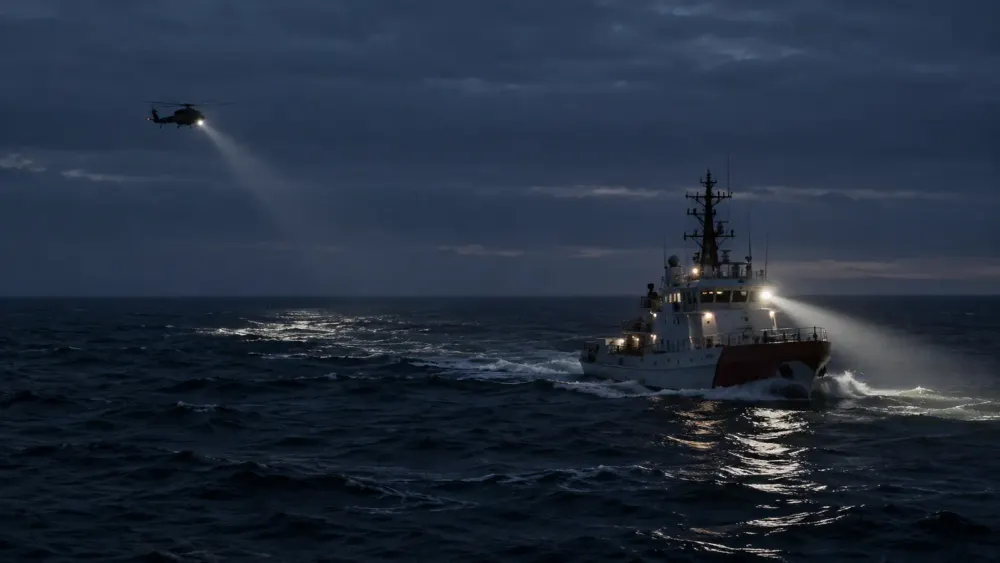
U.S. Coast Guard crews found a debris field south of Nantucket late Saturday that officials confirmed came from a missing medical transport jet carrying six people from Bermuda to Boston. The discovery shifted a daylong search into a more concentrated overnight operation, but the Coast Guard said the people aboard remained unaccounted for as the cutter William Sparling continued working the area.
The Coast Guard’s official update said crews had searched about 1,644 square miles over roughly 27 hours. Independent reports from The Associated Press and NBC10 Boston confirmed that the debris was associated with the aircraft and that search-and-rescue work was continuing through the night.
What officials have confirmed
The aircraft was a Canadian-registered Gulfstream G100 operated by Ontario-based Latitude Air Ambulance. It left L.F. Wade International Airport in Bermuda shortly after midnight Saturday with four Canadian crew members and two Bermudian passengers: a patient and a family member. It was headed to Boston Logan International Airport and did not arrive as scheduled.
The Federal Aviation Administration lost contact with the jet early Saturday and issued a search-and-rescue alert. CBS News reported that the aircraft departed at about 11:40 p.m. Eastern time Friday and was expected at Logan around 1:30 a.m. Saturday. The Canadian Press, citing a Latitude operations manager, placed the loss of contact around 1:30 a.m. as the flight approached Boston.
Search assets included fixed-wing aircraft, a helicopter, a motor lifeboat and the William Sparling, a 154-foot fast response cutter. Local reporting by the Inquirer and Mirror described crews initially searching about 13 miles south of Nantucket and later concentrating activity near the debris field.
Final communications remain preliminary evidence
Air traffic recordings published by LiveATC and reviewed by AP, NBC and other outlets indicate that the pilot reported electrical problems and declared an emergency. A controller can be heard asking whether the crew was “coming in blind,” but the pilot’s reply is not audible in the public recording. Preliminary commercial flight-tracking data also showed a rapid descent from roughly 24,000 feet toward 10,000 or 11,000 feet before tracking ended.
Those details may help investigators establish a timeline, but they do not establish a cause. Electrical trouble, weather shown near the flight path and the steep descent are facts or preliminary observations that require corroboration from aircraft systems, radar records, wreckage and other evidence. The National Transportation Safety Board told AP and NBC that it was gathering information, but it had not announced a formal investigation as of late Saturday. Because the jet was Canadian-registered and the event occurred over waters near the United States, the eventual inquiry may involve more than one national authority.
The distinction between the rescue operation and a safety investigation matters. Coast Guard crews are focused on finding people and identifying hazards in a large offshore search area. Accident investigators, if formally assigned, would later examine maintenance records, crew qualifications, communications, weather, radar information and recoverable aircraft components. The publicly available radio traffic and tracking data are only fragments of that larger record. They can show what controllers heard and how the aircraft appeared to move, but they cannot by themselves reveal which systems were functioning, what the crew could see or whether more than one problem developed.
It is also too early to characterize the debris beyond the Coast Guard’s confirmation that it came from the aircraft. No official had announced recoveries or changed the mission from search and rescue as of the latest public update. A Coast Guard briefing was scheduled for Sunday morning in Boston, making that the next likely point for verified information about the search area, conditions and operational plan.
A cross-border medical mission
The missing flight was part of an international medical evacuation. Latitude’s operations manager told the Canadian Press that two pilots and two medical staff members were accompanying the patient and relative. Bermuda Premier David Burt said his government was in contact with the families and the U.S. authorities coordinating the search. Canadian Transport Minister Steven MacKinnon also said Canada was monitoring the effort and working with the relevant agencies.
The nationalities involved underscore the coordination now required among U.S., Canadian and Bermudian officials. The immediate priority remains locating the six people. Separately, aviation authorities will need to preserve evidence and determine which agency leads the safety investigation, a process distinct from the Coast Guard’s rescue mission.
The scale of the response also reflects the difficulty of offshore searches. The 1,644-square-mile area reported by the Coast Guard is larger than Rhode Island, and crews were working from both the air and the water. The discovery of debris can narrow part of the operation, but currents, darkness and changing weather can continue to complicate the task. Officials had not released the identities of those aboard, saying next of kin had been notified.
For now, the most consequential fact is also the most limited one: searchers have located debris from the missing medical jet, but the fate of those aboard has not been officially determined. Until authorities issue further findings, accounts of the aircraft’s final minutes should be treated as preliminary rather than as a settled explanation of what happened.