
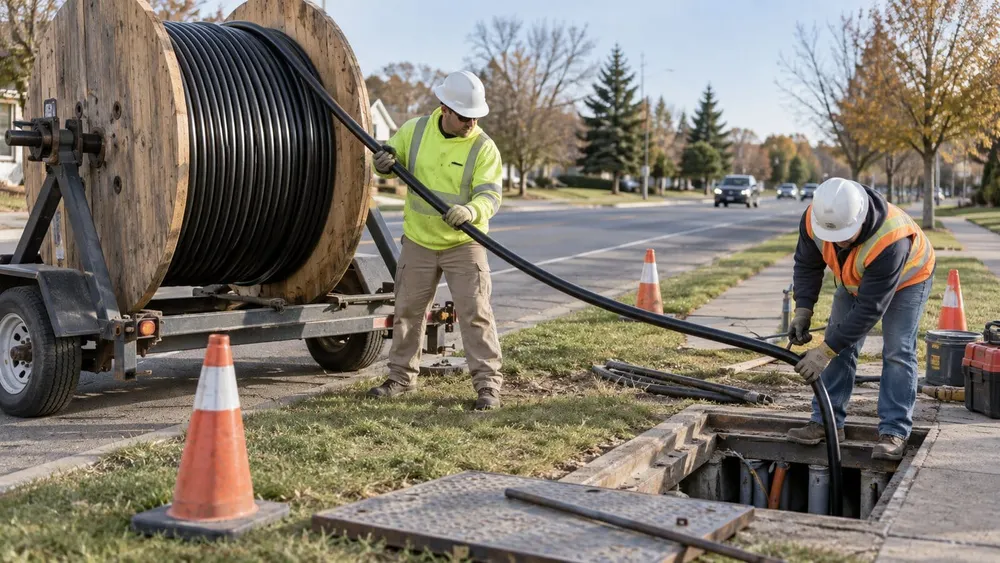
AT&T agreed Tuesday to buy more than $3 billion of fiber and cable from Corning under a multiyear contract designed to support one of the largest broadband construction programs in the United States.
The companies did not disclose the agreement’s duration, annual purchase schedule or volume commitments. They said Corning will supply U.S.-made optical fiber and cable as AT&T expands toward its goal of reaching more than 60 million customer locations with fiber by the end of 2030. Corning shares rose 3.3% in premarket trading after the announcement, according to Reuters.
The contract is consequential because it converts part of AT&T’s long-range network plan into a committed supply relationship. It does not, however, show how quickly fiber will reach individual communities, how much customers will pay or what return AT&T will earn on the buildout. Those outcomes will depend on construction, customer adoption and competition after the materials are delivered.
The deal secures materials for a larger footprint
AT&T and Corning described the agreement as a way to improve deployment speed and installation efficiency. Their joint announcement said Corning’s U.S. operations will manufacture the fiber while AT&T’s union-represented technicians build and maintain the network.
AT&T already reaches more than 37 million locations with fiber and has said it remains on pace to pass 60 million by the end of the decade. That total combines the company’s owned network with locations served through acquired and open-access systems, according to a May shareholder update. The distinction matters because AT&T does not necessarily construct or own every line counted in the broader footprint.
The company’s purchase of Lumen Technologies’ mass-market fiber business also expanded the base from which it is growing. That transaction added existing customers and construction capacity, making the Corning agreement part of a broader consolidation and expansion strategy rather than a stand-alone project.
Data growth is driving the investment case
AT&T said an average household on its fiber service now uses more than one terabyte of data each month, five times the 2016 level. The companies project monthly use could reach 2 to 2.5 terabytes by 2030 as streaming, gaming, cloud services, video calls and artificial-intelligence applications consume more capacity.
Those figures describe traffic on AT&T’s existing fiber network; they do not prove every household needs a new multi-gigabit plan. Fiber’s strategic value lies partly in its ability to carry substantially more data without replacing the underlying glass each time demand increases. Electronics at the endpoints can be upgraded while the cable remains in place, allowing a network investment to support several generations of service.
AT&T has framed fiber and wireless as complementary assets: fixed fiber connects homes, businesses and network facilities, while wireless covers mobile use. The company’s broader investment plan calls for more than $250 billion in U.S. connectivity spending over five years, although that figure includes multiple technologies and should not be read as fiber construction alone.
Corning is supplying rival networks at once
Corning’s position is notable because the manufacturer is becoming a central supplier to competing telecom carriers and major data-center operators. Earlier in September, Verizon signed a separate multiyear, multibillion-dollar supply agreement covering more than 80 million miles of high-density optical fiber through 2032.
That parallel demand supports Corning’s investment in U.S. manufacturing, but it also places execution pressure on a supplier serving multiple large customers. Long-term contracts can help a manufacturer justify capacity expansions and help buyers reduce the risk of shortages. They can also concentrate exposure if construction plans slow or if the customers’ forecasts prove too optimistic.
The AT&T agreement therefore signals confidence in sustained demand rather than exclusivity. Corning can sell to AT&T’s competitors, and AT&T may use other qualified suppliers. Neither company disclosed provisions governing minimum purchases, pricing adjustments or remedies if schedules change.
Construction economics remain the central test
Securing fiber does not remove the most expensive and variable parts of network deployment. Carriers must obtain permits, engineer routes, install conduit or aerial lines, connect individual properties and maintain the system. Population density, labor costs, existing infrastructure and local approval timelines can make the cost of passing one location very different from another.
The return also depends on the “take rate,” or the share of eligible locations that become paying customers. Cable companies, wireless home-internet providers and other fiber operators compete for the same households, often using promotional pricing. A network can pass millions of additional addresses without producing its expected return if too few residents subscribe or if competitive prices compress margins.
The Wall Street Journal reported that the agreement echoes the Corning deal Verizon announced earlier this month. That competition suggests large carriers are securing supply before expanding construction, but the contracts alone do not establish which network will gain more customers.
What the agreement establishes
The deal provides a clearer procurement foundation for AT&T’s 2030 target and gives Corning a large, multiyear revenue commitment. It also reinforces the domestic industrial chain behind broadband construction: fiber manufactured in U.S. plants, installed by a heavily unionized carrier workforce and used across residential, business and wireless networks.
AT&T said the agreement’s financial impact is already reflected in the outlook and capital-allocation plan it issued with second-quarter results. That reduces the likelihood that the contract represents an unplanned increase in near-term spending, but it does not reveal the timing of payments or the profit contribution Corning expects.
The evidence therefore supports a focused conclusion. AT&T has committed significant money to ensure fiber supply for a much larger network, and Corning has strengthened its role in the U.S. broadband buildout. The commercial outcome will be measured later through locations constructed, subscribers added, build costs and revenue—not by the $3 billion headline alone.