Alibaba plans to exceed 20 gigawatts of global data-center capacity by 2032, train future Qwen artificial-intelligence models with as many as 10 trillion parameters and begin selling a new in-house accelerator early next year, tying chips, models and cloud infrastructure into one of China’s broadest AI technology stacks.
The company unveiled the Zhenwu V900 processor Tuesday at its Apsara conference in Hangzhou. Chief Executive Eddie Wu said the chip delivers three times the performance of its predecessor and can be connected in clusters of as many as 500,000 processors. It is scheduled for mass production and commercial release in the first quarter of 2027, according to Reuters.
The announcement matters beyond a single product launch. Alibaba is attempting to reduce its dependence on foreign accelerators while using its own cloud customers, software and models to create demand for its silicon. That integration could give the company more control over cost and supply, but most of its performance and capacity claims remain company forecasts rather than independently tested results.
A faster chip timetable
The V900 is the latest accelerator from Alibaba’s T-Head semiconductor unit. Alibaba said the processor is three times faster than the M890, which it introduced in May for memory-intensive AI-agent workloads. Large clusters are intended to compensate for the limits of individual processors by spreading training and inference across many chips, although doing so requires fast networking, efficient software and reliable power delivery.
The release schedule appears to have accelerated. Alibaba’s May roadmap placed the V900 in the third quarter of 2027; Tuesday’s plan calls for commercial availability in the first quarter. The earlier roadmap also documented more than 560,000 Zhenwu-family chip shipments to over 400 customers in 20 industries. Those deployments show adoption, but they do not establish that the V900 can match the performance, software maturity or operating efficiency of leading Nvidia systems.
Models grow with infrastructure
Alibaba said it is training Qwen 4, while later Qwen 4.5 and Qwen 5 systems are expected to contain 5 trillion to 10 trillion parameters. Its current flagship, Qwen 3.8 Max, has 2.4 trillion. Parameters are numerical settings learned during training; they offer a rough measure of model scale but do not by themselves prove better reasoning, reliability or real-world usefulness.
The company says its research team is also developing methods that let models identify weaknesses, conduct experiments and generate training data with less human involvement. That is a research direction, not a demonstrated outcome at the scale Alibaba described. The company’s own profile now defines Alibaba around AI, cloud computing and commerce, illustrating how central Qwen has become to products serving both businesses and consumers.
Twenty gigawatts raises the stakes
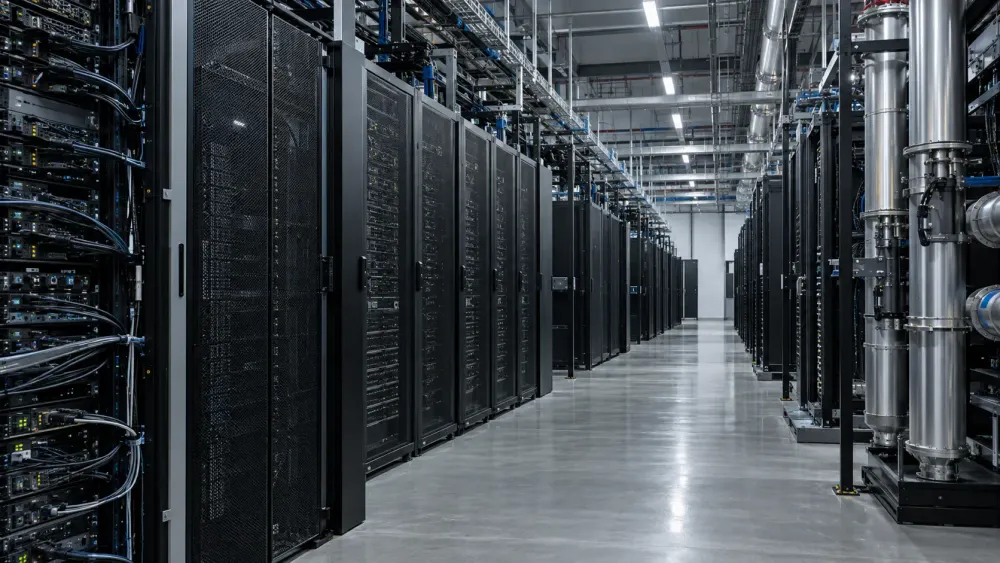
A 20-gigawatt target is a statement about physical infrastructure as much as software. Data centers at that scale require power generation, grid connections, cooling, land, servers and capital across multiple markets. Wu acknowledged that customer demand is growing faster than Alibaba can supply it and said commercial-scale AI supernodes would begin coming online this quarter.
Alibaba has already committed more than 380 billion yuan to cloud and AI infrastructure over three years. Its official results for the June quarter reported total revenue of 268.95 billion yuan, up 9% from a year earlier. Independent AP reporting found that cloud and AI-compute revenue rose 45%, while capital expenditure jumped 75% and quarterly profit fell sharply. The figures show demand and investment moving together, but they also show the near-term financial cost of building capacity ahead of proven returns.
China’s domestic chip race
U.S. export restrictions have limited Chinese access to the most advanced American accelerators and chipmaking equipment, encouraging local companies to build alternatives. Alibaba’s approach combines proprietary chips with a commercial cloud and a widely distributed model family. Huawei, by contrast, has emphasized large systems built from its Ascend processors and recently introduced a faster Atlas 960 SuperPoD cluster.
The AP reported that Chinese developers still use American chips for some advanced training even as domestic processors gain adoption. That mixed reality is important: a product roadmap and shipment count demonstrate industrial progress, but technological independence also depends on memory, manufacturing yields, networking, compilers and developer tools. Nvidia’s CUDA software ecosystem remains a substantial competitive advantage that hardware specifications alone do not erase.
What remains unproven
Alibaba’s announcement combines three different kinds of evidence. The V900 is a product scheduled for release; the Qwen models are development plans; and the 20-gigawatt figure is a six-year infrastructure target. None should be treated as a completed achievement. Independent benchmarks, customer deployments and audited capacity additions will determine whether the technical claims translate into dependable commercial systems.
The next tests are concrete. Alibaba must ship the V900 on the accelerated timetable, show that very large clusters can operate efficiently, and convert rising AI usage into returns sufficient to justify heavy capital spending. Tuesday’s launch establishes that Alibaba wants to compete across the full stack. It does not yet establish that the company has closed the performance gap with global leaders or that demand will absorb every gigawatt it plans to build.