The United States has confirmed that a new rotation of troops is on its way to Lithuania, restoring a visible American presence on NATO’s eastern flank after months of uncertainty over whether Washington would replace forces that left this summer.
Lithuanian President Gitanas Nausėda announced the confirmation Tuesday in an official post, calling the U.S. presence indispensable to deterrence and collective defense. A separate report said Foreign Minister Kęstutis Budrys described the return as one involving “large numbers,” although neither official disclosed the size, unit or equipment of the incoming force.
That missing detail matters. Lithuania has typically hosted a U.S. armored battalion of roughly 1,000 troops since 2019, but Tuesday’s announcement confirms only that a rotation is moving. It does not establish that the next contingent will match the personnel, armor or artillery of earlier deployments. The U.S. Embassy in Vilnius had not provided additional information when Reuters published its account.
Uncertainty gives way to a deployment
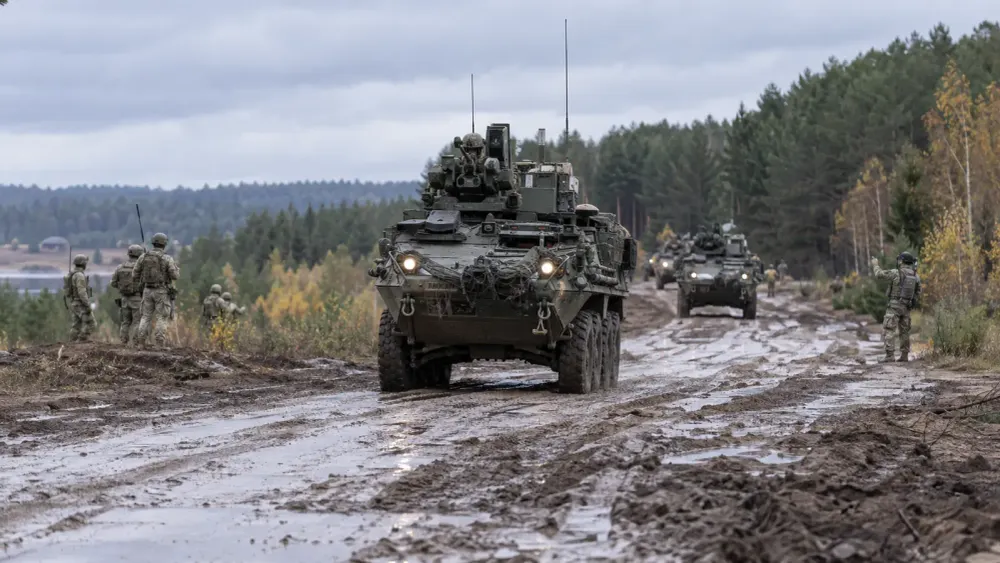
The announcement closes the central question raised in June, when Lithuanian Defense Minister Robertas Kaunas said the American posture was under review. The departing formation included two battalions from the Texas-based 1st Cavalry Division equipped with Abrams tanks, Bradley fighting vehicles and Paladin self-propelled howitzers. At the time, Kaunas said Lithuania had been assured that another rotation would arrive, but he did not know when, how large it would be or what capabilities it would bring.
The delay briefly left Lithuania without the continuously rotating U.S. armored battalion it had hosted since 2020. That gap attracted outsized attention because the country borders both Russia and Belarus and sits at the northern end of the Suwałki corridor, the narrow land connection between the Baltic states and the rest of NATO territory.
Lithuania responded politically as well as militarily. A reshaped governing coalition made a long-term, uninterrupted American presence a formal priority in June. The coalition also committed to defense spending of at least 5% of gross domestic product, air-defense improvements and continued support for Ukraine’s integration with NATO and the European Union.
Why a rotational force carries weight
A rotation is not the same as a permanent base, but it can create a persistent military effect when successive units arrive with combat vehicles, train with local forces and use established infrastructure. Since Russia’s full-scale invasion of Ukraine, Baltic governments have treated the continuous presence of allied troops as both a practical war-fighting asset and a political signal that an attack would immediately involve forces from multiple NATO countries.
The distinction also explains why troop numbers alone will not tell the whole story. Heavy armor, air defense, artillery, engineers, logistics units and headquarters staffs perform different missions and require different support. A smaller specialized detachment could strengthen one part of Lithuania’s defenses without replacing the combined-arms capacity associated with a full armored battalion. Conversely, a formation that arrives with tanks, fighting vehicles and field artillery would more closely restore the posture that ended during the summer.
Lithuania has spent years building the physical and logistical foundation for that model. Its Defense Ministry says U.S. Army battalions have rotated through the country since 2019 and describes the uninterrupted presence as a critical element of deterrence. The ministry has also highlighted American investments in ranges and maintenance facilities alongside Lithuania’s own improvements to rail and training infrastructure.
The Pabradė training area near the Belarusian border has become central to that effort. An official U.S. Army account described Lithuania’s long-term sustainment commitment to American forces there and the infrastructure needed to support recurring deployments. Those investments allow arriving units to train and maintain equipment without recreating a support network for every rotation.
Host-nation infrastructure is an important part of the burden-sharing debate surrounding American deployments. Barracks, maintenance space, training ranges and transport links do not substitute for soldiers, but they reduce the time and expense required to move a unit into position and keep it operating. Lithuania’s spending and construction therefore help explain why its leaders describe the country as a reliable platform for recurring U.S. forces rather than merely a beneficiary of them.
What remains unknown
Tuesday’s confirmation resolves the question of whether American troops are returning, but not the more consequential questions of scale, composition and duration. An armored battalion with tanks and artillery would provide a different military effect from a smaller training or enabling unit. The absence of a public arrival date also makes it unclear how quickly the gap in the rotational presence will close.
The announcement therefore should be read as a force-posture signal, not as a completed deployment. Lithuania obtained the commitment it had sought, while Washington preserved flexibility over the force package. That balance is consistent with a broader American review of troop levels in Europe and with U.S. pressure on allies to carry a larger share of regional defense costs.
For NATO, the immediate value is political clarity at a sensitive point on the eastern flank. For military planners, the decisive evidence will come when the arriving formation, its equipment and its mission are identified. Until then, the strongest verified conclusion is narrow but important: the United States is renewing its rotational presence in Lithuania rather than allowing the summer gap to become an open-ended withdrawal.