A 90-minute documentary in which its living subject was not newly filmed premiered at the Venice Film Festival on Thursday, using artificial intelligence to reconstruct parts of his life and to create an on-screen version of him. Reuters reported that Be Brave, director Francesco Carrozzini’s portrait of Diesel founder Renzo Rosso, combines real interviews and archival material with convincing AI-generated video. The film’s arrival at one of cinema’s most influential festivals moves a long-running industry argument into a form where the central issue is not simply whether AI can generate images, but whether audiences can reliably tell which images document an event and which ones reconstruct it.
The festival listing places the Italian production in the Venice Open non-fiction program, outside the main competition, and credits human writers, cinematography, editing, music, sound and visual-effects teams. It also identifies a substantial interview roster, including Anna Wintour, John Galliano and members of Rosso’s family. That record matters because Be Brave is not a machine-produced film without conventional authorship. It is a human-directed documentary that uses synthetic moving images as a major storytelling layer.
The production’s own account says artificial intelligence was selected as a narrative device suited to Rosso’s history of provocation and experimentation. At the premiere, however, the more consequential disclosure came from Carrozzini: no frame of Rosso was newly filmed for the documentary, even though an older version of him appears on screen. Actual filmed interviews with other participants are set against altered or stylized backgrounds. The result places authentic testimony, archive and reconstruction inside the same visual grammar, making disclosure and context essential to how viewers evaluate what they see.
A biography built from synthetic reconstruction
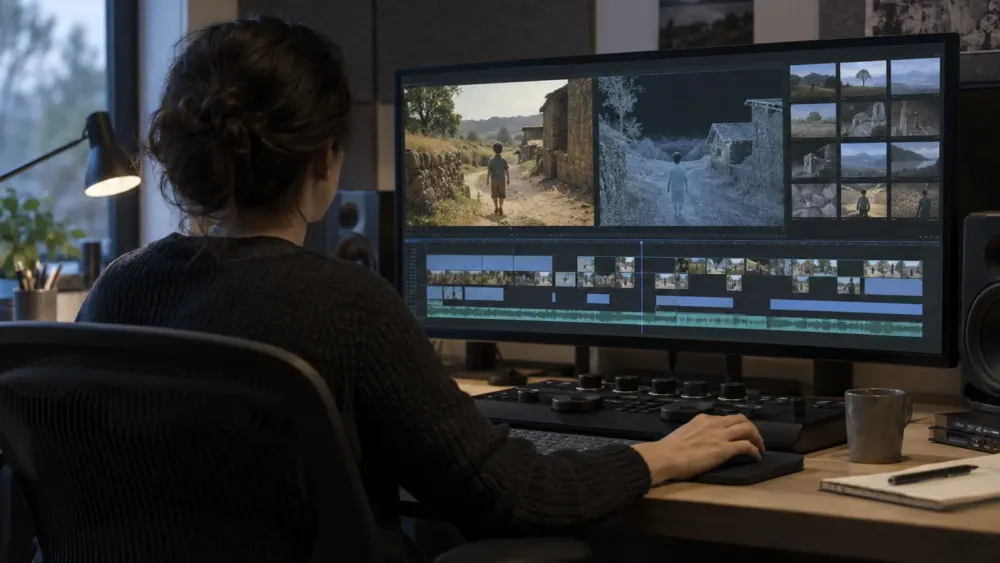
Documentaries have always reconstructed events they could not record. Filmmakers use reenactments, animation, maps, still photographs, voice-over and staged inserts, usually signaling the change through style or narration. Generative video changes that convention because a reconstruction can be made to resemble the texture, lighting and apparent spontaneity of found footage. The technology does not eliminate editorial choices; it expands the number of plausible images available to an editor when no camera was present.
Be Brave uses that capability to visualize Rosso’s childhood in rural northeastern Italy, a period for which he said no footage existed. The emotional effect is understandable: Rosso told reporters that seeing a child version of himself speak moved him to tears. Yet the sequence cannot function as archival evidence in the ordinary sense. It is an interpretation assembled from later knowledge, creative direction and model output, even if the broad biographical circumstances are accurate.
That distinction is especially important in a film centered on a real person who is alive, involved and supportive of the project. Consent answers one ethical question but not every evidentiary one. A subject can authorize a synthetic likeness and still leave audiences needing to know what was recorded, what was restored, what was composited and what was generated. The stronger the illusion of a camera having witnessed the past, the more valuable that provenance becomes.
Why documentary provenance is different
Fiction asks viewers to accept invented people and events; documentary earns authority from its relationship to the record. That does not mean every documentary image is unmediated or that editing is neutral. It means viewers reasonably assign different weight to an eyewitness interview, a contemporaneous photograph and a later reconstruction. If those categories become visually indistinguishable, a disclosure only in marketing materials or festival coverage may not travel with the film when a clip is shared elsewhere.
The U.S. Copyright Office’s report on digital replicas defines them broadly as realistic but false depictions created or manipulated through digital technology. The office stressed that such replicas can support legitimate creative work and accessibility, while also creating risks to livelihoods, reputation and public trust. Its analysis focused heavily on unauthorized uses, but the framework illuminates the documentary problem as well: authorization and authenticity are related questions, not interchangeable answers.
Technical provenance can help preserve those distinctions, though it cannot determine whether a scene is fair or accurate. Metadata and tamper-evident credentials can record that material was generated or altered and can retain information about parts of a production chain. Such systems still depend on tools, distributors and platforms preserving and displaying the information. Editorial explanation inside the work remains more durable because it reaches the audience at the moment a potentially ambiguous image appears.
Labor rules focus on consent, credit and control
The film also arrives after Hollywood unions spent several years converting general anxiety about AI into contract language. The Writers Guild of America says its AI rules treat generated text as neither literary material nor source material, prevent companies from requiring writers to use AI, and require disclosure when writers are given generated material. Those provisions protect compensation, credits and human responsibility for covered writing. They do not prohibit filmmakers from choosing AI as one tool in a wider production.
SAG-AFTRA’s published framework similarly emphasizes clear consent, reasonably specific descriptions of intended use and, in many cases, additional compensation for digital replicas. It distinguishes replicas based on real performers from wholly synthetic performers. That distinction is directly relevant to biographical work, where a generated likeness may reproduce a recognizable person without a conventional performance taking place before a camera.
California added statutory protections in 2024, requiring contracts to specify uses of digital replicas and protecting deceased performers against certain unauthorized commercial uses. The measures, summarized when they were signed, reflected the same basic priorities: authorization, representation and control over identity. Those rules are aimed chiefly at the rights of performers and other individuals. They do not by themselves establish a documentary-wide standard for telling audiences which scenes are synthetic.
Copyright protects the human arrangement
Copyright law draws another line, between using AI as an assistive tool and asking a system to make expressive choices. In its report on copyrightability, the U.S. Copyright Office concluded that prompts alone generally do not provide enough human control to make a user the author of an output. Human selection, modification and arrangement can nevertheless be protected when those contributions meet the ordinary originality standard. A larger human-authored film can also remain copyrightable even if individual generated effects are not.
That case-by-case approach fits the production credits for Be Brave. The festival lists named people responsible for its script, photography, edit, music, sound and effects, and Carrozzini made the overarching directorial decisions. The relevant legal question is therefore unlikely to be whether the finished film has any human authorship. More difficult questions concern which specific generated elements qualify for protection, what materials were used to build the systems behind them and whether all recognizable likenesses and source works were licensed.
An AP account of the Copyright Office’s findings emphasized the same boundary: AI-assisted work can be protected when human creativity is evident, while wholly generated material is not protected merely because someone requested it. That leaves ample room for filmmakers to experiment. It also places value on documentation of the human decisions that shaped the output, which can matter for ownership claims as well as for audience trust.
European rules make labeling immediate
The premiere took place in Italy weeks after the European Union’s AI transparency requirements became generally applicable. The European Commission says providers must make generated content identifiable and that certain realistic synthetic material should be visibly labeled. Its guidance notes that the rules include exceptions and tailored treatment for artistic or fictional works, but the governing direction is clear: realistic synthetic media should carry information about its artificial origin rather than relying solely on viewers to detect it.
For a documentary, the practical standard may need to exceed minimum legal compliance. A general opening disclosure tells viewers that AI was used, but it does not necessarily identify which claims or moments have an archival basis. Shot-level labels can interrupt a film, while end credits may arrive too late to prevent confusion. Filmmakers and distributors will have to decide how to balance narrative continuity with enough specificity for an audience to understand the status of consequential images.
The central achievement of Be Brave is therefore also its central test. It demonstrates that a synthetic reconstruction can be folded into a polished non-fiction film and exhibited by a major international festival. It does not establish that audiences will consistently understand the boundary between reconstruction and record, or that existing labor and copyright protections resolve the disclosure problem. What follows the premiere should be judged not only by visual quality, but by whether the film’s provenance remains clear in theaters, on streaming services and in detached clips.