
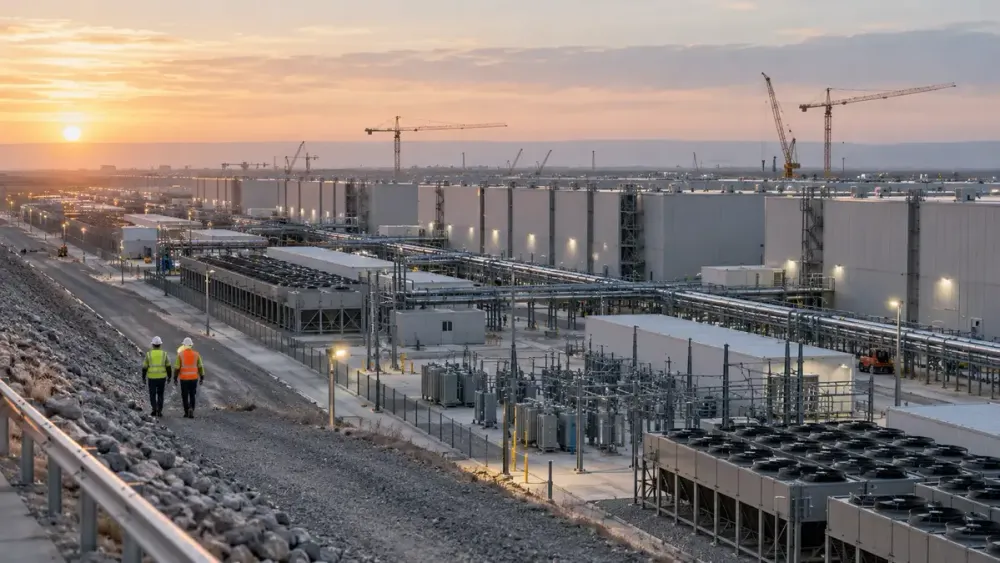
Global spending on data centers could reach $31.6 trillion through 2050 under a new baseline projection, turning the artificial-intelligence buildout into one of history’s largest capital programs before the industry has demonstrated revenue or productivity gains on a comparable scale.
The estimate, published by PwC and brought into sharper focus by a Reuters analysis on Saturday, is a forecast rather than money already committed. It covers data-center capital expenditure across 46 countries and territories and includes the repeated replacement of servers, processors and networking equipment. Even so, its scale illustrates the widening gap between the physical infrastructure being planned for AI and the economic returns needed to sustain it.
That gap does not prove an AI bubble, and it does not mean the infrastructure will lack lasting value. Railroads and internet networks survived the failures of companies that overinvested during earlier technology booms. But it does shift the immediate question from whether AI systems can perform useful tasks to whether businesses can turn those capabilities into enough revenue before financing costs, hardware obsolescence and construction risk catch up.
The $31.6 trillion forecast
PwC’s Global Data Centre Outlook projects annual data-center capital spending will rise from roughly $800 billion in 2026 to $1.8 trillion in 2050. Its central scenario produces the $31.6 trillion cumulative total; faster AI adoption could push the figure close to $50 trillion. Those are modeled scenarios, not guaranteed expenditures.
The spending differs from traditional infrastructure because much of it is short-lived computing equipment rather than concrete and steel. Advanced processors and associated systems can require replacement within a few years as newer models deliver more performance per watt. A data center may remain useful for decades, but the expensive technology inside it can depreciate much faster. That creates a recurring capital requirement even after buildings, power connections and cooling systems are complete.
PwC’s model also depends on demand, access to electricity, chip supplies, regulation and the pace at which businesses adopt AI. Each variable can move the total substantially. The headline figure therefore measures the scale of the industry’s current trajectory, not a settled bill that the global economy must pay.
A $4.2 trillion revenue gap
The more immediate test comes from Bain & Company’s estimate of what would be needed to support infrastructure spending expected by 2031. As summarized by MarketWatch, annual AI infrastructure investment could reach $1.5 trillion. If capital spending represents about one-quarter of industry revenue, the market would need to produce roughly $6 trillion in annual revenue to sustain that level.
Bain identified about $1.2 trillion to $1.8 trillion from subscriptions, advertising and enterprise productivity improvements, leaving as much as $4.2 trillion still to be found. Potential new markets include autonomous machines, industrial robotics, AI-assisted drug discovery and new materials. Those opportunities may become large, but forecasts are not sales, and many depend on technical advances or changes in business behavior that have not yet occurred.
The revenue challenge is especially important because the investment cycle is increasingly connected. Chipmakers finance customers, cloud providers sign long-term capacity agreements, and AI developers commit to infrastructure that suppliers then use to justify expansion. Those arrangements can accelerate construction, but they can also concentrate risk if expected demand is delayed.
Productivity evidence remains mixed
The economic case for the buildout rests partly on AI lifting worker productivity. The Congressional Budget Office’s 2026–2036 outlook expects broader adoption of generative AI to contribute to faster productivity growth. At the same time, CBO projects that real economic growth will moderate later in the decade as population growth slows and other constraints persist. That is consistent with AI providing a meaningful benefit without immediately producing the extraordinary gains needed to validate every current valuation or construction plan.
Labor-market evidence is similarly uneven. A revised Stanford Digital Economy Lab study found employment among workers ages 22 to 25 in highly AI-exposed occupations was 19% below where it would have been had it kept pace with less-exposed peers. The researchers did not find broad economy-wide displacement, however. They also cautioned that the estimated gap becomes smaller under some controls, that some divergent trends predated widespread generative-AI use, and that the effect is stronger in their payroll-company sample than in national survey data.
Those findings show why productivity cannot be inferred simply from spending or software adoption. AI may reduce the time needed for some tasks while companies absorb the savings through experimentation, integration costs or reduced hiring rather than measurable output growth. The benefits can be real without appearing quickly enough to service the financial commitments made during the buildout.
What would validate the investment
The strongest evidence would be sustained growth in revenue from AI products outside the companies financing the infrastructure themselves, combined with measurable productivity gains across industries. Rising utilization of existing data centers, durable customer contracts and lower computing costs would also strengthen the case. By contrast, repeated project delays, weak capacity use or dependence on circular financing would raise the risk that expansion has outrun demand.
For now, the industry is investing ahead of proof. The $31.6 trillion projection may ultimately look conservative if AI creates large new markets, or excessive if returns arrive slowly. The important distinction is that infrastructure capacity and economic value are not the same thing. The next phase of the AI race will be judged less by how much computing power companies can build than by how much durable output customers can produce with it.