
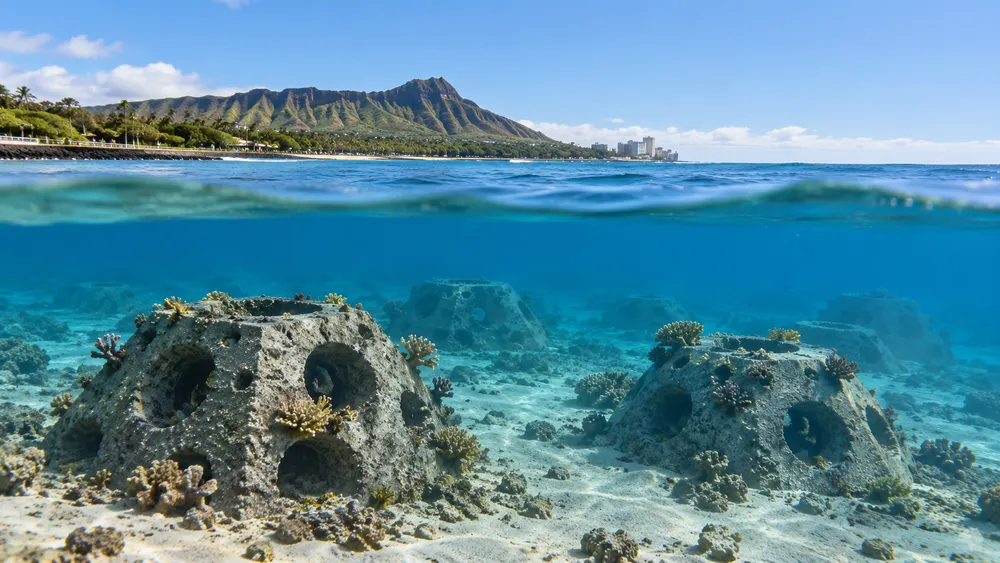
Hawaiʻi has begun a full-scale ocean test of a “living breakwater” designed to protect coastal transportation infrastructure while supporting coral growth. The Kalaeloa Hybrid Reef Project places 60 porous concrete structures offshore south of Kalaeloa Harbor, where they will be paired with native coral and monitored as a possible alternative to conventional shoreline hardening.
The Hawaiʻi Department of Transportation, the Defense Advanced Research Projects Agency and the University of Hawaiʻi developed the demonstration with academic, industry and community partners. HDOT says it is the first large-scale ocean deployment produced by four years of research under DARPA’s Reefense program. Ownership of the structures will transfer to the state after deployment, while Hawaiʻi’s Green Fee program will fund the first year of monitoring and maintenance.
The technology combines immediate engineering with slower biological growth. The concrete units are shaped to dissipate wave energy while allowing water to move through them. Coral-settlement modules are intended to help native coral establish on the structures, and specialized materials are being tested to limit competing algae and improve early coral growth. DARPA describes Reefense as an effort to create hybrid structures that provide near-term coastal protection and become more resilient as reef-building organisms grow.
Laboratory performance is promising but does not yet establish how the system will work over years in open water. The University of Hawaiʻi reported that model breakwaters reduced incoming wave energy by more than 80% in large wave-flume tests. Separate experiments in Kāneʻohe Bay found that small spiral shelters in the ceramic coral modules produced sharply higher settlement and survival than flat surfaces. Those controlled results are why the Kalaeloa deployment will function as a living laboratory rather than a finished coastal-defense template.
The location is a degraded hard-bottom area with little live coral. Project teams plan to preserve coral fragments already present, install the engineered units, attach live fragments and then track engineering, environmental and cultural effects. A monitoring hui that includes researchers, agencies, community groups and cultural practitioners is expected to help guide long-term stewardship.
The project also tests whether installation can be less disruptive than traditional marine construction. The UH Applied Research Laboratory says the design uses locally manufactured, customizable reef structures. A shallow-water catamaran and rotary micropiles are intended to reduce the need for heavy crane barges and large pile-driving equipment.
For Hawaiʻi, the immediate outcome is data, not proof of statewide protection. Researchers must determine whether the units remain stable, meaningfully reduce wave energy, support healthy coral and avoid unintended effects on sediment and nearby habitat. The evidence will also help regulators and coastal managers judge where this approach may be appropriate. If the monitoring confirms those goals, the state could have a new tool for coastal roads and other infrastructure where seawalls may be expensive, ecologically damaging or impractical.