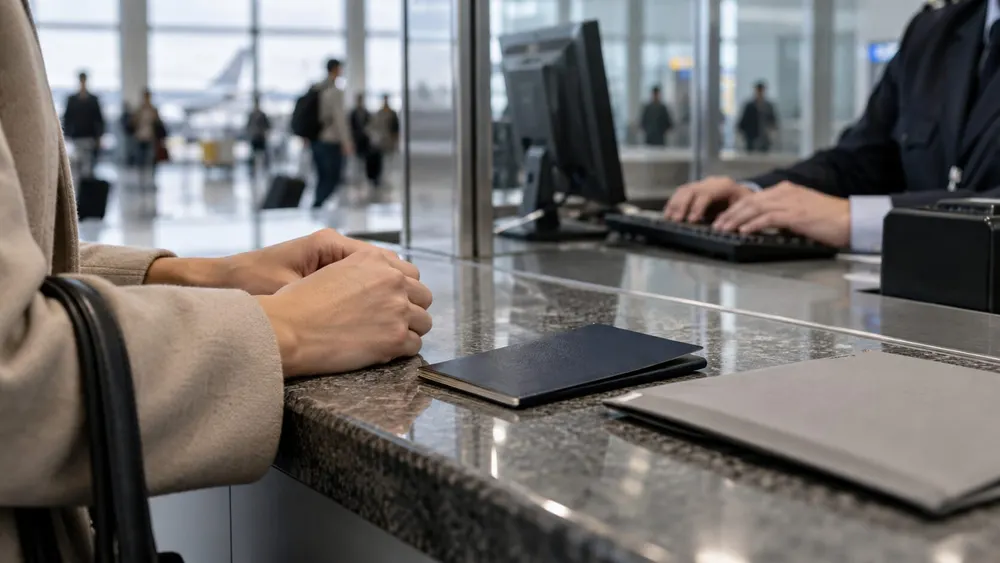
The State Department said Tuesday that it has revoked more than 300,000 U.S. visas since President Donald Trump returned to office in January 2025, a sharp expansion of an immigration-enforcement tool that can block travel and, in some cases, carry consequences for people already in the country.
The new total, first reported Tuesday, is at least 125,000 higher than the department’s Aug. 10 tally. Because both figures were presented as minimums, they do not support an exact rate. Still, the increase over roughly 10 weeks demonstrates how rapidly revocations have accelerated as the administration broadens screening and enforcement across legal immigration channels.
A major jump in a short period
The department’s August update said more than 175,000 visas had been revoked during Trump’s second term. It attributed most actions to law-enforcement encounters and identified assault, driving under the influence, theft and drug offenses as leading causes. Tuesday’s disclosure raises the cumulative total above 300,000 without providing a category-by-category, nationality or visa-class breakdown.
A State Department official offered additional detail to Al Jazeera, saying most revocations involved criminal activity, public-safety concerns, immigration violations, fraud, misrepresentation or information suggesting a person was no longer eligible. The official said more than 4,000 cases involved people alleged to have engaged in or facilitated “birth tourism.” The department did not publish underlying case data that would allow independent verification of those proportions.
State Department spokesman Tommy Pigott said the administration had revoked visas faster than any previous administration and described the policy as one of zero tolerance for visa holders who break the law, commit fraud or threaten national security. That is the administration’s characterization; the public tally combines different grounds and does not by itself show how many people were accused of serious crimes, lesser violations or conduct tied to speech and political activity.
What a revocation does—and does not do
A visa permits a foreign national to travel to a U.S. port of entry and request admission. It does not guarantee entry, and it is distinct from the immigration status a person may hold after being admitted. Revocation therefore does not automatically mean that every affected person was deported or even present in the United States when the visa was canceled.
The State Department’s governing guidance says nonimmigrant visas may be revoked when a person is no longer eligible for the classification, has been found inadmissible, or becomes subject to certain security or watchlist information. The manual also provides for “prudential” revocations based on possible ineligibility while a case is reviewed. Those procedures give officials substantial discretion, but the legal effect depends on the visa type, the grounds used and whether the person is inside or outside the country.
That distinction matters for interpreting the headline figure. The 300,000 total measures canceled visas, not criminal convictions, removals or findings by a court. The department has not disclosed how many revocations were later reversed, how many affected people still held another lawful status, or how many cases led to removal proceedings.
Screening now reaches more visa categories
The increase comes as the government expands its review of applicants’ online activity. In a September notice, the department said that beginning Oct. 1 it would extend “online presence” screening to foreign media representatives and certain Canadian and Mexican professionals and their dependents. The department instructed applicants in those categories to make social-media profiles public.
That notice said similar screening already applied to students, exchange visitors, temporary workers, religious workers and several other visa classes. The government argues that continuous vetting helps identify national-security and public-safety risks and determine whether applicants remain eligible. Taken together with the revocation total, the policy shows that scrutiny is no longer concentrated only at the initial application stage; it can continue after a visa is issued.
Civil-liberties concerns remain unresolved
Rights advocates do not dispute the government’s authority to cancel visas in appropriate cases, but they argue the administration has used that power too broadly and with too little transparency. The American Civil Liberties Union’s recent policy report included mass visa revocations and actions against immigrant-rights protesters among measures it says threaten speech, due process and democratic checks.
Those concerns are heightened by cases involving pro-Palestinian demonstrators and foreign nationals whose social-media comments drew government scrutiny. Administration officials frame such cases as national-security enforcement; advocates argue that vague standards can punish protected expression or produce uneven treatment. The latest disclosure does not resolve that dispute because it offers no granular data about the reasons, evidence standards, notice or review available across the full set of cases.
The policy question is now transparency
The new total is consequential less because it changes visa law than because it shows the scale at which existing authority is being used. The administration can point to criminal and fraud cases as evidence of enforcement. Critics can point to speech-related cases and the lack of public data as reasons for stronger oversight.
For Congress and the public, the next useful disclosure would be a breakdown by visa class, legal ground, nationality, whether the holder was in the United States, and whether the decision was contested or reversed. Without that information, the 300,000 figure documents an extraordinary increase in government action but leaves its composition—and therefore much of its policy meaning—unclear.