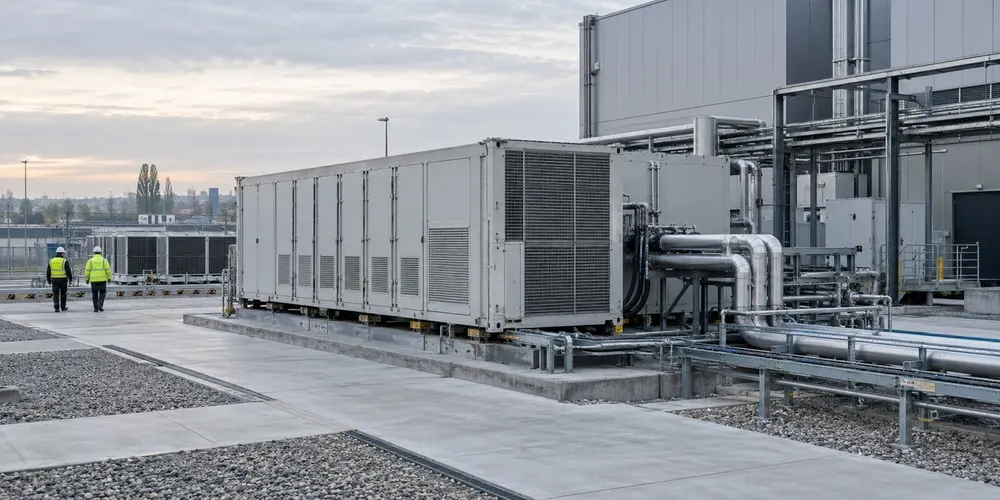
Nvidia says a factory-built data-center module can cut installation at a prepared site from roughly six months to as little as 14 days, a claim that puts deployment speed at the center of Europe’s effort to close a large artificial-intelligence computing gap.
The U.S. chipmaker unveiled the DSX POD reference design on Wednesday at its GTC conference in Berlin. The containerized system combines seven Vera Rubin NVL72 computing racks with networking, cabling, rack-level power and liquid cooling that are assembled and tested before shipment. Nvidia said the first systems are expected to be delivered worldwide through manufacturing and infrastructure partners in early 2027.
The announcement matters beyond a single product launch. Europe has put billions of euros behind sovereign AI infrastructure, but access to power, advanced chips and specialized construction remains a limiting factor. Nvidia is arguing that modular construction can remove part of that bottleneck while extending its influence from processors into the physical design of entire AI facilities.
A factory approach to AI infrastructure
Under Nvidia’s design, partners would finish the most complicated integration work in a manufacturing plant while a customer prepares a site’s electrical, cooling and network connections. The two processes could occur in parallel, reducing the amount of specialized work performed outdoors or at a partially completed data center.
The company has named 17 prospective manufacturing and infrastructure partners, including Dell Technologies, Hewlett Packard Enterprise, Lenovo, Eaton, Schneider Electric and Vertiv. Independent trade publication Data Center Knowledge reported that the module is intended for worldwide use even though Nvidia chose Berlin to emphasize Europe’s need for faster capacity growth.
The 14-day figure is Nvidia’s estimate for connecting a finished pod at a site that is already prepared; it does not cover permitting, land acquisition, grid interconnection or construction of the supporting facility. No customer deployment has yet demonstrated the full schedule in commercial operation. That distinction is important because electricity supply and transmission capacity, rather than assembly alone, often determine when a large data center can begin operating.
Europe’s compute gap is the target
At the Berlin event, Nvidia CEO Jensen Huang framed the product as a way for Europe to build more of the infrastructure needed to train and run AI systems. The Associated Press reported that Europe accounts for about 5% of global AI computing capacity, compared with roughly 75% in the United States, and that Huang said Nvidia invested $10 billion in European startups and partners over the past year.
Public investment is also accelerating. The European Commission says 19 AI factories and 13 satellite sites are being established through its EuroHPC program. At least nine additional AI-optimized supercomputers are planned, while a separate call for as many as seven AI gigafactories is backed by up to €10 billion in public funding and is expected to unlock at least €20 billion in private investment, according to the Commission’s program page.
Those figures show why Nvidia is treating Europe as an infrastructure market rather than only a customer base for chips. Governments and companies want locally controlled computing capacity, but they also need designs that can be replicated across sites with different labor markets, grids and climate conditions.
Efficiency claims remain to be tested
Nvidia paired the modular launch with broader claims about water and power efficiency for its DSX platform. The company says closed-loop liquid cooling and dry coolers can sharply reduce cooling-water consumption, while power-management software can deliver the same token output with less electricity.
Specialist outlet Data Center Dynamics reported Nvidia’s estimate that a two-gigawatt deployment could save 54 million liters of water a day compared with conventional cooling towers. It also noted Nvidia’s caveat that extremely hot climates may require additional mechanical cooling. The savings are projections based on Nvidia’s design assumptions, not independently measured results from a finished DSX POD fleet.
That uncertainty does not make modular construction insignificant, but it shifts the near-term test. Customers will need to show that the pods can be manufactured at scale, transported safely, connected without lengthy delays and operated efficiently under real grid and weather conditions.
OpenShell adds a security layer
Nvidia also introduced an OpenShell reference architecture intended to constrain autonomous AI agents. The company says the system combines a software runtime with Vera processors and BlueField-4 data-processing units that monitor agent behavior from an isolated layer. If an agent violates a policy boundary, Nvidia says the system can quarantine and stop it.
The announcement lists cloud providers, cybersecurity vendors, model developers and enterprise software companies that are working with the architecture. OpenShell is available now, but participation by large partners does not by itself validate Nvidia’s security and performance claims. Independent testing will be necessary to determine how the controls behave against novel attacks, misconfigured policies and agents that operate across several systems.
Still, pairing infrastructure with governance is strategically revealing. Nvidia is positioning itself not just as the supplier of accelerators, but as the designer of the facility, the operating stack and the security boundary around automated software.
What comes next
The immediate milestones are practical: partner manufacturing schedules, named customers, permitted sites and measured deployment times. Early 2027 deliveries would give operators a chance to test whether factory integration truly shortens the path from construction to usable computing capacity.
For Europe, the launch offers one possible shortcut but not a complete solution. Modular pods cannot create new transmission lines, generate electricity or resolve regulatory disputes. They could, however, reduce the integration burden once those prerequisites are in place. If Nvidia’s timetable holds, the approach may turn data-center assembly from a bespoke construction project into a more standardized manufacturing process—and deepen the company’s role in deciding how the next generation of AI infrastructure is built.