
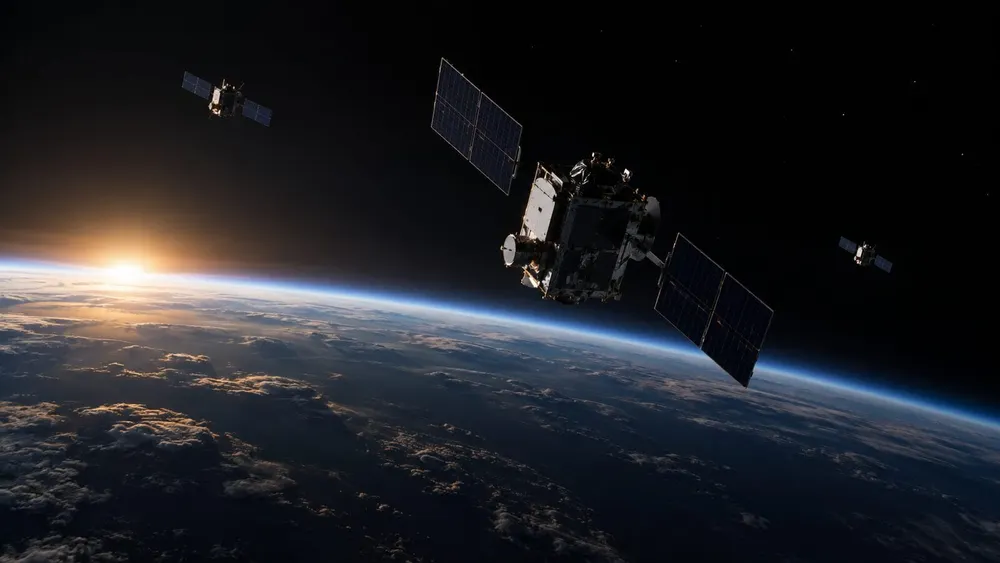
The United States has publicly confirmed for the first time that it has weapons operating in orbit, ending a longstanding policy of ambiguity around an American military capability that officials say is intended to defend U.S. forces and strengthen deterrence in an increasingly contested domain.
Air Force Secretary Troy Meink made the disclosure Monday at the Air, Space and Cyber Conference in National Harbor, Maryland. In an official Air Force account of the speech, Meink said the United States has “on-orbit space control weapons capable of defending the Joint Force against hostile adversary action.” The service described his statement as the first acknowledgement that Space Force has deployed weapons in space.
The significance of the disclosure became clearer Tuesday as the Pentagon’s own description was independently confirmed and senior officials explained why the government had chosen to speak. Richard Palmer, who directs capability and resource integration at U.S. Space Command, called the acknowledgement a landmark moment and told Reuters that making the capability known was fundamental both to preventing deterrence from failing and to being ready if it did fail.
The government has not identified the spacecraft, their number, their orbit, their payloads, their contractors or the circumstances in which they could be used. It has not said whether the systems can physically damage another object, disable one through electronic or cyber effects, interfere with sensors, inspect or shadow a spacecraft, or perform some combination of those missions. Meink declined to say whether the weapons are kinetic or non-kinetic and would not discuss testing. That boundary matters: the existence of a capability is now confirmed, but its destructive capacity and operating rules remain classified.
A deliberate shift
Meink said the wording was intentional and “very well thought out,” according to a conference report published after his address. He argued that acknowledging the systems could reinforce deterrence while disclosing technical details would undermine it. The calculation resembles the logic of other strategic forces: an adversary must believe a response is possible, even when the mechanism and threshold for that response are concealed.
That makes Tuesday’s confirmation more than a change in vocabulary. U.S. officials have discussed counterspace operations, space fires and the need to protect satellites for years. They have also acknowledged ground-based electromagnetic systems intended to interfere with hostile spacecraft. But saying that weapons are already on orbit crosses a public line that the Pentagon had previously avoided. The AP separately reported that this was the first official U.S. confirmation of deployed space weapons.
A Space Force spokesperson provided a broad definition, telling War Zone that space-control operations can employ kinetic or non-kinetic means to disrupt, degrade or destroy an adversary’s ability to use space capabilities, and can be offensive or defensive. That statement describes the mission set; it does not establish which of those effects the newly acknowledged systems can produce. The distinction is essential because a maneuverable inspection satellite, an electronic jammer and a device designed to smash a target would create very different military, legal and environmental risks.
Even so, the disclosure formalizes a strategic reality that has become steadily harder to hide. A recent investigation documented increasingly sophisticated American and Chinese spacecraft maneuvers, including satellites able to approach other objects and systems designed for inspection, refueling, interference or capture. The same technologies that support maintenance and rescue can also enable surveillance or attack. Intent can be difficult to infer until a spacecraft is already moving near a target.
Why it matters on Earth
Military operations on Earth depend on orbital systems for communications, positioning, navigation, missile warning, weather data and intelligence. Civilian networks, emergency response, aviation, shipping, agriculture and financial timing also rely on satellites or signals distributed through them. That overlap means an attack on a military space asset could spill into the civilian economy, while a maneuver meant as deterrence could be misread as preparation for a strike.
Space Command’s publicly stated mission is to integrate military space power to deter aggression, defend national interests and defeat threats. Meink’s disclosure indicates the command now wants at least some adversaries to know that its defensive options extend beyond Earth-based systems. The acknowledgement may also help the Pentagon justify budgets, training and command structures for missions that are difficult to debate openly when their central capabilities are not admitted.
The strategic pressure is not hypothetical. The United States has repeatedly warned that China and Russia are developing ways to disrupt or destroy satellites. The independent Secure World Foundation’s annual threat report tracks electronic warfare, cyber operations, directed energy, direct-ascent missiles and co-orbital systems across multiple countries. In 2024, Washington also said Russia was developing a space-based anti-satellite capability involving a nuclear weapon, although officials said then that the threat was not imminent. No public evidence links Meink’s newly acknowledged systems to a particular foreign program or crisis.
The disclosure is also likely to intensify debate over orbital stability. A destructive collision can create debris traveling fast enough to damage unrelated satellites for years. Non-destructive tools such as jamming, dazzling or cyber intrusion avoid a debris field but can still produce cascading consequences if they interrupt warning, navigation or command systems. Because many space capabilities are dual-use and their effects can be reversible or concealed, attribution may be slower and escalation decisions more uncertain than in conventional domains.
What the law does — and does not — prohibit
The 1967 Outer Space Treaty does not impose a blanket ban on every military system in orbit. Its treaty text prohibits placing nuclear weapons or other weapons of mass destruction in orbit, stationing them in outer space or installing them on celestial bodies. It also requires the moon and other celestial bodies to be used exclusively for peaceful purposes. The agreement does not expressly bar all conventional weapons in Earth orbit.
The Space Force told The War Zone that U.S. operations comply with international law, including the treaty and the law of armed conflict. That is the government’s position, not an independent legal finding about systems whose characteristics remain secret. Without knowing what the platforms do, outside experts cannot fully assess questions involving proportionality, distinction, harmful interference, responsibility for damage or whether particular operations would be lawful.
The same secrecy complicates arms-control diplomacy. A foreign government cannot easily distinguish a satellite built to inspect, service or reposition another spacecraft from one designed to interfere with it. Public acknowledgement may enhance deterrence by removing doubt about American capacity. It may also encourage rivals to accelerate their own deployments, disperse satellites, adopt faster launch plans or place forces on higher alert.
Programs adjacent to the disclosure
Meink placed the weapons statement inside a broader argument that the Air Force and Space Force must modernize faster and at lower cost. He cited proliferated constellations and said the Space-Based Interceptor program had moved from an initial contract to flight-ready hardware in less than a year. He also said an air-moving-target-indication satellite constellation would begin launching this month.
Those programs should not automatically be treated as the weapons he acknowledged. Space-based interceptors are being developed as part of the Golden Dome missile-defense architecture, and the tracking constellation is intended to follow airborne targets. The official remarks did not identify either program as an operational space-control weapon. Conflating them would turn proximity in a speech into a technical claim the Pentagon did not make.
The disclosure nevertheless shows how quickly the boundary between support satellites and combat systems is changing. Sensors can cue interceptors. Communication networks can coordinate attacks. Maneuverable spacecraft can service friendly satellites or approach hostile ones. The Financial Times reported that ambiguity over the weapons’ nature left open the possibility of systems designed to jam or otherwise disable satellites without physically destroying them.
What comes next
The immediate questions are likely to move to Congress, where classified briefings can test whether the systems are operational, how they are controlled, what risks they impose on other spacecraft and whether their costs are included transparently in the defense budget. Lawmakers may also press the administration to explain the legal review and command authority governing any use.
Allies will want to know how the capability fits collective defense, particularly because Palmer framed it as protecting American partners and economic interests as well as U.S. forces. Russia and China are likely to cite the disclosure in their own military planning and diplomatic messaging, even as Washington points to their counterspace programs as the reason it needs stronger defenses.
For now, the confirmed change is narrow but consequential: the United States has moved from implying it possesses counterspace options to declaring that weapons are already in orbit. What those weapons are remains secret. The decision to announce them, however, is itself an operational act — an attempt to make uncertainty deter an adversary before a crisis in space becomes a conflict on Earth.