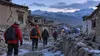
Two hydropower workers were pulled alive from a tunnel in Nepal on Friday after surviving nine days beneath debris left by floods that have killed at least 1,294 people and left 5,053 missing in the country. The rescue of Kabir Maharjan and Sanjay Sah at the Upper Trishuli 3A project supplied the first confirmed survivors among hundreds of workers feared trapped at damaged power sites, according to the latest Reuters account.
The men were taken by helicopter to an army hospital in Kathmandu. Doctors said both were stable in intensive care, although Maharjan could not move his hands or legs; Sah was not in critical condition. Sah, a mechanical foreman, told rescuers that three or four other people may still be alive inside, turning an extraordinary recovery into an urgent lead for teams working through mud, broken machinery and unstable terrain.
The discovery offers a narrow measure of hope inside a cross-border disaster whose scale is still changing. Nepal's official count on Friday included 583 missing foreign nationals, while authorities in China's Tibet region reported 31 deaths and 531 missing. The figures differ slightly by publication time and verification method: an AP report put Nepal's confirmed toll at 1,287, underscoring why the newest government totals should be treated as provisional rather than final.
A Rescue From Beneath the Mud
The catastrophe struck on August 26, when a mass of rock, ice and mud collapsed high in the Langtang region and swept into the river system below. At Upper Trishuli 3A, Sah said roughly 40 to 45 people had been in a control room as the danger approached. He stayed behind to help colleagues escape before the passage was cut off, according to a second Reuters interview.
Rescuers heard voices before reaching the two men, an army spokesperson told the Associated Press. The operation combined Nepalese soldiers and police with helicopters, earthmoving equipment and remote advice from specialists in India, South Korea and China. A WhatsApp group let engineers and rescuers exchange drawings and technical judgments while teams on site confronted conditions that could change with each attempt to remove debris.
That coordination matters because tunnel rescue is less a single excavation than a sequence of risk calculations. Mud must be pumped or removed without destabilizing blocked sections; ventilation and water levels must be monitored; and every advance has to preserve whatever air pockets sustained the men. The army also recovered bodies from the site, a reminder that promising sounds or reported contact do not establish how many other workers survived.
Officials believe about 900 people may have been trapped across hydropower projects during the initial disaster, with roughly 500 thought to have been inside tunnels, according to earlier AP reporting. Those numbers describe the situation at the time of the flood, not a current count of people still underground. Rescue, escape, recovery and duplicate missing-person reports will continue to alter the total.
Hydropower Became the Center of the Search
The disaster hit the infrastructure that Nepal has relied on to expand domestic electricity and export power to neighboring markets. Eleven operating hydropower stations and one solar plant, together representing 431.1 megawatts, were forced offline, while 15 projects under construction with another 470 megawatts of planned capacity were damaged, a preliminary UNDP assessment found.
Hydropower sites are unusually exposed because dams, tunnels, access roads and worker camps are concentrated along steep river corridors. The same geography that provides hydraulic head also channels rock, water and sediment toward installations with few alternative routes. When bridges and roads fail, heavy rescue machinery can be separated from a tunnel by only a few miles on a map but days of difficult movement on the ground.
The financial consequences extend beyond lost generation. Nepal's disaster authority estimated direct losses at 387.5 billion rupees, about $2.56 billion, while insurers expected commercial claims to exceed $132 million, led by hydropower damage. At least 7,500 homes were destroyed and about 20,000 will need rebuilding. Those early estimates do not yet capture every interruption to trade, tourism, agriculture or future electricity revenue.
Debris itself has become a reconstruction problem. UNDP estimated that the floods produced about 2.2 million metric tons of material, enough to obstruct roads, waterways and building sites long after immediate searches end. Removing it safely will require decisions about contaminated sediment, disposal areas and river channels, not simply pushing mud aside to reopen a route.
The Disaster Reached Far Beyond the Tunnels
Government figures reviewed by UNDP indicated that more than 84,000 people across 17 municipalities were affected, and about three-quarters lived in communities already classified as vulnerable. Agriculture supports 67.4% of people in the affected areas, so damage during the June-to-September planting season threatens income and food supplies well beyond families who lost homes.
Children face distinct risks as displacement stretches into a second week. UNICEF said more than 22,000 children needed humanitarian assistance, six health facilities and 19 schools had been destroyed, and roughly 10,000 school-age children required education support. Unsafe water, crowded shelter and interrupted routine health services can turn a geological emergency into a prolonged public-health crisis.
The United Nations and partners launched a UN appeal for $49.6 million on Friday to provide shelter, food, clean water and other help for more than 84,000 people. That request is modest beside the estimated physical loss, because emergency appeals address immediate humanitarian gaps rather than the full cost of rebuilding power plants, roads, bridges and permanent homes.
Scientists Are Still Parsing the Trigger
Satellite and seismic analysis indicates that the event began when bedrock beneath or beside a glacier failed, sending rock and ice roughly 1,200 meters downslope before the flow accelerated through narrow valleys. Scientists have emphasized that it was not a conventional glacial-lake outburst. A Science analysis described international work that rapidly distinguished a landslide-driven cascade from simpler early explanations.
That distinction changes what should be monitored. Lake levels remain important, but slope deformation, permafrost, fractured rock and ice can create hazards without a large lake serving as the initial reservoir. Nepal has more than 2,000 glacial lakes, including 21 considered potentially dangerous, yet this disaster shows that warning systems built only around lake drainage will miss other high-mountain failure modes.
Climate change is part of the risk context, but scientists have not attributed this specific collapse to warming alone. The Himalayas are warming at roughly twice the global average, conditions that can thin glaciers and destabilize frozen ground, according to a cause review. Geology, recent weather, construction and local slope conditions still require field investigation before researchers can assign their relative roles.
Relief Now Competes With Reconstruction
Search teams must keep acting on possible signs of life while authorities restore roads, communications, water systems and medical access. Those missions compete for helicopters, excavators, fuel and trained personnel. A landslide blocking the Chaulani River about 450 kilometers from the main disaster area prompted a separate alert Friday, demonstrating that the national emergency is not confined to one valley.
The rescue of Maharjan and Sah changes the emotional and operational calculus because it proves that survival after nine days was possible inside at least one tunnel. It does not resolve how many people remain trapped or where. Officials will need transparent, frequently reconciled lists separating people missing at hydropower sites from residents, travelers and foreign nationals whose status is still being verified.
The most immediate test is whether rescuers can convert Sah's report of other survivors into another safe recovery. The longer test is whether Nepal and its partners rebuild critical infrastructure for the compound hazards now visible: floods that move rock and ice at extreme speed, tunnels that become isolated rescue sites, and communities whose exposure deepens when electricity, roads, schools and clinics fail together.