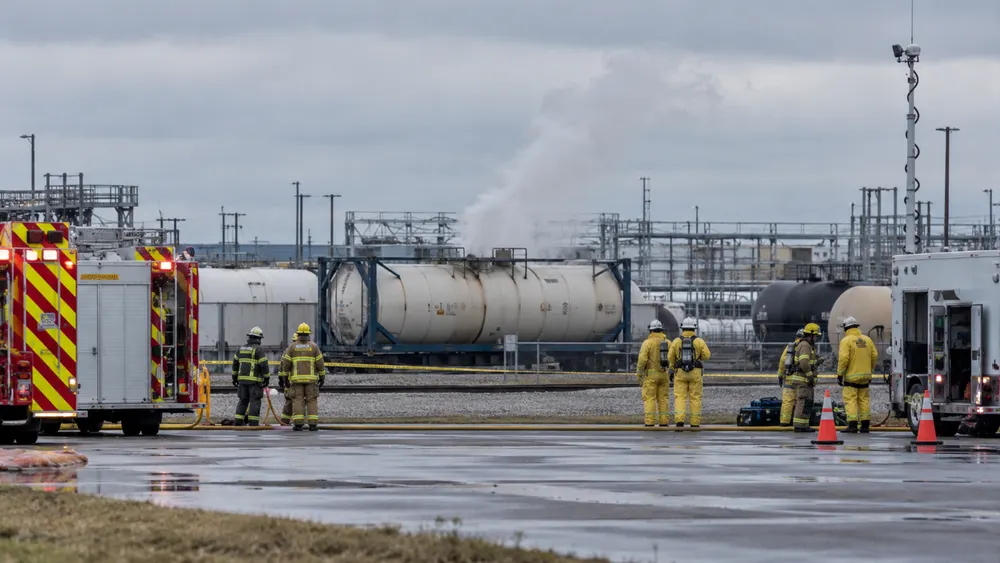
Toledo officials kept a one-mile evacuation zone and a three-mile shelter-in-place order in effect Wednesday afternoon after attempts to contain a leaking chemical tank failed. At a 1 p.m. briefing, officials said the safest option was to let the tank’s chemical reaction finish, a process that could take another six to 16 hours. The latest city update and a continuing local briefing said both public-safety orders remained active.
The release involves glycidyl methacrylate, an industrial chemical carried in an intermodal tank on Progress Avenue in north Toledo. The U.S. Environmental Protection Agency described the vessel as holding approximately 5,000 gallons; Ohio officials cited a capacity of about 5,500 gallons. The EPA’s incident page said the tank was compromised and continued venting after fire crews were unable to stop the release.
Containment attempts failed
Emergency crews were called to the industrial corridor at about 10 p.m. Tuesday after a release and reported explosion. Toledo initially ordered people within one mile to evacuate. At 4:24 a.m. Wednesday, officials added a three-mile shelter zone after air modeling and the behavior of the tank indicated a wider precautionary perimeter was needed. The Associated Press reported that hundreds of residents left their homes and that authorities remained concerned about the possibility of another explosion.
By Wednesday afternoon, the tank was still releasing vapor, and responders had not been able to approach it safely. Mayor Wade Kapszukiewicz said drone readings showed the tank’s temperature falling and the amount of venting declining, signs that conditions were improving. He also stressed that the emergency was not over. The distinction is important: reduced heat and vapor do not mean the evacuation zone is safe to reenter while the reaction is still underway.
The incident also interrupted a major manufacturing corridor. The Toledo Jeep plant canceled its afternoon shift, and several nearby suppliers halted work, according to the local live report. Those closures were precautionary and reflected the active shelter order, not evidence that the facilities themselves had been contaminated.
What residents must do
The health advisory directs everyone inside the one-mile zone to remain out until officials explicitly announce that it is safe to return. A temporary shelter is operating at Shoreland Elementary School. People living or working between two and three miles from the site should remain indoors, close windows and exterior doors, turn off heating or cooling systems that pull in outside air and keep pets inside.
Drivers near the affected area should keep vehicle windows closed and use the recirculation setting. Officials have also told residents not to use visibility or odor alone to decide whether conditions are safe. Glycidyl methacrylate has a strong smell, and the EPA said people may detect it before concentrations reach hazardous levels, but only official air monitoring can establish when the protective orders can be lifted.
Health monitoring continues
Glycidyl methacrylate is used in plastics, paints and coatings and can irritate the eyes, nose, mouth, skin and respiratory system. Some residents reported eye and throat irritation, and one sheriff’s deputy sought medical care after responding, the Associated Press reported. People with asthma or other breathing conditions may be more sensitive to exposure.
EPA teams began mobile monitoring for volatile organic compounds and particulates around the evacuation boundary at about 6 a.m. The mayor said testing available by early afternoon had not shown concentrations expected to cause lasting harm to the broader public. That finding is reassuring but limited: monitoring was continuing, the source was still venting and officials had not withdrawn their orders. CBS Detroit reported at 12:30 p.m. that the evacuation and shelter restrictions were still in place.
What happens next
Responders are allowing the reaction to complete because officials concluded that an attempted intervention could create greater danger. Once venting stops and the tank cools, crews will need to approach the site, verify stability and review air-monitoring results before residents can return. The EPA said it would share those measurements with local and federal health officials.
The precise sequence that produced the release remains under investigation. The Ohio EPA told the Associated Press that an error occurred while material was being transferred. MC Tank Transport, whose equipment was involved, said it was cooperating with authorities and helping arrange lodging and transportation for displaced residents. That statement describes the company’s response; it is not a finding about legal responsibility.
Until Toledo Fire & Rescue changes the orders, the practical guidance remains unchanged: people inside the evacuation zone should stay away, those inside the shelter zone should remain indoors, and everyone nearby should follow official alerts rather than social-media images or visible conditions. The next consequential update will be whether the reaction ends within the projected window and whether monitoring supports a safe reopening of the neighborhoods and industrial sites around Progress Avenue.