
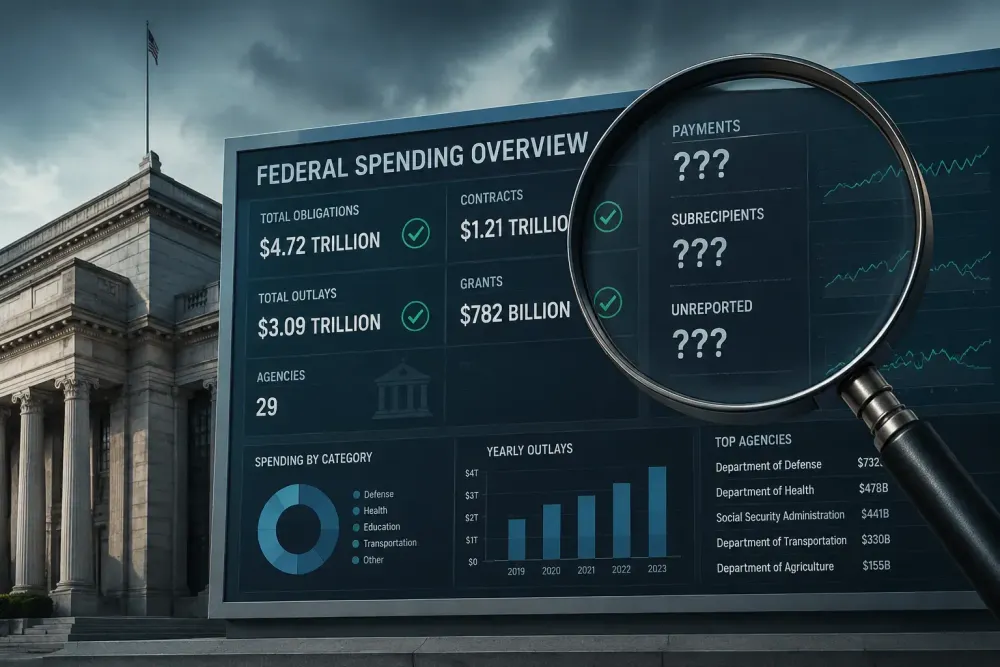
Ninety-six percent of the $49.2 billion in federal grant savings claimed by the Department of Government Efficiency could not be verified by government auditors, according to a GAO report released August 6. The finding, drawn from a review covering January 20, 2025, through July 7, 2026, is less a story about one initiative's failure than a window into a structural weakness that spans administrations: the federal government's own accounting systems are not built to confirm, in real time, whether announced spending cuts actually happened.
DOGE's "Wall of Receipts" website claimed $110 billion in savings from terminated contracts, grants, and leases as of July 7, according to the GAO. Investigators found that of 13,476 contracts DOGE listed as terminated, 2,503 — representing $27.4 billion in claimed savings — showed no termination action in any federal database, and an additional several thousand lacked enough identifying information to check at all, according to ABC News. A $1.7 billion Defense Health Agency information-technology contract, covering more than 700 military treatment facilities worldwide, was listed as a savings win even though the contract was never terminated, its scope was never reduced, and no funding was ever cut, GAO found. On leases, DOGE claimed roughly $113 million in savings across 264 terminations; GAO's review put the verifiable figure at $53.5 million, and found that 108 of those leases — about 41 percent — had already been moving toward termination before DOGE existed, according to Government Executive and GAO's own findings.
The pattern GAO describes is not fabrication in the sense of invented numbers pulled out of thin air. Investigators who requested comment from DOGE officials say they received no response, so auditors could not determine why data-quality problems went undisclosed, according to the GAO report. What the record shows instead is a mismatch between the pace of political claims and the pace at which government financial systems can confirm them. DOGE calculated most of its contract savings without applying the methodology it said it was using, and the Wall of Receipts never explained how lease savings were derived at all, auditors found. That gap between announcement and verification is the actual policy failure, and it is one that neither party has fully solved in twenty years of trying.
The reason lies in how federal spending is tracked. Systems like USASpending.gov and the now-retired Federal Procurement Data System were built to record contract actions after they occur, not to validate savings claims made in press releases or on public dashboards, according to FedScoop's account of GAO's methodology. Auditors had to reverse-engineer DOGE's numbers by comparing the Wall of Receipts against these downstream databases — a process that took the watchdog more than a year to complete for a website that updates in real time. GAO also found that DOGE's grant-savings formula assumed access to a "total value" figure for each grant that USASpending.gov does not actually publish, meaning the stated methodology could not have produced verifiable numbers even if it had been followed consistently. That is a data-architecture problem, not a partisan one: the tools available for after-the-fact reporting were never designed for before-the-fact public accountability claims, regardless of which administration or initiative is making them.
This is also not the first time GAO has flagged the mismatch between what the government reports and what it can prove. In April, the watchdog found that federal agencies made an estimated $186 billion in improper payments in fiscal year 2025 — the highest figure on record and about $24 billion above the prior year — spread across 64 programs at 15 agencies, according to GAO's report. Cumulative improper payments since fiscal year 2003 now total nearly $3 trillion, and GAO has separately estimated that fraud alone costs the government between $233 billion and $521 billion annually, according to figures cited in a House resolution drawing on GAO's own analysis. Roughly three-quarters of the improper-payment total is concentrated in five programs — Medicare, Medicaid, the Earned Income Tax Credit, the Supplemental Nutrition Assistance Program, and the Shuttered Venue Operators Grant program — meaning the exposure is not evenly distributed but clustered in large, complex benefit systems that both parties have relied on and expanded over successive administrations, according to GGF's summary of the GAO data. A separate Congressional Research Service analysis found that of the overpayments tallied for fiscal 2025, only about 16 percent has been recouped, underscoring that identifying an improper payment and actually recovering the money remain two very different capabilities.
Congress has tried to legislate its way around parts of this gap. The Payment Integrity Information Act of 2019 requires agencies to estimate and publish improper-payment rates annually, which is why the $186 billion figure exists at all — but the law does not require real-time verification of savings claims made outside that formal reporting cycle, which is precisely the loophole the Wall of Receipts fell into. A bipartisan bill introduced by Representative Pete Sessions, the Fraud Prevention and Accountability Act, would give inspectors general permanent access to the government-wide fraud analytics tools built during the pandemic and expand Treasury's authority to build detection systems before improper payments go out the door, according to the Oversight Committee. That committee's own request to GAO, which produced a July report on fraud risk across $1.1 trillion in federally funded, state-administered programs, was issued by a Republican chairman; the DOGE-specific Wall of Receipts inquiry that produced the August findings was requested by two Democratic senators. The oversight mechanism itself — GAO — operates identically regardless of who requests the audit, which is part of why its findings on both fraud exposure and savings-claim verification have drawn comment from officials across the political spectrum rather than becoming a one-sided talking point.
GAO's sole recommendation in the DOGE report was narrow: post the known data-quality issues and methodological limits prominently on the Wall of Receipts itself, so that anyone using the site understands its limitations, according to the GAO report. The Wall of Receipts remains online, still displaying a cumulative total of $215 billion in claimed savings across all categories, without such a disclaimer as of the date of GAO's review. The broader lesson extends past any single dashboard. Federal financial-reporting infrastructure was built for retrospective compliance, not live public accountability, and until that infrastructure changes, any administration's real-time savings claims — whatever the intent behind them — will remain difficult for outside auditors, journalists, or the public to confirm on the same timeline the claims are made.