The Trump administration asked the Supreme Court on Wednesday to restart more than 300 miles of border-wall and road work in West Texas, placing a dispute over executive power, environmental review and the meaning of “high illegal entry” on the justices’ emergency docket.
The application, filed by the Justice Department on behalf of the Department of Homeland Security, seeks to pause an Oct. 2 injunction covering five projects across the roughly 500-mile Big Bend Sector. The filing does not decide the underlying lawsuit. It asks the court to let construction resume while the government appeals.
A fight over waiver power
The case turns on a provision of the 1996 Illegal Immigration Reform and Immigrant Responsibility Act, expanded by the REAL ID Act of 2005. It directs the homeland security secretary to build barriers and roads in areas of high illegal entry and permits the secretary to waive legal requirements considered necessary for faster construction.
Homeland Security used that authority three times this year to set aside environmental and conservation laws for Big Bend projects. The government argues that Congress expressly granted broad waiver power and sharply limited judicial review. Its filing says the lower court treated a disagreement over statutory authority as a constitutional claim, allowing the challengers to get around those limits.
U.S. District Judge Kathleen Cardone reached the opposite conclusion. In the court record, she wrote that the major-questions doctrine is rooted in the Constitution’s separation of powers and therefore falls within the type of challenge Congress allowed courts to hear. She found that the challengers were likely to show that the secretaries exceeded their authority by applying the waiver power to a sector with comparatively low apprehension rates.
The administration calls that reasoning legally mistaken. It says the statute does not require Big Bend to have more illegal entries than other sectors, only that the secretary determine it is an area of high illegal entry. The Supreme Court could resolve only the immediate request, leaving the broader merits for later proceedings.
Same numbers, different conclusions
The parties largely agree on the government’s raw data but dispute what it proves. Customs and Border Protection recorded more than 89,000 apprehensions in the Big Bend Sector from fiscal years 2021 through 2025. An acting Border Patrol chief told the district court that open stretches could become funnel points as other parts of the border are reinforced, increasing pressure from smuggling organizations.
Cardone’s opinion placed those totals in a wider frame. Big Bend covers about one-quarter of the U.S.-Mexico border, yet annual apprehensions there represented between 0.3% and 2.2% of border-wide apprehensions over the past 30 years. The judge said unrebutted evidence put the sector last among the seven southern border sectors in both total apprehensions and apprehensions per mile.
That contrast is central to the case. The administration says a sector can qualify as high-entry based on its own conditions and security risks. The challengers say accepting that interpretation would make the statutory limit effectively meaningless because every southern-border sector has more apprehensions than Big Bend.
Construction already underway
The injunction has halted work at different stages across five project areas. According to declarations included with the government’s filing, contractors had installed about three-quarters of a mile of barrier in one area and had begun clearing, surveys or equipment mobilization elsewhere. The government says delays are disrupting contracts and creating costs that cannot be recovered.
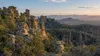
Independent reporting confirms that the plan includes barriers in and around Big Bend National Park and has drawn objections from conservationists, local officials and some Texas Republicans. The administration paused some park work in August after criticism, but separate construction proceeded in Hudspeth County.
By mid-September, CBP said crews had begun installing 30-foot steel panels along a 47-mile stretch known as Big Bend 1, according to an AP account. Other portions call for a mix of walls, vehicle barriers, patrol roads and surveillance technology. The agency has said the broader border effort is part of a $46 billion construction program.
Environmental and local stakes
The lawsuit was brought by the Center for Biological Diversity, Friends of the Ruidosa Church and a local river guide and landowner. They argue that construction threatens desert habitat, scenic landscapes and a historic adobe church, and that normal review is especially important in a region defined by national and state parks, ranches and tourism.
The lower court found that the plaintiffs faced irreparable aesthetic, recreational and cultural harm. Earlier coverage reported that CBP planned roads, sensors and vehicle barriers rather than 30-foot walls inside the national park itself. Texas Republican Sen. John Cornyn had also urged federal officials to consult local leaders and reconsider barriers where rugged terrain already limits crossings.
The administration says those interests cannot outweigh national-security needs and Congress’s decision to accelerate border construction. The challengers say the dispute is not a general referendum on border security but a test of whether an agency may use extraordinary waiver authority in a place that does not fit the statutory condition.
What the justices could do
The court can grant a short administrative stay while it reviews the application, leave the injunction in place, or allow construction to resume during the appeal. The government’s request arrived less than three weeks after Cardone issued the injunction and one week after she released a fuller explanation.
Both the Associated Press and Reuters reported the emergency filing Wednesday. No Supreme Court decision had been issued by late Wednesday. Whatever the immediate result, the case puts a narrow but nationally significant question before the justices: how far Congress allowed the executive branch to go when it paired a mandate to build border infrastructure with the power to suspend other laws.