
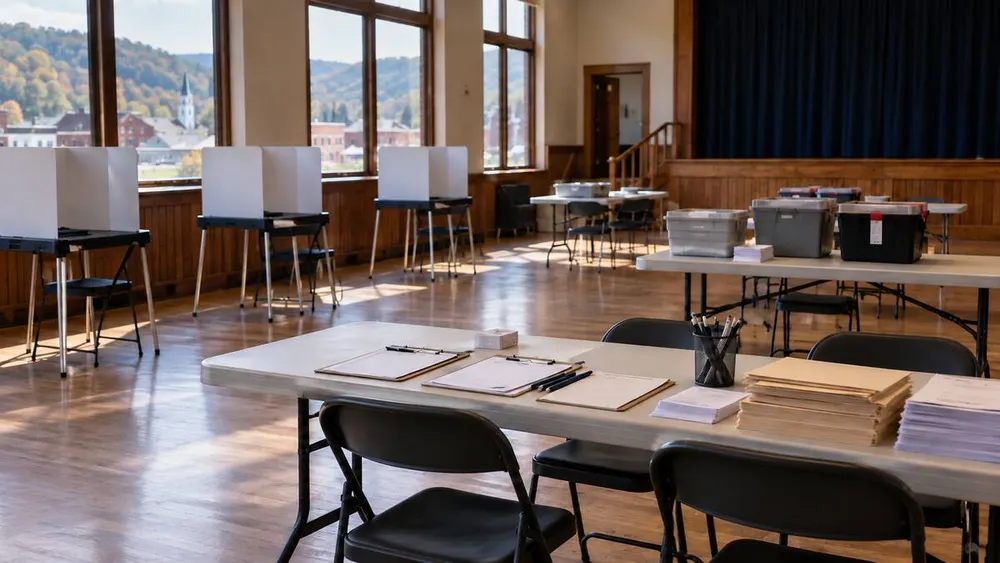
West Virginia election officials are seeking poll workers in 15 counties with less than six weeks remaining before the Nov. 3 general election, a staffing need that spans the Eastern Panhandle, Northern Panhandle and southern coalfields.
The Secretary of State’s Office identified Berkeley, Brooke, Cabell, Clay, Doddridge, Fayette, Hardy, Jefferson, Lincoln, Logan, Ohio, Randolph, Tyler, Wayne and Wood counties. Jefferson County specifically needs Democratic poll workers, while Randolph County is seeking alternates. The other counties reported broader vacancies.
Fifteen counties represent more than one-quarter of West Virginia’s 55 counties. State officials did not publish a single statewide vacancy total, so the announcement does not establish how many positions remain unfilled. It does show that the shortage is geographically dispersed rather than confined to one election office or region.
What the work requires
West Virginia says a poll worker generally must be registered to vote in the county, able to read and write English and complete required training. Some counties also permit high school juniors and seniors in good academic standing to serve. Workers are paid for training and Election Day service, according to the state release.
The duties are operational and nonpartisan: preparing voting rooms, checking voter identity and registration, issuing ballots, assisting voters and securing election materials after polls close. Statewide, more than 1,600 precincts require over 8,400 trained workers on Election Day. Polls are scheduled to operate from 6:30 a.m. to 7:30 p.m., and many workers must report before 5:45 a.m.
Independent coverage from West Virginia Public Broadcasting confirmed the 15-county recruitment push and the basic eligibility requirements. The scale is consistent with the May primary: the Secretary of State’s certification announcement credited more than 8,500 poll workers with supporting 252,008 Election Day voters and 2,717 candidates.
How residents can apply
Residents can contact the election office in their county directly or submit an interest form through the state’s poll-worker portal. The portal notes that applicants ordinarily must be registered in the county where they serve, while qualified students can also participate. County clerks make the assignments and may contact applicants as needs change.
The recruitment notice is not a prediction that polling places will close or that votes will go uncounted. It is an early operational warning. Poll workers provide the staffing redundancy needed to handle illness, last-minute cancellations and busy precincts without longer lines or disruptions. Adequate staffing also helps clerks assign specialized tasks before voting begins.
Because election administration is county-run, the practical picture can change quickly. Applicants who volunteer now give clerks time to verify eligibility, balance bipartisan staffing where required and complete training before Nov. 3. That lead time is the central reason the state issued its appeal in September rather than waiting until the final days of the campaign.