
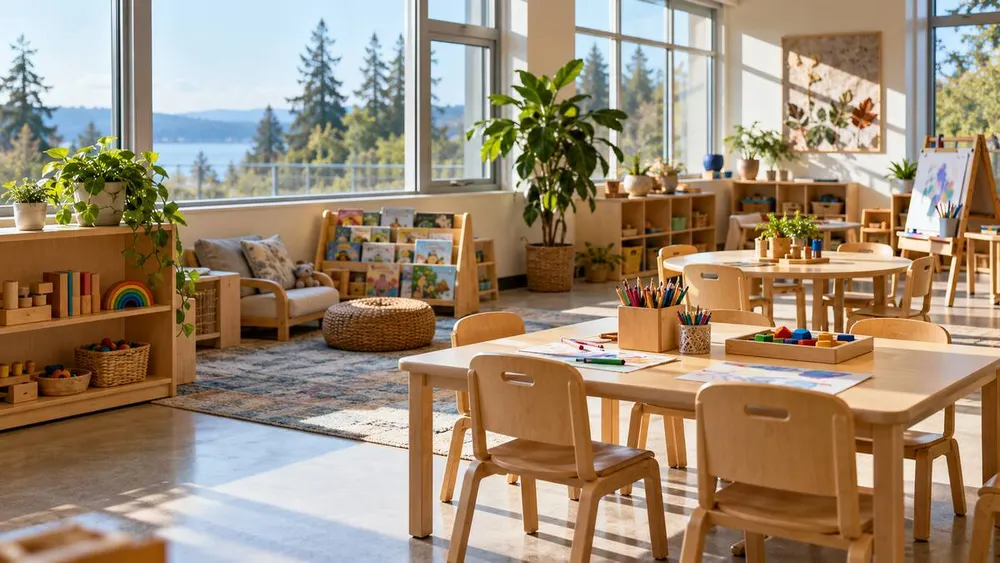
Washington is opening 42 new public pre-kindergarten sites and adding about 2,400 seats for the 2026-27 school year, turning a public-private funding agreement into classrooms across the state.
The final expansion list, released by Gov. Bob Ferguson and the Department of Children, Youth, and Families, places new Early Childhood Education and Assistance Program sites in communities from Blaine and Concrete to Wapato, Warden and Spokane. According to the state announcement, more than $251 million in state and philanthropic funds will support additional capacity at 105 existing sites as well as the 42 new locations.
The final numbers are slightly below the June projection of roughly 2,500 seats at 54 new sites. DCYF said some providers returned funding because of workforce shortages and unexpected barriers to opening classrooms. Even with that reduction, the department says the approximately 2,400 seats exceed the state’s initial first-year goal of 2,000.
Who qualifies
ECEAP is Washington’s state-funded preschool and family-support program for eligible 3- and 4-year-olds. The new announcement says families generally qualify when household income is at or below 36% of the state median — $50,152 for a family of four — while children may also qualify because of homelessness, family violence, foster care, developmental needs or other circumstances. Families can use DCYF’s monthly dashboard to find nearby sites and available openings.
The expansion is backed by the PreK Promise structure created this year. DCYF said when the authorizing law was signed that the account would allow public and private money to be combined for statewide growth. The state’s supplemental budget plan identified a $34.5 million initial philanthropic grant to support 2,000 seats in 2026-27, while Ballmer Group’s broader commitment is expected to support as many as 10,000 additional school-day seats over 10 years and total about $1 billion.
Opening classrooms is the next test
The revised count highlights the practical constraints behind a large expansion. Funding does not automatically produce teachers, classroom space or enrollment. DCYF’s 2026-27 standards require part-day and school-day classes to begin by Sept. 30 and direct providers to seek agency support when they cannot fill an open seat within the enrollment timeline.
For families, the statewide totals matter only if a site is accessible and has room. The new list spans school districts, nonprofit providers, child-care centers and licensed family homes, a mix intended to reach both large metropolitan areas and smaller communities. The immediate measure of success will be how many of the 2,400 announced seats open on schedule and remain staffed.
The expansion is consequential because it pairs long-term philanthropic support with state oversight rather than establishing a short-term pilot. But the reduced site count also supplies an early warning: Washington will need enough qualified workers and viable facilities if the decade-long promise is to translate into durable preschool access.