
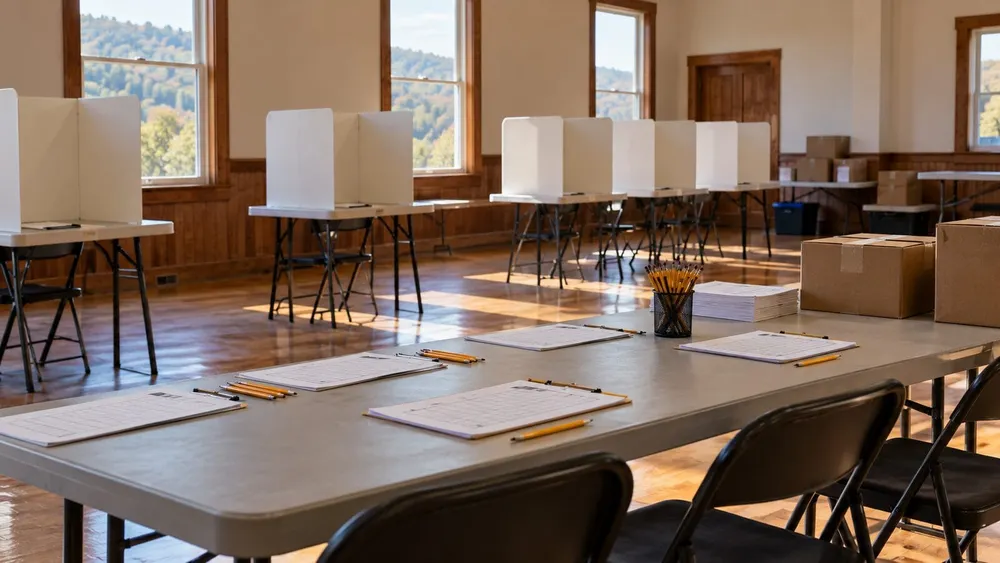
West Virginia election officials are still seeking poll workers in 15 counties for the Nov. 3 general election, with more than five weeks remaining before voters go to the polls. Secretary of State Kris Warner’s office issued the statewide recruitment notice Sept. 24 and urged interested residents to contact their county clerk promptly.
The counties listed are Berkeley, Brooke, Cabell, Clay, Doddridge, Fayette, Hardy, Jefferson, Lincoln, Logan, Ohio, Randolph, Tyler, Wayne and Wood. The notice says Jefferson County specifically needs Democratic poll workers and Randolph County needs alternates. It does not quantify each county’s vacancy, so the announcement signals an active staffing need rather than a statewide count of unfilled positions.
West Virginia has more than 1,600 voting precincts and needs more than 8,400 trained poll workers on Election Day, according to an earlier state notice. Workers can deliver election supplies, set up voting rooms, verify registrations and identification, issue ballots and secure materials after polls close. They are paid for both training and Election Day service, though compensation can vary by county.
Standard applicants must be registered voters in the county where they serve, be able to read and write English and complete required training. A new path also permits qualifying high school juniors and seniors to participate as election-official trainees. Under the enacted state law, student trainees must be in good standing, satisfy the training requirement and obtain required parental and school approval when applicable; the Secretary of State’s guidance also specifies a minimum 3.0 grade-point average for public- and private-school students.
Election Day will demand a long shift. Polling places are open from 6:30 a.m. to 7:30 p.m., and the current recruitment notice says workers in most counties must arrive before 5:45 a.m. The official calendar confirms Nov. 3 as Election Day and lays out the deadlines leading into canvassing and certification.
The immediate responsibility belongs to county clerks, who appoint and train local election teams, while the Secretary of State’s office provides statewide guidance and a central recruitment portal. Contact information for each of the 15 counties appears in the Sept. 24 notice, including a named local official, telephone number and email address. Residents elsewhere can use the official registration form to express interest through the statewide system and indicate whether they are available Nov. 3.
The shortage announcement does not say polling places will close or that election operations are in jeopardy. It does show that local administrators are still building their teams close enough to Election Day that training and assignment time matter. For prospective workers, the practical next step is to contact the county clerk rather than wait for a statewide assignment, because eligibility, training schedules, party-balance needs and pay are administered locally.