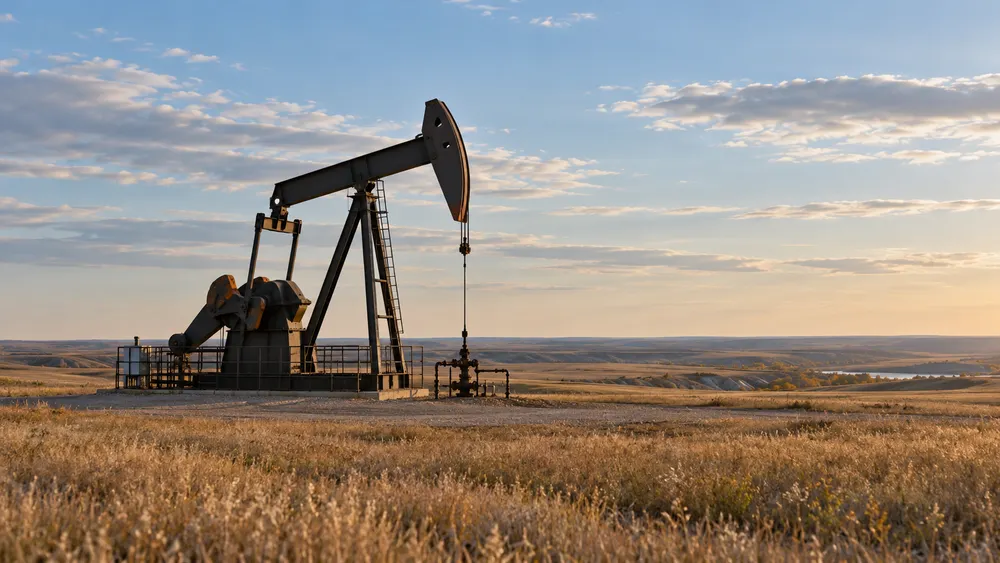
North Dakota reached a record 20,177 producing wells in August, but daily output rose only slightly, according to state figures released Tuesday, Oct. 20. The Department of Mineral Resources’ Director’s Cut and the Pipeline Authority’s monthly update show why a larger producing-well count should not be mistaken for a comparable jump in barrels.
Preliminary August oil production averaged 1,161,427 barrels a day, compared with July’s final 1,158,660. That is an increase of 2,767 barrels daily, or about 0.24%. The production table reports 36,004,228 barrels for August as a whole. These are retrospective production figures, not a measurement of output on the day of Tuesday’s briefing.
Operators move wells toward production faster
Richard Suggs, a geologist with the state’s Oil and Gas Division, said operators were accelerating well completions to take advantage of higher crude prices, Reuters reported. He said the interval between drilling and preparing wells for production had roughly halved since the year began. Reuters also reported the record well count and rounded August output to 1.161 million barrels a day.
The department’s activity report lists 105 completions in September, following 96 in August and 74 in July. Its cycle-time discussion separately tracks the interval from initial drilling to stimulation and from stimulation to first production. Those operational milestones describe the path toward output, rather than barrels already produced.
The same report puts August’s producing-well count 105 above July and the inactive-well count 86 lower. The record is a count of producing wells, not a claim that each well set a production record. Taken together with the modest statewide volume increase, the figures indicate that well counts and output growth are different measures.
Current activity also has a different reporting date. The Pipeline Authority’s October update lists 36 North Dakota rigs as of Oct. 20. The department’s presentation lists 34 and says that activity snapshot was pulled mid-month. Neither count is an August production average, and the differing snapshots should not be presented as simultaneous measurements.
Gas handling remains part of the operating picture
The Pipeline Authority’s monthly update reports preliminary natural-gas production of 3,632,710 thousand cubic feet daily in August, up from July’s final 3,621,967. For nonconfidential well data, it summarizes gas disposition as 96% captured and sold, 3% flared because of challenges or constraints on existing gathering systems, and 1% flared from wells with zero sales.
Director Justin Kringstad’s separate briefing slides distinguish those two flaring categories, rather than treating all flared gas as evidence that a well lacks a pipeline. That distinction provides useful context when judging whether higher production can be gathered and moved to market; the rounded percentages do not eliminate the remaining infrastructure constraints.
The October update therefore presents a measured expansion, not a sudden production surge. Its August estimate remains preliminary, while the report labels July’s numbers final. For businesses and communities following the industry, the useful comparison is the combination of producing wells, completed wells, actual daily volumes and gas handling—not any one headline number in isolation, as the department’s published report illustrates.