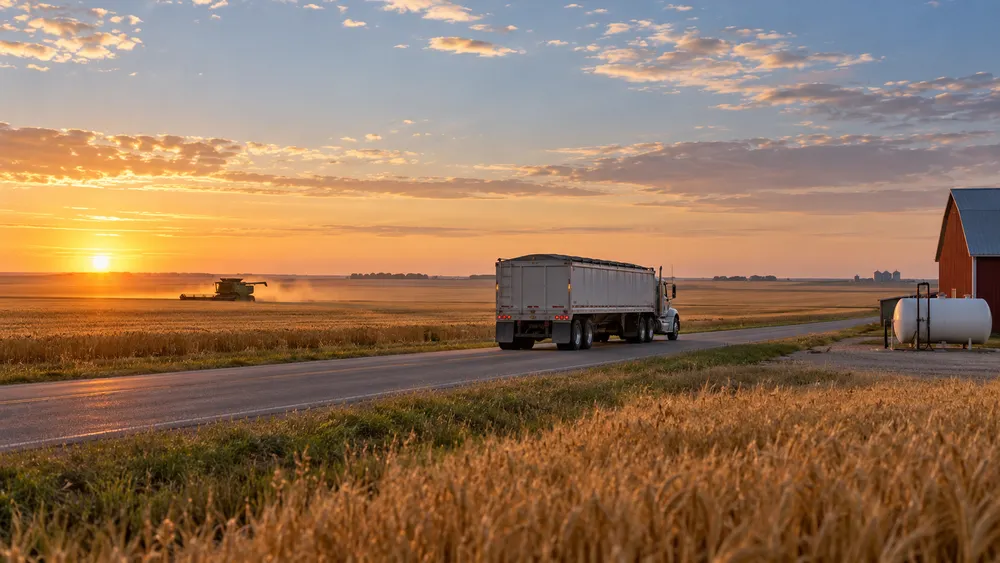
North Dakota is temporarily allowing farmers to use lower-taxed red-dyed diesel in licensed vehicles on public roads for specified agricultural work, a harvest-season measure that took effect Sept. 29 and runs through Nov. 30. Gov. Kelly Armstrong declared a state emergency over diesel supply and availability and issued an executive order expanding the fuel’s permitted uses under state law.
The order covers licensed motor vehicles used in connection with agricultural operations. The governor’s announcement says qualifying highway uses include hauling grain, livestock, feed, seed, fertilizer, equipment and other agricultural inputs or products, along with activities connected to storing and processing agricultural products.
The immediate financial benefit comes from North Dakota’s fuel-tax structure. The state taxes ordinary on-road diesel at 23 cents per gallon and red-dyed diesel at 4 cents, producing a 19-cent-per-gallon difference for eligible use. Agriculture Commissioner Doug Goehring said that margin can matter because fuel consumption rises during harvest, when producers are moving crops and supplies as well as operating field equipment.
The state action does not erase federal obligations. Armstrong’s office specifically said the order does not affect the federal diesel excise tax of 24.4 cents per gallon. The IRS Farmer’s Tax Guide ordinarily treats highway use of dyed diesel as taxable, even when a truck is being used in a farm business, and advises operators to keep records separating on-farm and other uses. It also warns that knowing misuse of dyed fuel can trigger a penalty of at least $1,000 or $10 per gallon, whichever is greater.
That distinction makes compliance central to the order’s practical value. Producers and fuel vendors need to understand what North Dakota has authorized, what documentation state officials require and whether any separate federal relief applies to a particular transaction or vehicle. The state authorization should not be read as a blanket federal tax exemption.
The emergency comes amid an unusually tight diesel market. Reuters reported that U.S. diesel prices reached a record $6.53 per gallon in late September as international supply disruptions and reduced refining availability strained the market. Analysts cited by Reuters said broader access to dyed diesel can reduce taxes for eligible users but does not increase the amount of diesel produced or lower the underlying wholesale price.
In North Dakota, the North Dakota Monitor reported an average state diesel price of $6.17 on Sept. 29, with soybean and corn harvests underway. The temporary policy therefore targets a defined cost during a short, fuel-intensive period rather than attempting to resolve the broader supply shortage.
For producers who qualify, the state savings are straightforward: 19 cents for each gallon shifted from regular state-taxed diesel to the authorized dyed fuel. The larger effect will depend on how many gallons are used in covered vehicles before Nov. 30—and on careful adherence to the separate state and federal rules.