
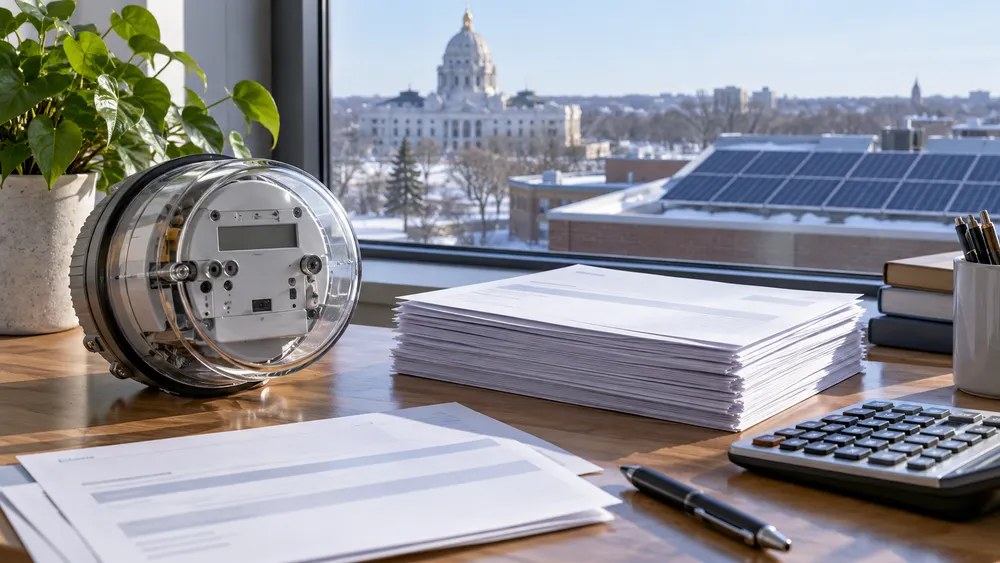
Minnesota utility regulators are weighing whether Xcel Energy’s billing problems require stronger oversight after cities, businesses and residential customers reported delayed credits, inaccurate charges and other account errors.
The Minnesota Public Utilities Commission opened a formal investigation after customer complaints increased sharply beginning in 2022. The commission ordered Xcel to explain the causes, describe corrective work and submit monthly data on new and unresolved billing errors. A Sept. 30 review of the docket shows that complaints have continued while that monitoring remains underway.
Recent filings illustrate the range of problems. Roseville’s city manager said a municipal property went eight months without an electric bill or solar-production credits before receiving a bill of about $15,000. The city said the episode complicated annual energy reporting and required staff to check accounts repeatedly. Its Sept. 24 complaint also described errors across other municipal accounts.
St. Louis Park told the commission that billing mistakes generated more than $6,500 in late charges during a recent 12-month period. The city also said it lost $16,000 in 2023 after it was not notified that it could move to a lower-cost renewable-energy subscription program before enrollment closed. Its filing requests an independent audit and better notice of major rate or program changes.
A St. Paul printing business separately reported that it had received no 2026 payments for electricity generated by its rooftop solar array, even though the system was producing more power than the building used. The company’s commission filing says the missing credits undermined the economics of its solar investment.
Attorney General Keith Ellison’s office argues that the utility may be defining billing errors too narrowly. Its latest submission says residential invoice cancellations tied to billing issues rose by more than half from 2023 to 2026 and asks regulators to require broader reporting.
Xcel disputes that the record demonstrates a systemic failure requiring a third-party audit. The utility told the Minnesota Reformer that it has reduced backlogs and addressed underlying causes. It reported that residential invoice cancellations attributed to controllable factors declined from 7,098 in July to 4,812 in August, while saying many apparent solar nonpayments involved ineligible or vacant accounts.
The improving monthly figure does not by itself resolve the dispute. Cities are asking regulators to examine whether accounts were corrected promptly, whether customers received all money owed and whether Xcel’s definition excludes errors that still impose costs. Those questions are central to deciding whether continuing company reports are sufficient or an outside audit is warranted.
The commission has not announced a final remedy. Its eventual decision matters beyond the individual disputes because Xcel’s Minnesota electric utility serves roughly 1.5 million customers. The immediate questions are whether current monthly reporting captures the full scale of errors, whether refunds and credits are arriving promptly and whether an independent review is necessary.