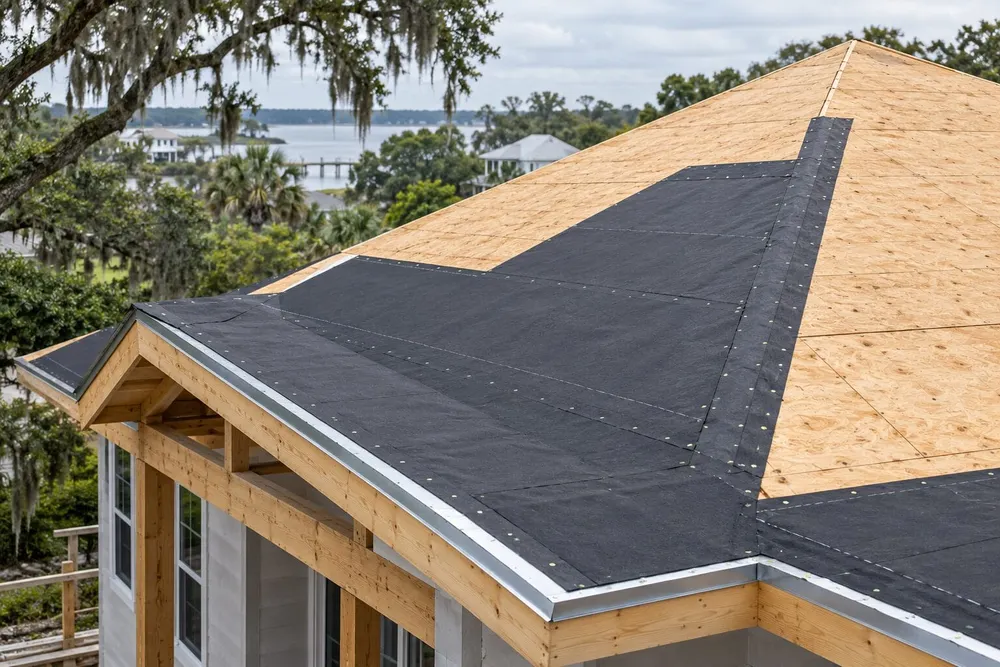
Louisiana officials have assembled $100 million for fortified-roof projects this year, combining federal disaster-recovery money, redirected hurricane bonds and a state funding stream intended to make homes more resistant to wind damage.
Gov. Jeff Landry and Insurance Commissioner Tim Temple announced the package Sept. 21. The governor’s office described three components: $20 million in U.S. Department of Housing and Urban Development money aimed specifically at coastal homeowners, $50 million in remaining Hurricane Katrina and Rita bond proceeds, and $30 million appropriated by the Legislature this year.
The Department of Insurance provided more detail on how the money is divided. Its funding announcement says the new $20 million will move to the Louisiana Office of Community Development’s Restore Resilient Opportunities for Overhead Fortification program, known as Restore ROOF. The $50 million in bond money is being added to the department’s Louisiana Fortify Homes Program. The department projects that roughly $30 million a year will flow to that program from insurance-industry taxes and fees beginning this year.
The package expands a state strategy that pays for physical risk reduction rather than only subsidizing insurance premiums. Louisiana’s homeowner program offers grants of up to $10,000 for work that reaches the Insurance Institute for Business & Home Safety’s FORTIFIED Roof standard. That standard calls for measures such as stronger roof edges, a sealed deck and improved attachment designed to keep wind and rain from entering a house after the outer covering is damaged.
For homeowners, the announcement does not mean $100 million is immediately available through one open application. The department’s current program page says lottery registration is closed and that future rounds will be announced later. It also lists eligibility limits: the property generally must be a primary residence with a homestead exemption, carry active insurance with wind coverage, and have flood insurance when it is in a special flood-hazard area. New construction, condominiums and mobile homes are excluded.
Recipients must wait for program approval before hiring an evaluator or contractor. Grants are paid directly to contractors, homeowners cover costs above the grant amount, and the completed project must qualify for the FORTIFIED designation. The program page says a resulting certificate can be shared with an insurer for a premium discount, though the size of any discount depends on the company and policy.
The policy goal is therefore twofold: reduce storm losses by strengthening roofs and use the lower physical risk to support a more stable insurance market. Landry said the investment is intended to reduce the financial barrier to fortification and lower premiums. Temple called stronger homes a central part of improving affordability.
The practical next step for interested homeowners is to monitor the Department of Insurance for a new lottery round rather than begin work independently. The agency warns that owners who fortify a roof before receiving a grant cannot later use the program to reimburse that project.