
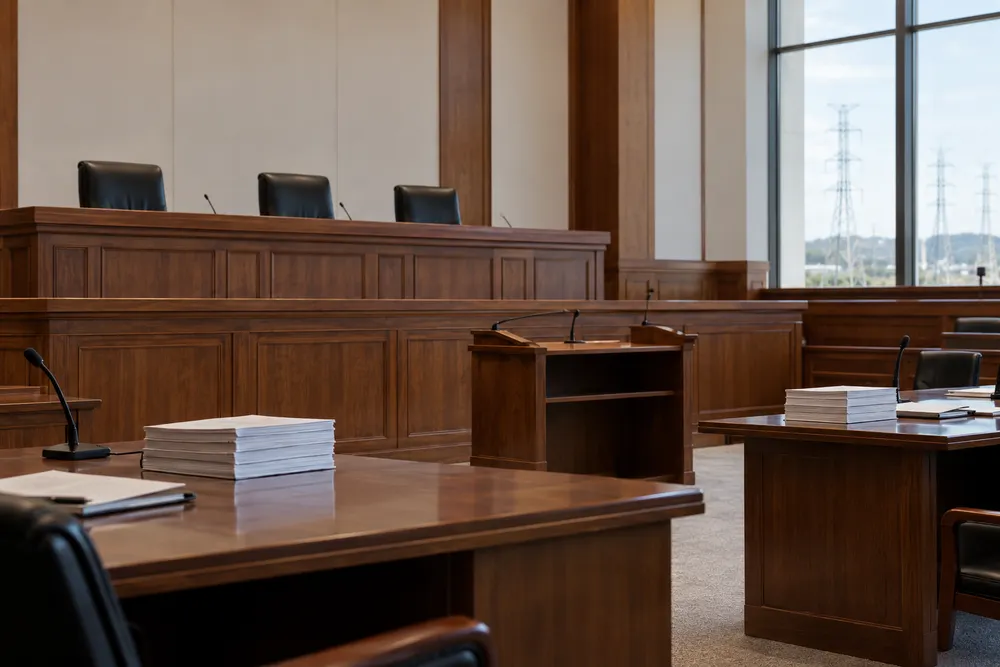
The Indiana Supreme Court is weighing whether membership organizations may continue suing on behalf of their members without naming an individual member as a plaintiff, a procedural question raised in a Duke Energy case that could affect litigation well beyond utility regulation.
At oral arguments on September 17 in Citizens Action Coalition of Indiana v. Duke Energy Indiana, the justices examined Indiana’s doctrine of associational standing. A decision is pending. The case asks whether Citizens Action Coalition and Vote Solar can challenge a utility order as associations representing affected members, or whether at least one individual member must be formally included.
The dispute began with Indiana Utility Regulatory Commission Cause No. 46193. In October 2025, regulators approved Duke Energy Indiana’s plan to construct two natural-gas generating units at the Cayuga station in Vermillion County and begin recovering construction costs from customers before the units enter service. Duke has said that financing structure for the roughly $3.3 billion project would avoid about $560 million in additional financing costs.
Citizens Action Coalition and Vote Solar opposed the construction-work-in-progress mechanism and appealed. Duke then asked the Supreme Court to bypass the Court of Appeals and decide whether Indiana should recognize associational standing. An official April transfer report shows the court accepted the case under Appellate Rule 56(A), with Chief Justice Loretta Rush and Justice Christopher Goff voting against emergency transfer because they did not believe the appeal presented an emergency sufficient to skip intermediate review.
The statewide question
Duke argues that the associations themselves are not Duke customers and therefore have not shown their own injury. The groups respond that requiring a named individual can expose members to retaliation, privacy loss or added expense, and can make collective legal advocacy harder. The competing positions have drawn briefs from organizations spanning environmental advocacy, civil liberties, gun rights, construction, real estate, retail and other sectors.
During the hearing, justices explored a possible middle course: allowing an association to direct a case while identifying an affected member as a nominal plaintiff. According to Indiana Capital Chronicle’s account of the arguments, the parties disputed whether that step would add meaningful constitutional protection or merely impose a new barrier.
The court’s ruling could determine who is able to seek judicial review of agency decisions across Indiana. A narrow decision could leave organizations free to participate in administrative and legislative proceedings while requiring a named member once a dispute reaches court. A broader ruling preserving associational standing would retain the framework Indiana appellate panels have applied for roughly two decades, as described in a briefing summary from the Indiana University Conservation Law Center.
What happens next
No deadline governs when the justices must rule. The underlying energy project and rate-recovery challenge remain part of the case, but the standing question comes first: without standing, the court cannot reach the merits of the associations’ objections. For ratepayers and other Hoosiers who rely on membership groups to challenge state action, the forthcoming opinion will clarify whether collective representation alone is enough to open the courthouse door.