
Hawaiʻi officials say the state’s combined bill for four major disasters this year is approaching $1 billion, a preliminary total that brings immediate recovery costs and longer-term resilience projects into the same fiscal picture. A statewide accounting released Wednesday identifies about $686 million in damage and recovery commitments and at least $319 million in proposed work to harden critical infrastructure.
The estimates cover the March Kona Low storms, the May 22 magnitude-6.0 Hawaiʻi Island earthquake, Hurricane Lala and Hurricane Lowell. The state counted 1,290 affected homes across those events: 74 destroyed, 451 with major damage, 514 with minor damage and 251 otherwise affected. Officials cautioned that the total remains provisional because assessments and federal eligibility reviews continue, while many residential, agricultural, utility and business losses have not yet been fully calculated. Those totals may rise as agencies reconcile claims.
The March storms account for the largest identified share, roughly $463.6 million. That includes about $191.8 million in transportation costs, $162 million in preliminary repairs at public schools and $65 million committed to restoring Kula Hospital. Hawaiʻi has expanded its case-management program to households affected by the Kona Low, the earthquake and both hurricanes, giving survivors a single path to help with housing, benefits and other recovery needs.
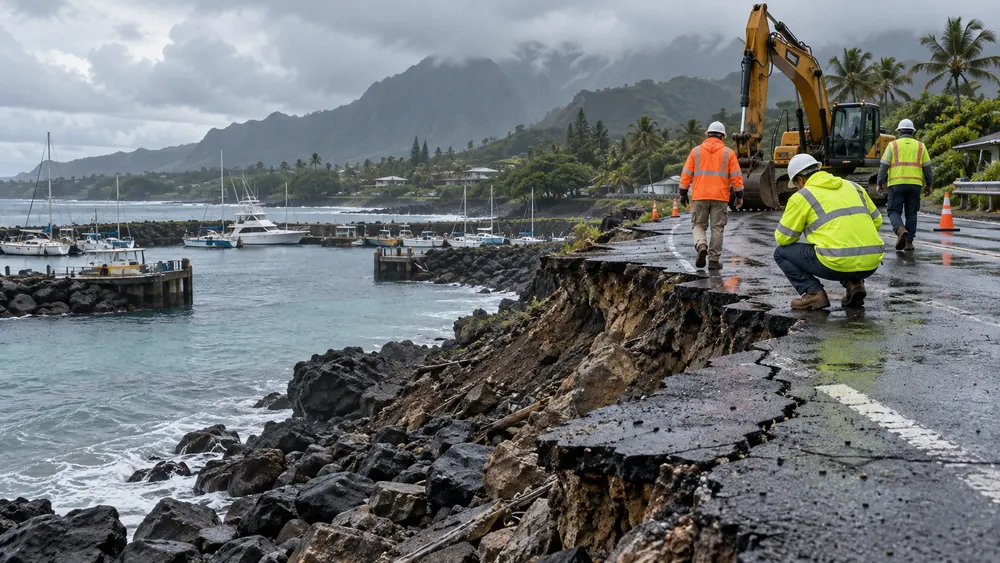
The two hurricanes together add more than $220 million to the current tally. Lala caused an estimated $108 million in damage and recovery needs, including impacts at 38 public schools. Lowell’s estimate is about $112.4 million, with Kauaʻi County accounting for $93.7 million in preliminary public-infrastructure damage. On Sept. 9, the governor submitted an expedited request for federal assistance after Lowell disrupted power, roads, harbors and airport operations across Kauaʻi and left Lānaʻi’s only commercial cargo harbor unusable.
The disasters arrived during an exceptionally wet year. Federal climate data show Hawaiʻi recorded its wettest January-August period in the modern statewide record, with precipitation averaging more than three feet above normal after Hurricane Lala helped make August the state’s second-wettest since 1991. That does not by itself establish the cause of individual losses, but it helps explain why recovery planning is increasingly focused on cumulative strain rather than isolated events.
The resilience list includes $175 million to harden Honolulu Harbor, $80 million to modernize the State Emergency Operations Center, $20 million for community resilience hubs, $20 million to study an alternate port, $9 million for airport generators and at least $15 million for other mitigation. Potential funding sources include federal disaster aid, insurance, new legislative appropriations, reserve funds and Green Fee revenue. The practical issue for lawmakers is that the headline total blends verified and still-evolving losses with proposed investments; future budget decisions will depend on which projects qualify for federal reimbursement and how much additional damage emerges from ongoing assessments.