Enrollment across North Dakota’s 11 public colleges and universities held nearly level this fall, with 47,377 students counted systemwide—145 fewer than a year earlier. The 0.3% decline interrupts several years of growth but leaves the system close to its 2025 high, according to figures presented to state lawmakers and reported by the North Dakota Monitor.
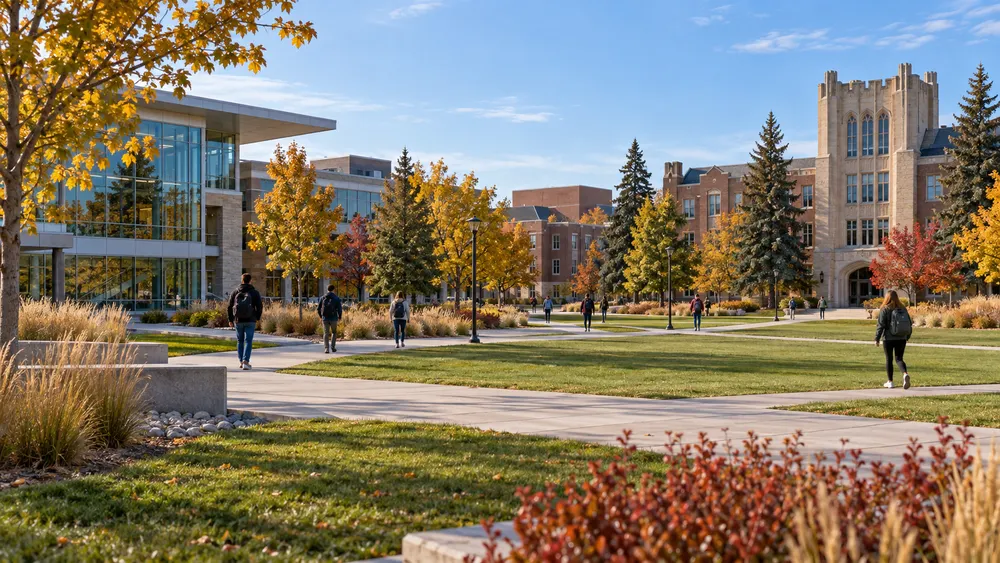
The statewide total masks a divergence between the two largest campuses. The University of North Dakota reached a seventh consecutive year of growth and a record 15,908 students. UND’s own profile confirms that figure and says the university enrolls students from all 50 states. North Dakota State University, by contrast, fell by 343 students, or about 3%, to 11,609.
That split matters because UND and NDSU together account for roughly 58% of the system’s headcount. NDSU began the academic year with an ambitious growth target under President Marshall Stewart, who has said the Fargo university should exceed 15,000 students. Its current total is also below the 11,952 students the university reported for fall 2025 on its official facts page.
Smaller campuses produced a mixed but generally steady picture. Bismarck State College gained 119 students, while Valley City State University and Dakota College at Bottineau also posted increases. University System Commissioner Brent Sanford told the Legislature’s Higher Education Institution Committee that changes at most institutions were modest. He also pointed to higher dual-credit participation among high school students and a slight decline in international enrollment.
The system is comparing the new count with a strong prior year. Its official 2025 report recorded 47,522 students, up nearly 4% from fall 2024. UND supplied much of that increase, rising 5.5% to a then-record 15,844. The new count adds 64 students at UND even as the systemwide total slips.
The distinction between headcount and instructional load will matter when officials translate the numbers into budgets. The University System’s annual reports track both individual students and full-time-equivalent enrollment. Growth driven by dual-credit or part-time students can expand access without producing the same tuition revenue or classroom demand as an equal increase in full-time students.
Retention also helped UND extend its run. Vice Provost Janelle Kilgore told lawmakers that 82% of last year’s freshman class returned for a second year. She said the incoming class might have been larger, but capacity limits in some programs constrained enrollment. That detail suggests the Grand Forks campus’s challenge is increasingly where to place demand, while NDSU’s challenge is rebuilding it.
North Dakota remains better positioned than much of the region, according to Sanford. He said national college enrollment is down more than 11.5% since 2011, compared with a 2.7% decline in North Dakota. The near-flat 2026 total therefore looks less like a collapse than a pause. Still, the campus-level split gives lawmakers a practical policy question: whether funding, recruiting and program capacity are aligned with where students are choosing to enroll.