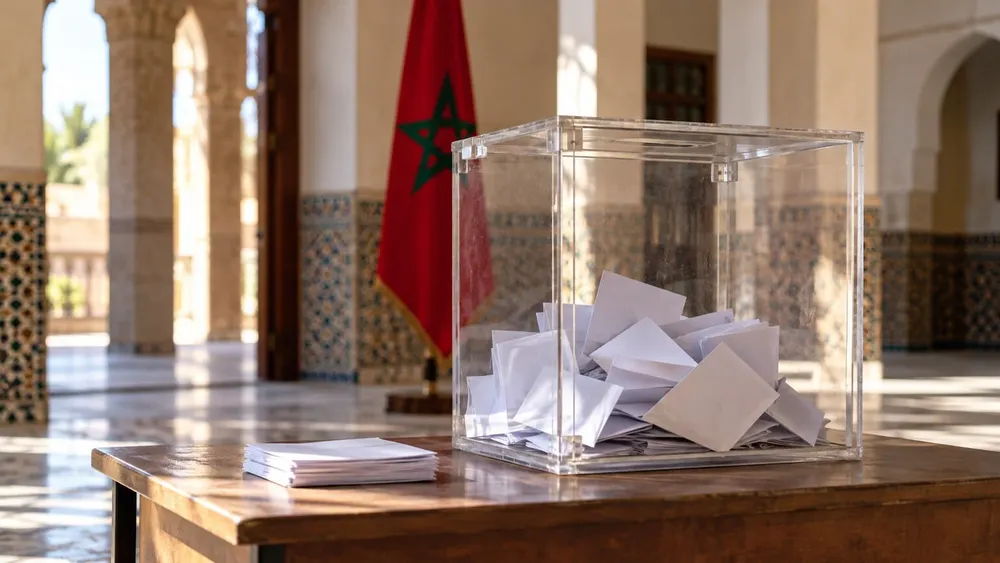
Morocco’s Authenticity and Modernity Party, known as PAM, won the largest bloc in Wednesday’s parliamentary election, taking 97 of the 395 seats in the House of Representatives. The preliminary results, announced by Interior Minister Abdelouafi Laftit early Thursday, placed the National Rally of Independents, or RNI, second with 66 seats and Istiqlal third with 65. No party approached the 198 seats required for an outright majority, making coalition negotiations unavoidable.
The result changes which party leads Morocco’s governing alliance without necessarily ending the alliance itself. PAM, RNI and Istiqlal served together in the outgoing government and together hold 228 seats in the new chamber. That arithmetic gives the three parties a straightforward route to another majority if they can agree on leadership and a governing program. It does not guarantee that outcome: PAM can negotiate with other parties, and disputes over cabinet posts, priorities and the premiership could reshape the coalition before a government is formed.
The election also produced a warning about public confidence. The Interior Ministry put turnout at 38.02%, down from just above 50% in 2021, according to Reuters. With 15.8 million registered voters, the rate means a clear majority of those on the rolls did not cast ballots. AFP described it as Morocco’s lowest parliamentary turnout in nearly two decades, making participation as consequential a result as the distribution of seats.
Low engagement came after a campaign dominated by jobs, wages, housing and access to schools and hospitals. An AP overview reported that 27 parties competed and that youth unemployment and unequal access to opportunity remained central concerns despite economic growth and rising foreign investment. Those pressures had become harder to ignore following youth-led protests and a deadly mass migration attempt toward the Spanish enclave of Ceuta. The vote therefore tested whether established parties could convert promises of social improvement into renewed political trust.
The next government will also supervise the final years of an estimated $20 billion investment drive tied to Morocco’s preparations to co-host the 2030 FIFA World Cup. Roads, rail links, stadiums and urban projects can support growth and employment, but the campaign exposed a competing demand: voters want large national projects to produce visible improvements in household security and public services. The political challenge is not simply completing infrastructure on time; it is demonstrating that investment reaches communities that feel excluded from Morocco’s industrial and tourism gains.
Morocco’s constitutional structure gives PAM’s first-place finish immediate importance while preserving a decisive role for the monarchy. Under Article 47 of the 2011 Constitution, King Mohammed VI appoints the head of government from the party that finishes first in elections for the House of Representatives. The king then appoints ministers on the head of government’s proposal. PAM has therefore earned the right to lead the government-formation process, but the party must still assemble partners able to sustain a majority in parliament.
The result should be read as both a victory for PAM and a fragmented mandate. Its 97 seats amount to less than one-quarter of the chamber. RNI and Istiqlal remain large enough to determine whether a familiar governing coalition survives, while smaller parties can influence negotiations if one of the three principal partners breaks away. Morocco’s elections portal provides the official framework for reporting results, but preliminary totals still require the usual administrative confirmation before the new chamber and government are finalized.
The turnout decline complicates any claim of sweeping endorsement. Parliamentary elections remain meaningful because they determine the largest party, the composition of the legislature and the starting point for forming a cabinet. Yet Morocco’s king retains authority over strategic areas, and skepticism about how much elected officials can change has long shaped participation. The combination of a divided parliament and low turnout means the incoming government will need to establish legitimacy through measurable performance rather than rely on the election result alone.
What happens next
Final results must be certified, after which the king is expected to appoint a head of government from PAM. That person will consult other parties and propose a cabinet capable of commanding parliamentary support. If PAM, RNI and Istiqlal renew their alliance, the process could be relatively direct. If they split, negotiations could widen and delay agreement over ministries and policy. Either way, the next government inherits a demanding agenda: job creation, social services, regional inequality and delivery of World Cup-related projects. Investors and foreign partners will also watch whether coalition bargaining preserves policy continuity while responding to the social pressures reflected in the vote.
Morocco’s election has therefore produced a clear first-place party but not a self-sufficient governing mandate. PAM’s 97 seats give it the constitutional initiative. The 38.02% turnout gives it an equally clear constraint. Coalition choices will determine who governs; the harder test will be whether the resulting government can persuade disengaged voters that parliamentary politics can improve the economic and public-service conditions that shaped the campaign.