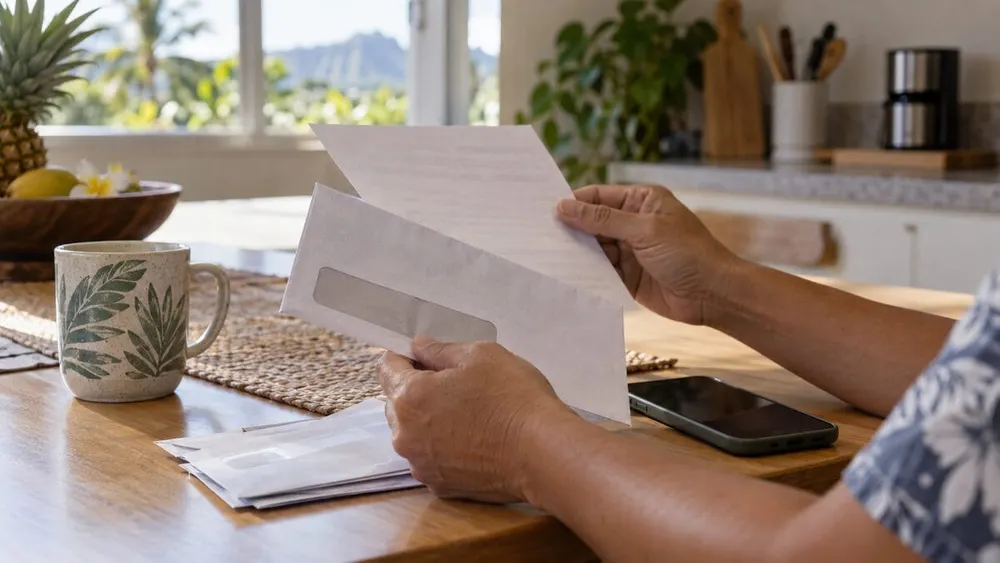
Hawaiʻi officials are warning homeowners not to respond to letters that borrow the name of the state’s green-financing authority while promoting supposed home-warranty or mortgage-protection services.
The alert issued September 17 by the Department of Business, Economic Development and Tourism, the Hawaiʻi Green Infrastructure Authority and the Office of Consumer Protection says the mailers are fraudulent. They use names such as “Hawaii Green Infrastructure AU” or “Hawaii Green Infrastructure Authority” to make the solicitation appear connected to government.
The letters try to create urgency with phrases including “final notice,” references to county-clerk record dates and claims that a property warranty is about to expire, according to the agencies. They then direct recipients to phone numbers associated with offers for a home warranty, mortgage protection or another purportedly urgent property matter.
HGIA says it has no relationship with the businesses or phone numbers in the notices. The authority does not sell home-warranty products and does not ask for personal information through unsolicited mail. Residents who receive one of the letters should not call the number printed on it or disclose personal, financial or mortgage information.
How residents can verify a letter
The safest check is to contact the agency through a channel obtained independently of the mailer. HGIA says its legitimate communications with program participants use its office number, 808-587-3868, or its email address, dbedt.gems@hawaii.gov. Residents can use those same contacts to ask whether a letter is genuine.
That distinction matters because HGIA is a real public entity. Its official description identifies it as part of state government and administratively attached to DBEDT. Its work includes clean-energy financing for underserved ratepayers, credit support for small businesses and nonprofits, and commercial property clean-energy and resilience financing. Home warranties are not among those stated functions.
The federal Consumer Financial Protection Bureau gives the same practical advice for impersonation attempts: official-looking letters and government documents can be faked, so consumers should use an agency’s independently verified website or phone number rather than the contact information supplied in an unexpected message. The CFPB’s fraud-and-scams guidance also warns that impostors commonly seek money or account details by pretending to represent a government office or financial institution.
Where to report concerns
Hawaiʻi’s Office of Consumer Protection investigates alleged unfair or deceptive business practices. Its consumer-complaint page directs residents to the state’s complaint portal and also links to current scam alerts and business-verification resources.
People who already called a number on one of the letters should avoid any further contact, preserve the mailer and record what information they shared. If bank, credit-card or mortgage information was disclosed, contacting the relevant financial institution promptly can help secure affected accounts. The central point of the state alert is narrower but immediate: the notices are not HGIA communications, and the urgency they project should not override independent verification.