
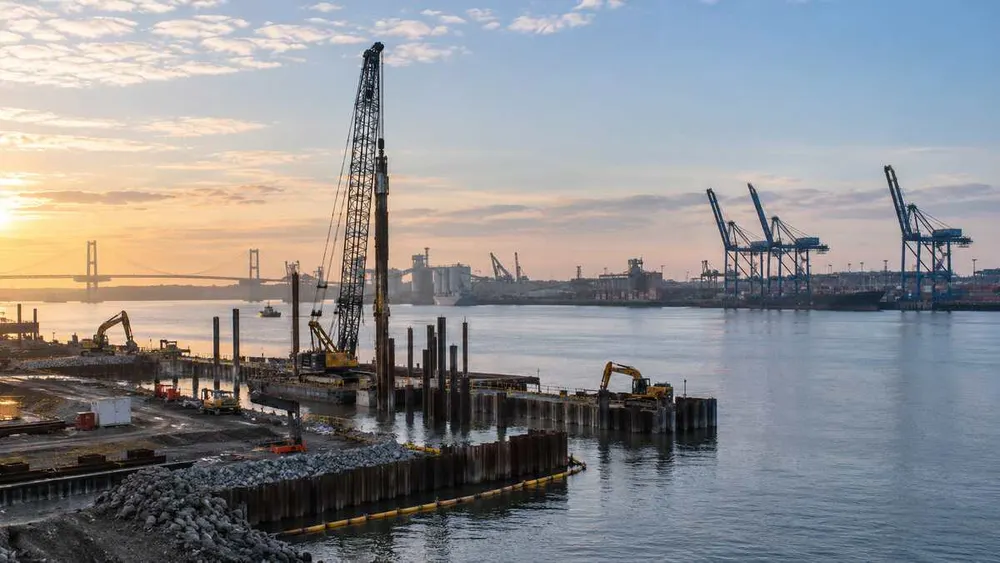
Construction has formally begun on the Delaware Container Terminal at Edgemoor, advancing a long-planned expansion that is intended to sharply increase the state’s cargo capacity and reshape Delaware’s maritime economy.
Enstructure and the state-owned Diamond State Port Corporation marked the groundbreaking in Wilmington on Sept. 14. The partners said in the state’s official announcement that the terminal is on track to open in early 2029. The milestone moves the project from years of permitting and planning into physical construction, although its economic and traffic effects will unfold over several years.
The terminal is being built along the Delaware River about three miles northeast of the existing Port of Wilmington. State officials said when federal permits were issued in April that the facility is designed to handle as many as 1.2 million twenty-foot-equivalent container units. The permit announcement said the U.S. Army Corps of Engineers completed a regulatory review that included navigation analysis, independent simulations and stakeholder feedback.
For Delaware, the development is significant because it adds container capacity rather than simply renovating the existing port. The Port of Wilmington currently handles more than 400 vessels and 6 million tons of cargo annually across containers, perishables, bulk cargo, vehicles and project freight, according to the groundbreaking announcement. The new terminal is intended to accommodate larger ships and strengthen the state’s position in Northeast supply chains.
Public investment, private operation
The project is structured as a public-private partnership between Diamond State Port Corporation and Enstructure, which operates the Port of Wilmington under a long-term concession. When Delaware joined the project in 2024, the state described it as a $635 million infrastructure investment. That announcement projected nearly 6,000 new jobs, including more than 3,100 direct jobs, plus more than 3,900 construction jobs. Those figures are forecasts rather than completed hiring and should be evaluated against actual contracts and employment as construction advances.
The initial work is expected to be heavily waterside: a seawall, high deck and associated dredging were identified as early construction priorities. Landside terminal construction follows later. State officials previously said later expansion phases would proceed when commercial demand justifies additional capacity.
The April permit announcement placed Phase I completion in 2028, while the latest groundbreaking release says the terminal is on track to open in early 2029. The two dates are not necessarily contradictory: completing a construction phase can precede full opening. They do, however, establish a practical window for residents, businesses and job seekers to watch for procurement, workforce and transportation updates.
The immediate development is the start of construction, not the realization of every projected benefit. Delawareans should expect the clearest measures of progress to be completed marine works, confirmed equipment and shipping commitments, union hiring, and public reporting on costs and timelines through 2028.