
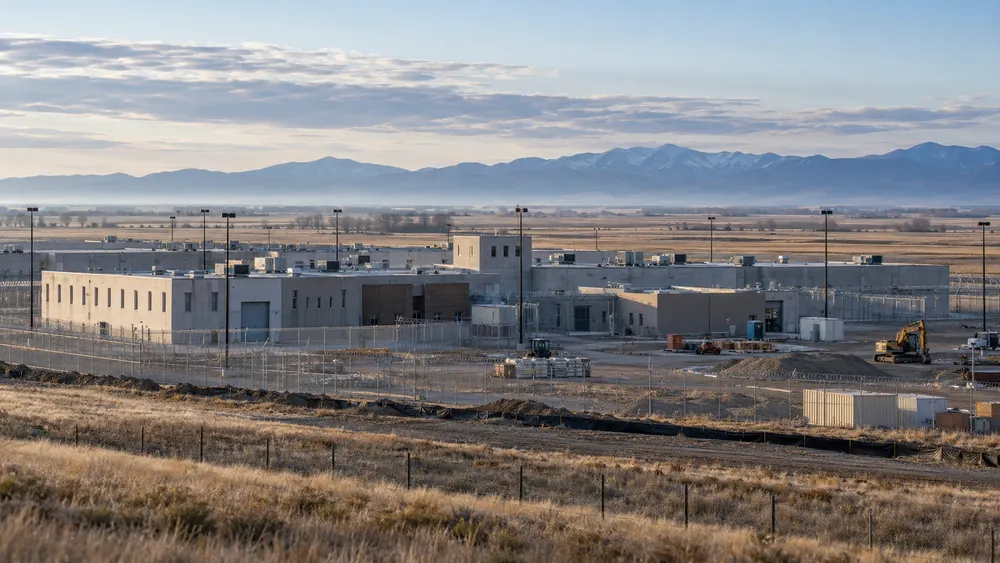
Colorado has asked a federal judge to stop work on a planned 1,188-bed immigration detention center in Hudson until federal agencies complete environmental and legal reviews. The state lawsuit, filed in Denver, challenges the Department of Homeland Security and Immigration and Customs Enforcement contract with private prison operator GEO Group.
The proposed Big Horn facility would reuse the former Hudson Correctional Facility, which closed about 12 years ago. The town is roughly 30 miles northeast of Denver. Colorado says converting the site to civil immigration detention could nearly double Hudson’s population and affect local water, wastewater, emergency services, traffic and other community resources.
The complaint alleges DHS and ICE moved forward without the review required by the National Environmental Policy Act, without an adequate public explanation and without determining that the location is appropriate for civil detainees. Colorado also invokes the Administrative Procedure Act and the Immigration and Nationality Act. Those are allegations; the court has not ruled on the merits.
Attorney General Phil Weiser is asking the court to vacate the contract and halt construction or renovation until the agencies comply with federal law. The state argues that Congress’s recent detention funding did not exempt ICE from environmental review. It also points to earlier federal assessments of contractor-operated detention projects as evidence that such reviews are not unprecedented.
GEO announced the five-year contract in July. The company said activation would be completed by the end of 2026, with normalized operations expected in the first quarter of 2027. GEO projected about $85 million in annual revenue once the center is fully operational and described the site as part of expanded federal immigration-processing capacity.
Local and state scrutiny began before the latest filing. A Colorado report said contractors had begun remodeling work and that the planned center would significantly expand the state’s detention capacity. The report also noted that ICE prepared an environmental assessment before awarding a contract for a different private detention facility near Houston in 2016, a comparison now central to Colorado’s claim that Hudson should receive similar review.
The dispute is therefore about both process and outcome. Colorado is not asking the judge in this case to decide national immigration policy. It is asking whether federal agencies may activate a large detention operation through a private contract without first measuring environmental effects, disclosing the analysis and considering alternatives.
The distinction matters for Hudson residents. An environmental review would not automatically block the facility, but it could require agencies to document expected demands on utilities and public services, examine mitigation and respond to public comments. If the court agrees with Colorado, the project could be delayed while that work proceeds; if the state loses, GEO’s activation timetable could remain in place.
No hearing date or final ruling was announced with the filing. Until the court acts, the contract remains the governing federal plan, while Colorado’s request for an injunction creates immediate legal uncertainty around continued renovation and the intended opening schedule.