
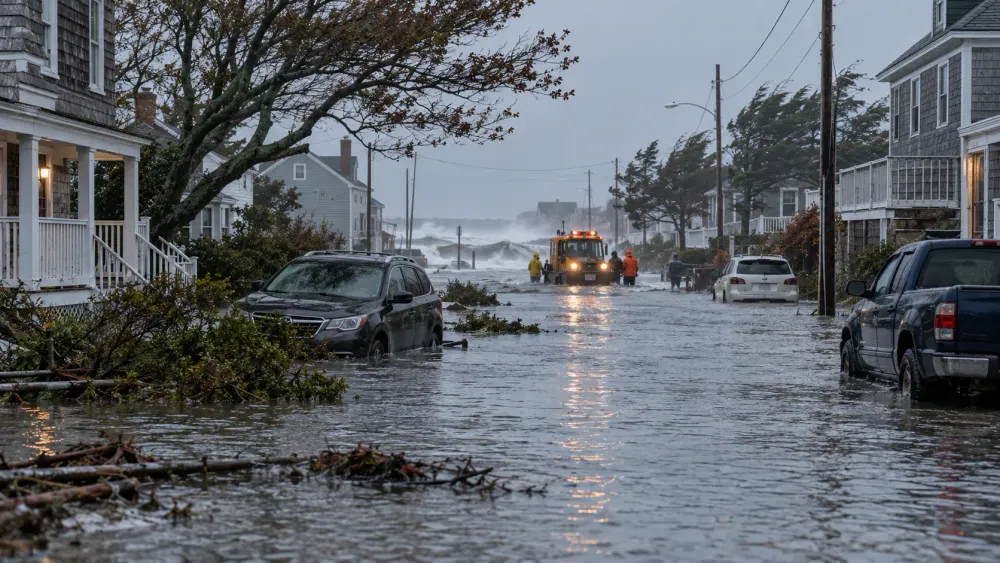
At least one person was killed and more than 100,000 homes and businesses lost electricity at the height of a nor’easter that flooded coastal communities from New Jersey through New England, disrupted hundreds of flights and kept flood alerts active into Monday. The storm’s most severe effects arrived over the weekend, but an overnight CBS News update and the latest federal outlook showed that heavy rain and coastal flooding remained concerns as the system weakened.
The death occurred in Brooklyn, where New York City Housing Authority employee Leighton Brown, 56, was struck by a falling tree, according to officials cited by CBS News. Separate AP reporting documented inundated streets, vehicle rescues and power failures across the region. The full economic cost was not yet known early Monday, and preliminary outage and damage totals were still changing.
A slow-moving coastal storm multiplies the damage
Nor’easters draw their name from the persistent northeasterly winds they produce along the Atlantic coast. The Weather Service says such systems can occur at any time of year but are most frequent and violent from September through April. This storm lingered offshore before turning back toward the coast, allowing several tide cycles, repeated rain bands and prolonged wind to affect the same low-lying areas.
That combination mattered as much as any single rainfall total. More than four inches of rain fell in parts of New Jersey after Friday, while ocean water pushed into communities accustomed to routine tidal flooding, according to the Associated Press. The Weather Prediction Center’s rainfall outlook placed parts of eastern Pennsylvania, New Jersey and nearby areas under an elevated excessive-rainfall risk, meaning saturated urban drainage systems and small waterways could respond rapidly to additional downpours.
Wind and surf expanded the threat beyond the heaviest rain. Gusts reached 81 mph at Montauk Point, New York, and approached 74 mph at Surf City, New Jersey, according to CBS News; the same report said rough water and rip currents extended south toward the Carolinas. Federal marine bulletins still listed coastal flood and small-craft advisories early Monday for parts of Maryland and Virginia, showing the storm’s broad footprint even as its center pulled away.
Flooding, outages and transportation disruptions converge
Power failures were widespread but began easing Sunday. The Reuters account put peak outages above 100,000 customers and flight cancellations above 400, while AP reporting said the outage total at one point exceeded 130,000. Differences between snapshots reflect when trackers were checked, not necessarily conflicting measurements. By Sunday night, more than half of the roughly 70,000 outages reported earlier in New York and Connecticut had been restored.
The storm also exposed the compounding risks of coastal development. Water entered streets and homes in places including Sea Bright, Long Branch and Long Beach Island, New Jersey, while flooding was reported around New York City and Long Island. Emergency crews rescued a woman and her dog from a vehicle trapped in Sea Bright floodwater, the AP reported. Those effects occurred as high winds toppled trees and power lines, creating hazards that could remain after water levels receded.
Emergency declarations unlocked state coordination
New Jersey Governor Mikie Sherrill declared emergencies in eight counties before the storm, including Atlantic, Burlington, Cape May, Cumberland, Middlesex, Monmouth, Ocean and Salem. The official state notice said the declaration was designed to focus resources on counties forecast to receive the worst impacts while keeping support available elsewhere. New York also declared an emergency for New York City, Long Island and adjacent counties, a step reported by both CBS News and AP.
Declarations do not measure damage by themselves. They allow states to move personnel, equipment and money more quickly and to coordinate with local governments. In this case, the operational priorities were clear: keep people away from flooded roads and dangerous surf, restore electricity, clear fallen trees and monitor another round of high tides. The New Jersey order and federal weather bulletins both emphasized that local conditions could vary sharply even across short distances.
The immediate threat eases, but the accounting has begun
Forecast guidance early Monday indicated that the nor’easter would gradually move away, with rain becoming more intermittent and winds diminishing. Flood watches remained posted for parts of the Northeast, however, and coastal advisories continued farther south. That meant the transition from response to recovery would be uneven: some communities were cleaning businesses and pumping basements while others still faced high water or hazardous roads.
The evidence so far establishes a multi-state storm with a confirmed death, extensive coastal flooding, major but improving power losses and significant travel disruption. It does not yet establish a final damage figure or the full number of homes and businesses affected. Those totals will depend on local inspections, insurance claims and utility reports after water recedes. The next meaningful measures will be the pace of power restoration, updated flood records and whether additional injuries or structural damage emerge from the hardest-hit coastal towns.