
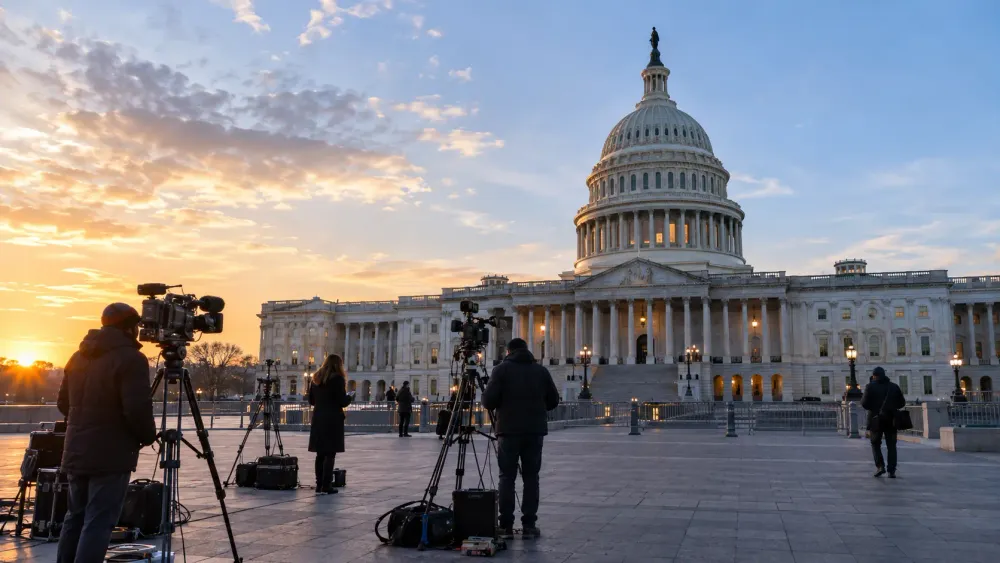
The Senate is scheduled to vote Monday evening on a sweeping college-sports bill that would create national rules for athlete compensation, transfers, health coverage and media rights, giving lawmakers one final major legislative test before leaving Washington for the midterm campaign.
A final vote after months of delay
The Protect College Sports Act, S. 4668, is set for a 5:30 p.m. vote, according to the Senate’s official floor schedule. The chamber adopted a bipartisan substitute amendment 77-23 on Sept. 24 and then voted 74-25 to end debate on the amended bill. Those margins strongly suggest that the measure can pass the Senate, though the vote does not resolve its uncertain path through the House.
The bill’s timing gives the vote added political weight. Senators are spending their final scheduled week in Washington before Election Day, while control of both chambers is contested. A Sunday preview of the week identified the college-sports measure as the Senate’s central scheduled legislative business before members return to campaign events.
The proposal is led by Republican Sen. Ted Cruz of Texas and Democratic Sen. Maria Cantwell of Washington, with additional bipartisan sponsors. It cleared the Commerce Committee 19-9 in June but stalled during the summer as major conferences, lawmakers and athlete advocates disputed how much authority schools and the NCAA should receive. Negotiations with the Big Ten and Southeastern Conference produced revised language and revived the bill.
National standards for pay, transfers and care
The legislation would replace a state-by-state system with a federal right for college athletes to earn money from their name, image and likeness. A committee summary says NIL contracts would have to disclose basic duties and compensation, agents would face registration requirements and a 5% fee cap, and athletes could sue to enforce specified rights without being forced into arbitration.
The amended bill also would create a $22.5 million school retention fund, allowing as much as $5 million more when matched by NIL spending on women’s and Olympic sports. It would guarantee scholarships for 10 years after eligibility begins, require five years of post-eligibility medical coverage for sports injuries at Division I schools and establish health standards for brain injuries, heat illness, sickle cell trait and asthma.
On eligibility, athletes generally would receive five years beginning at age 19 or high-school graduation, with exceptions for circumstances including pregnancy, military service and religious missions. Athletes would be guaranteed one transfer without losing eligibility; most second transfers would require sitting out a year. Schools also would be barred from cutting women’s and Olympic-sport roster positions below their 2024-25 levels.
The bill also reshapes college-sports economics
The measure would permit schools to join a voluntary collective to pool and negotiate media rights, extending an antitrust protection used by professional leagues. Existing broadcast contracts would remain in place, and participation would not be mandatory. The bill would require certain unused rights to return to schools and make football and basketball games available on a nonexclusive basis to at least one local outlet in each participating school’s home market.
Revisions announced by the Commerce Committee tightened the revenue-sharing cap, required certification for multimedia-rights companies and sponsors, and created a maximum $27.5 million retention pool. They also limited large conferences to 19 institutions for purposes covered by the bill and sought to block private-equity structures designed to form a breakaway super league. The Republican-side committee release said the changes were intended to close recruiting and payment loopholes that had prevented broader conference support.
Supporters argue that a national framework is necessary because court decisions, state laws and conference rules have created inconsistent obligations. They also say pooled media income and spending controls can preserve sports that generate little revenue. The bill’s bipartisan procedural support is documented in the Senate’s cloture record, which shows two separate votes exceeding the 60-vote threshold.
Opposition centers on athlete power
The lopsided procedural votes mask substantive opposition. Several Senate Democrats, including members of the Congressional Black Caucus, and some Republicans have argued that the bill grants too much legal protection to institutions while restricting athletes who lack collective-bargaining representation. An Associated Press account of the initial 74-24 vote reported that critics described the measure as preserving an exploitative structure rather than treating athletes as participants with independent economic power.
Those concerns are especially important because the bill would standardize limits that could otherwise be challenged under state law or federal antitrust law. Supporters answer that the measure creates enforceable scholarships, healthcare and NIL rights that do not uniformly exist today. The disagreement is therefore not about whether college sports need rules, but who should set them and how much freedom athletes should retain within the system.
Passage would shift the fight to the House
If the Senate approves the bill, the House would have to accept the same text or negotiate changes. That chamber has considered a different approach and has narrower political margins, making timing difficult before the election. Reuters reported after the summer delay that House passage was expected to be closer than the Senate vote.
Monday’s result will nonetheless establish the Senate’s position on an issue that has resisted a federal solution for years. A decisive vote would give supporters momentum and a specific framework for House negotiations. Failure or delay would leave schools, athletes and conferences operating under the same mixture of litigation, private settlements and state rules that prompted the legislation.