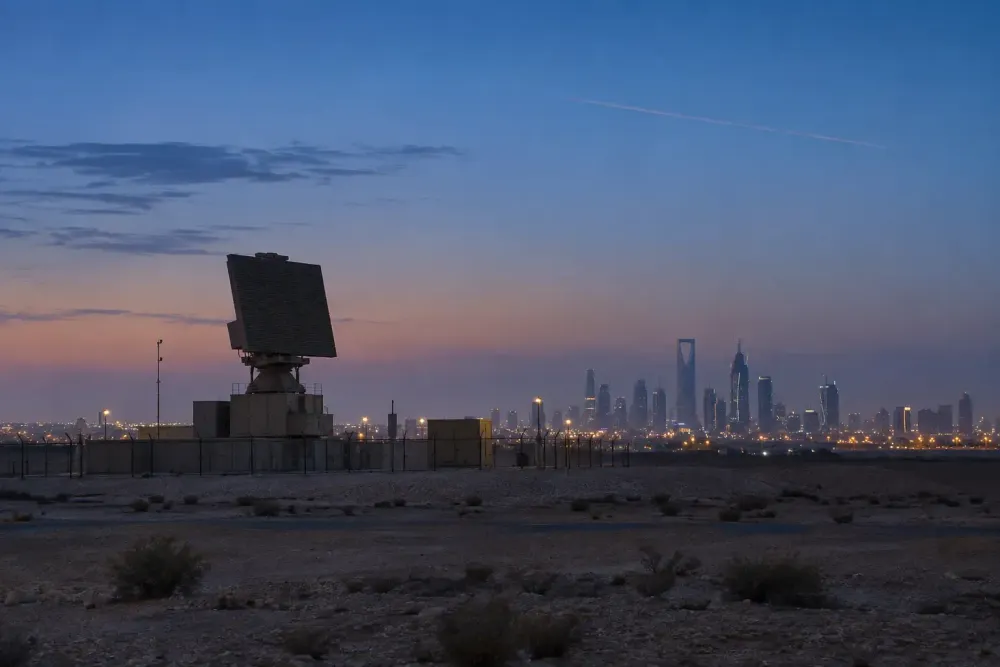
Saudi Arabia said it intercepted a Houthi ballistic missile aimed at Riyadh on Saturday, the first reported attempt to strike the capital since the latest escalation began in July. The Saudi-led coalition also said it thwarted attacks on Yanbu, Taif, Baysh and Farasan, according to the Associated Press. No casualties or confirmed missile damage were reported.
The attempted strike marked a significant expansion of a confrontation that had recently focused on southern Saudi cities, energy infrastructure and the Red Sea. It placed the kingdom’s political center and its principal international airport under direct threat while renewed fighting inside Yemen has given the Houthis control of more coastline near one of the world’s busiest maritime chokepoints.
What Saudi Arabia and the Houthis said
The Saudi coalition said air defenses destroyed a missile traveling toward Riyadh and stopped additional attacks against civilian infrastructure elsewhere in the kingdom. Residents heard explosions, while photographs and video showed smoke and flames near King Khalid International Airport. Reuters documented a fire near fuel tanks, but Saudi authorities had not publicly established that the intercepted missile caused it.
The Houthis claimed they used ballistic and cruise missiles and drones against what they called sensitive sites in Riyadh and an Aramco facility in Yanbu. They presented no independently verifiable evidence for their claim of large fires. Aramco had not publicly confirmed damage. The competing accounts leave the precise sequence and effects uncertain, even though Saudi confirmation of an incoming ballistic missile makes the attempted attack itself clear.
Alerts reach the capital
Saudi civil defense authorities sent air-raid warnings to residents of Riyadh, Jeddah, Yanbu and other cities before issuing an all-clear. The alerts were the first for Riyadh during the current phase of fighting. Airport tracking data showed severe disruption at King Khalid International Airport, and residents were told not to gather after the warning ended, Reuters reported.
The events followed a week of widening attacks. Saudi Arabia said debris from an intercepted Houthi drone killed a Yemeni resident on Thursday, the first reported civilian death in the kingdom during the renewed confrontation. Riyadh had also accused the Houthis of sending a drone toward Mecca earlier in the week; the group denied that allegation. Each side has accused the other of escalating without providing a complete public accounting of its operations.
A Red Sea conflict moves inland
The missile attempt matters beyond the immediate security of Riyadh. Houthi forces have advanced along Yemen’s Red Sea coast, taking Mokha and islands near the Bab al-Mandab Strait. Their expanded position gives the group better ability to observe maritime traffic through the narrow passage connecting the Red Sea and Gulf of Aden.
That geography links the fighting to energy and commercial routes already under strain. The Houthis say their maritime restrictions are directed at Saudi-linked vessels, but their earlier record of attacks has made broader shipping assurances difficult to assess. A recent analysis described U.S.-Houthi talks in Oman alongside Washington’s reluctance to open another military front.
The international legal framework is not ambiguous about attacks on commerce. In Resolution 2722, the U.N. Security Council demanded an end to Houthi attacks on merchant and commercial vessels and emphasized navigational rights. On Friday, the council again condemned attacks affecting civilian and energy infrastructure in Saudi Arabia and urged practical cooperation to enforce the arms embargo.
Regional defense ties come into focus
The strike also tested Saudi Arabia’s evolving security partnerships. Turkish Foreign Minister Hakan Fidan said Ankara was prepared to meet Saudi military needs under a three-country defense agreement with Pakistan. The pact treats an armed attack on one member as an attack on all three, although Pakistan has said no immediate military response has been discussed.
Fidan’s statement underscored the gap between mutual-defense language and operational commitments. Turkey offered technical support and called for the Houthi attacks to stop, while also urging a negotiated end to the wider conflict, according to a separate Reuters report. Washington, meanwhile, has signaled that it does not currently intend to fight the Houthis directly.
The human cost is rising
The danger is not limited to missiles and shipping. Renewed ground combat in Yemen has displaced more than 100,000 people, with families reporting repeated flight from front lines and severe shortages of shelter, water and medical care. A September 18 U.N. update said humanitarian needs were growing rapidly as access deteriorated.
The Riyadh attempt therefore represents both a military escalation and a warning about the conflict’s direction. Saudi air defenses prevented a reported ballistic missile from reaching its target, but interception does not resolve the underlying risk: a revived Yemeni war now spans population centers, energy infrastructure and a critical shipping corridor. Public information remains incomplete, and claims from both belligerents require independent verification. The next question is whether regional diplomacy can contain that expansion before the competing campaigns produce larger civilian harm.