Germany announced more than €1.3 billion in new support for Ukraine on Sunday, including roughly €1 billion in military aid and €350 million to repair energy infrastructure as Russian attacks intensify ahead of winter. Chancellor Friedrich Merz said in Kyiv that the military portion would cover long-range strike weapons, combat drones and satellite technology, according to the Associated Press. The package is intended to strengthen Ukraine’s ability to intercept fast attack drones and strike the sites from which Russian weapons are launched.
The visit paired government aid with a deeper defense-industrial relationship. German officials told Reuters that executives traveling with Merz signed 14 agreements with Ukrainian public and private partners worth about €6.6 billion. Ukraine’s presidency described a broader set of 15 agreements and documents valued above €8.5 billion, mostly involving security cooperation, weapons production, procurement and joint projects.
Those totals are not directly interchangeable. The €1.3 billion package is immediate public support, while the larger figures encompass commercial orders, industrial arrangements and cooperation documents whose timing and financing differ. That distinction matters because a signed agreement or budget commitment does not itself prove that equipment has reached Ukrainian units.
Air defense moves to the center
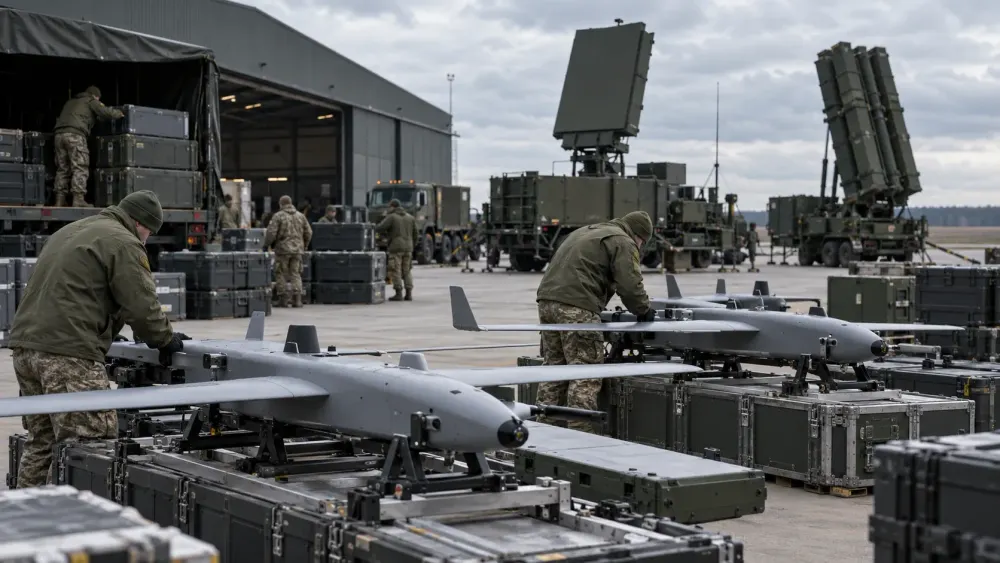
The agreements reported Sunday include planned supplies of IRIS-T air-defense missiles from Diehl Defence, radar equipment from Hensoldt and jet-powered interceptor drones from Quantum Systems. Merz said recent technical advances would allow faster joint production of interceptors designed to counter Russia’s newer jet-powered drones. Ukrainian President Volodymyr Zelenskyy said Russia launched about 900 such drones during the past week and that Ukraine intercepted roughly half, figures reported by AP but not independently verified.
The mix reflects a shift in the air war. Ukraine still needs conventional surface-to-air missiles against ballistic and cruise missiles, but firing scarce high-end interceptors at large numbers of smaller drones can strain both inventories and budgets. Dedicated interceptor drones offer another defensive layer, while radars and satellite support can improve detection, tracking and targeting. Whether the new systems materially change interception rates will depend on production volume, delivery schedules, integration and battlefield performance.
German industry becomes part of the strategy
Merz framed the partnership as more than a one-way transfer. In an official account of his Kyiv visit, the chancellor said German and Ukrainian companies were jointly developing technologies that could strengthen both countries. Zelenskyy’s office said the day produced 15 agreements between governments and businesses, with a total stated value exceeding €8.5 billion.
That model links Ukraine’s combat experience with Germany’s manufacturing capacity and financing. It may shorten the cycle between identifying a battlefield problem, refining a design and ordering production. It also creates work for German defense companies while giving Ukraine a more durable supply base than one-off transfers from military stockpiles. The approach is visible in the agreements involving missiles, radar and drone interceptors, which combine different parts of an air-defense network rather than treating each weapon as a stand-alone purchase.
The package builds on a much larger commitment
Germany says it has provided more than €43.3 billion in bilateral civilian assistance since Russia’s full-scale invasion in February 2022 and has provided or earmarked about €57.6 billion in military aid for current and future years. The federal government’s aid summary says support has included air defense, artillery, armored vehicles, ammunition, medical supplies and protective equipment. Germany also reports training more than 27,000 Ukrainian troops.
The new package therefore adds a targeted layer rather than creating a new policy from scratch. Its military emphasis is paired with €350 million for generators, substations and repairs to Ukraine’s damaged power and heating systems. That civilian component has military significance because functioning electricity, communications and transport networks are essential to mobilization, logistics and continuity of government.
Strikes during the visit sharpen the urgency
Merz arrived as Russian attacks hit Kyiv and other cities. Reuters reported that air-raid sirens and explosions sounded during the visit, while a strike damaged Kyiv’s Northern Bridge and injured two people, according to the city’s mayor. The Financial Times reported that Russia has been intensifying pressure on major Ukrainian cities as winter approaches.
Moscow says it targets military sites and related infrastructure and denies deliberately attacking civilians. Ukraine says Russia is targeting bridges, power systems, telecommunications and other civilian infrastructure alongside military assets. The competing claims are difficult to verify in real time, but the repeated damage to transport and energy networks explains why Germany coupled weapons funding with emergency infrastructure support.
Delivery will determine the package’s value
The key questions now are practical: how many interceptors, missiles and radar systems will be produced; when they will arrive; and whether joint manufacturing can keep pace with Russian launches. The Ukrainian president’s official meeting summary confirms the €1.3 billion package and the broader €8.5 billion value assigned to the day’s agreements, but it does not provide complete delivery schedules or unit quantities.
That leaves a gap between political commitment and measurable military effect. Sunday’s announcements are consequential because they combine near-term funding, industrial orders and joint technology work at a moment of heavier aerial attacks. Their success, however, will be judged by fielded systems, interception performance and sustained production—not by the headline value of the agreements alone.