
Micron Technology closed its fiscal year with quarterly revenue of $54.23 billion—nearly five times the $11.32 billion reported a year earlier—and said customers have now committed $32 billion under long-term supply agreements. The results offer unusually concrete evidence that the artificial-intelligence infrastructure boom is reshaping not only chip demand, but also how one of the industry's most cyclical businesses sells future production.
The Boise, Idaho-based memory manufacturer reported $37.70 billion in generally accepted accounting principles net income for the quarter ended Sept. 3, according to its results release. Revenue rose 31% from the previous quarter and 379% from the same period last year. For the full fiscal year, revenue reached $133.19 billion, compared with $37.38 billion in fiscal 2025.
Micron also projected first-quarter revenue of $61.5 billion, plus or minus $1.5 billion, with adjusted earnings of $38.15 per share, plus or minus $1. The forecast exceeded the analyst consensus figures reported by Reuters, which placed average expectations at $57.02 billion in revenue and $35.40 in adjusted earnings per share.
Long-term contracts change the equation
The most consequential part of the announcement may be the scale of Micron's strategic customer agreements rather than the quarterly headline. In its prepared remarks, the company said it has signed 26 multiyear, take-or-pay agreements that it estimates will cover more than 35% of revenue through 2030. Customer financial commitments increased to $32 billion from $22 billion disclosed in June, and Micron said most of the commitments are cash deposits.
The contracts are designed to give customers supply assurance while giving Micron more visibility into future demand and pricing. About three-quarters of the expected revenue covered by the agreements has a defined pricing framework; most of those arrangements use price floors and ceilings. The company put remaining performance obligations tied to agreements with determined pricing at approximately $150 billion, though it said that measure uses minimum contract pricing and does not capture all expected revenue.
That structure matters because memory chips have historically moved through sharp shortages and gluts. When customers over-order, manufacturers add capacity and prices can later collapse when demand cools. Long-term volume commitments and pricing bands may soften that pattern, but they cannot eliminate it. A Barron's analysis noted that investors remain cautious precisely because the memory business has a long record of boom-and-bust cycles, despite Micron's record margins and earnings.
AI demand is colliding with slow capacity growth
Micron said artificial-intelligence systems are consuming growing amounts of high-bandwidth memory, conventional DRAM and data-center storage. In its earnings deck, the company reported record fourth-quarter DRAM revenue of $39.8 billion and record NAND revenue of $14.1 billion. Data-center solid-state-drive revenue approached $10 billion, more than 10 times the year-earlier quarter.
The company said agreements are already in place for the vast majority of its calendar 2027 high-bandwidth-memory output, with higher prices than this year. It expects memory and storage supply-demand conditions to become tighter in 2027 and 2028 and said it lacks visibility into when DRAM supply will return to balance. Those are company forecasts, not independent guarantees, and they depend on AI investment continuing at extraordinary levels.
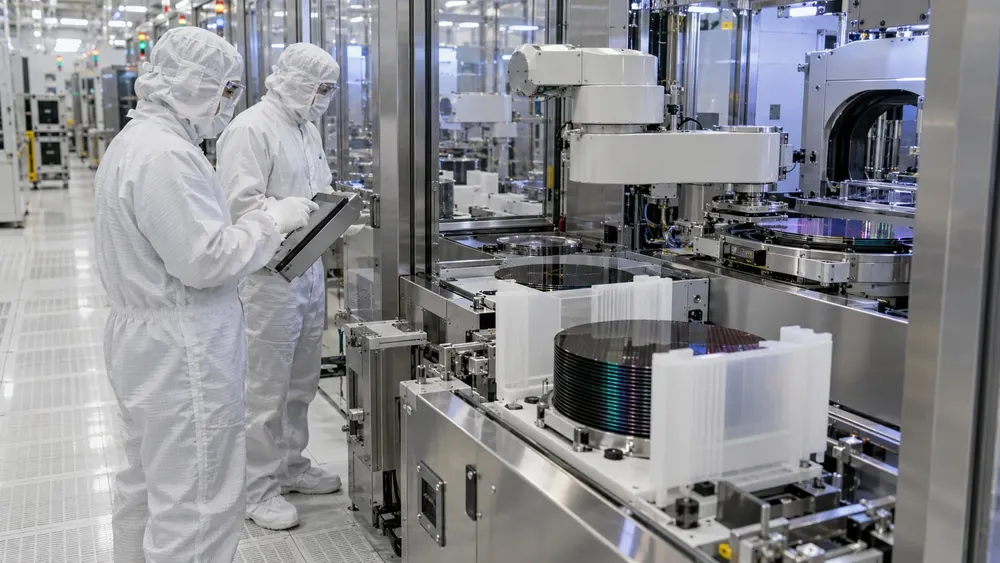
A Journal report underscored both sides of that outlook: profit and revenue surged, while management warned that shortages could persist through 2028. Constraints arise because fabrication plants and cleanrooms require years to build, qualify and ramp. Micron said new output from its first expanded Idaho facility is expected in mid-2027, followed by additional Idaho capacity in late 2028 and initial New York production in 2030. Virginia operations are also part of its domestic supply plan.
Management plans to increase fiscal 2027 capital spending beyond its prior expectations, with about $25 billion projected for the first half of the year. Much of the increase will support construction intended to make more cleanroom space available in late 2028 and beyond. The company previously raised its broader U.S. investment plan to more than $250 billion through 2035, a move Reuters detailed in July.
What the results signal
Micron's quarter strengthens the case that AI spending is flowing beyond graphics processors into the memory and storage systems needed to run increasingly large models. It also shows major technology customers trying to lock in supply years ahead, an approach that transfers some demand risk from the manufacturer to buyers.
For Micron, the immediate economics are exceptional: record revenue, expanding prices, an 86.8% GAAP gross margin and $43.97 billion in operating cash flow. The longer-term test is whether customer commitments and disciplined factory expansion can keep profitability more stable when the current shortage eventually eases.
The results do not settle the durability of the AI investment cycle. They do establish, at least for now, that memory has become a binding constraint for data-center growth—and that customers are backing their forecasts with multibillion-dollar commitments rather than expressions of interest alone.