Iran-aligned Houthi forces have seized Yemen’s Red Sea port of Mocha, multiple major news organizations reported Thursday, a territorial breakthrough that brings the armed group closer to the Bab el-Mandeb shipping chokepoint as Brent crude climbed above $105 a barrel and U.S. oil crossed $100. The advance adds a second acute threat to Gulf energy exports already constrained by fighting around the Strait of Hormuz, raising the risk that disruptions in two narrow waterways will reinforce each other.
The seizure was reported by Reuters, the Financial Times and the Wall Street Journal, each citing sources close to the fighting. The Associated Press reported that Houthi fighters had entered the city and that witnesses and local doctors saw their presence as roads and businesses closed. That AP account cautioned that battlefield reports could not yet be independently verified. Taken together, the reporting establishes a major Houthi entry into and apparent control of Mocha, but the full perimeter, casualties and disposition of retreating government-aligned forces remained unclear as of Thursday morning.
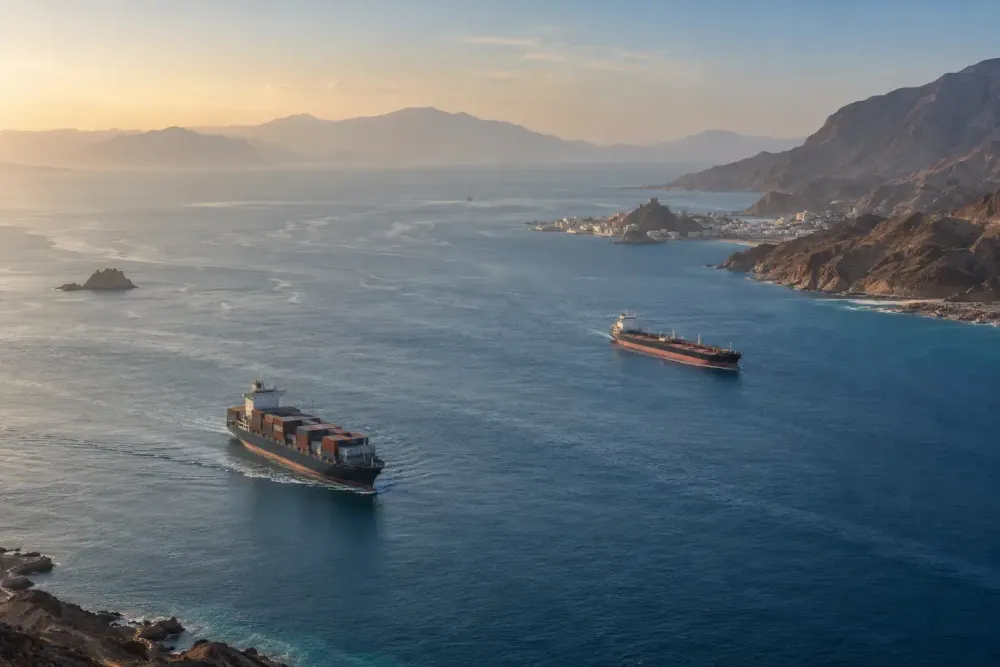
Mocha had been held by forces loyal to Yemen’s internationally recognized government. Its fall is not simply another exchange of remote territory. The port sits on Yemen’s western coast, roughly 50 kilometers north of the Bab el-Mandeb, according to the FT report. The strait connects the Red Sea and Suez Canal corridor to the Gulf of Aden and Indian Ocean. At its narrowest point it is about 18 miles wide, divided by Perim Island into constrained navigation channels, and roughly 7% of global oil supply normally passes through it, a Reuters explainer said.
A new front at a vulnerable chokepoint
The immediate fact is territorial: Houthi forces, which already control Yemen’s capital and much of the country’s north, have pushed south along the Red Sea coast into a strategic government-held city. The broader consequence is maritime. Control of Mocha does not by itself give the Houthis legal or physical control over the Bab el-Mandeb, and commercial vessels were not reported to have stopped transiting the strait Thursday morning. It does, however, shorten the distance between Houthi-held territory and the waterway while expanding the group’s access to coastal positions, roads and port infrastructure.
The Guardian reported that the offensive also produced gains at Hays and the Khalid ibn al-Walid military base, widening the front after the effective collapse of the relative calm that followed a 2022 United Nations-brokered truce. The precise size of Houthi gains is still contested, and no independent assessment Thursday had established that the group could sustain control of every claimed position. Saudi airstrikes and counterattacks by Yemeni forces could still change the map.
Even without a formal closure, the threat matters because shipowners and insurers respond to perceived risk before a waterway becomes impassable. Houthi attacks since late 2023 have repeatedly forced carriers to divert around Africa, adding time, fuel and insurance costs. A position closer to Bab el-Mandeb may increase the group’s ability to monitor or threaten vessels approaching the strait, although no authoritative source had confirmed deployment of new coastal missiles or mines at Mocha by the reporting cutoff.
The advance follows this week’s missile and drone attacks on southern Saudi cities and oil facilities that wounded 73 people, a development TAQ reported Tuesday. Saudi Arabia answered with strikes inside Yemen, while Pakistan relayed a Saudi warning to Iran to restrain the Houthis. Tehran denies controlling the group. The Houthis make their own operational decisions, but Western governments and United Nations investigators have long documented Iranian weapons support. The extent of any direct Iranian role in the Mocha offensive has not been established.
Oil markets register the compounded risk
Energy markets moved sharply as the territorial news arrived. Brent crude rose about 4% and reached $105.26 a barrel, while West Texas Intermediate climbed above $100 for the first time since May, according to market data reported by Reuters. Those moves do not measure the effect of Mocha alone. Traders were simultaneously pricing Iranian attacks on ships near Hormuz, U.S. strikes on Iranian tankers, reduced regional output and the possibility of further retaliation.
The distinction is important. No public evidence Thursday showed that Mocha’s seizure had physically removed a new volume of oil from the market. The price increase reflects a larger risk premium: Saudi barrels that cannot move efficiently through the Persian Gulf have become more dependent on Red Sea routes, just as the western exit from that route has become more exposed. The two chokepoints are not interchangeable, and Saudi pipelines can move some production across the kingdom, but alternatives have finite capacity and do not eliminate shipping risk.
The supply cushion was already eroding. The U.S. Energy Information Administration raised its oil-price forecasts this week after estimating that global inventories had fallen by roughly 400 million barrels in 2026. Middle East shut-ins reached 6.7 million barrels a day in August, and the agency projected an average 5.7 million barrels a day of shut-in production during the fourth quarter, according to a Reuters account of the forecast. The EIA did not expect production and exports to normalize before the second quarter of 2027.
For the United States, the transmission channel is direct even though domestic crude production reduces dependence on imported oil. Oil is globally priced, and higher crude costs flow into gasoline, diesel, aviation fuel and freight. The national average for regular gasoline was nearing $4.28 a gallon Thursday, about 34% higher than a year earlier, according to an AP update. Persistent energy inflation can also complicate Federal Reserve decisions by lifting headline prices and business costs at the same time that expensive fuel weakens household purchasing power.
What is confirmed—and what is not
The most consequential confirmed development is that Houthi forces reached Mocha in strength and were reported by several independent organizations to have taken the city after government-aligned forces withdrew. It is also confirmed by market reporting that Brent traded above $105 and WTI above $100 Thursday morning. Witness accounts support the Houthi presence, and multiple outlets describe the advance as the largest change on this front since the 2022 truce.
Still unconfirmed are the final casualty count, the durability of Houthi control, whether port operations remain functional and whether the group has moved anti-ship systems into the area. It would also be premature to describe Bab el-Mandeb as closed or under Houthi control. Mocha is near the strait, not the strait itself, and naval access depends on more than possession of one city. Those distinctions will determine whether Thursday’s shock remains primarily a military and financial warning or becomes a sustained physical disruption to global trade.
The next indicators are therefore concrete: whether Yemeni government forces attempt to retake the port; whether Saudi air operations expand; whether the Houthis consolidate farther south toward Dhubab or Perim Island; and whether maritime authorities report attacks, diversions or a change in commercial traffic through Bab el-Mandeb. Oil prices and tanker-insurance rates will provide faster but less definitive signals of perceived risk.
Mocha’s fall changes the balance because it links Yemen’s renewed ground war to the already stressed energy corridor around Iran. It does not guarantee a shipping shutdown. It does mean that a force with a demonstrated record of attacking commercial vessels has moved closer to one of the world’s narrowest and most important sea lanes at the same moment the other major Gulf outlet is constrained. That combination is why the development carries consequences well beyond Yemen—and why the next few days of battlefield and maritime reporting will matter.