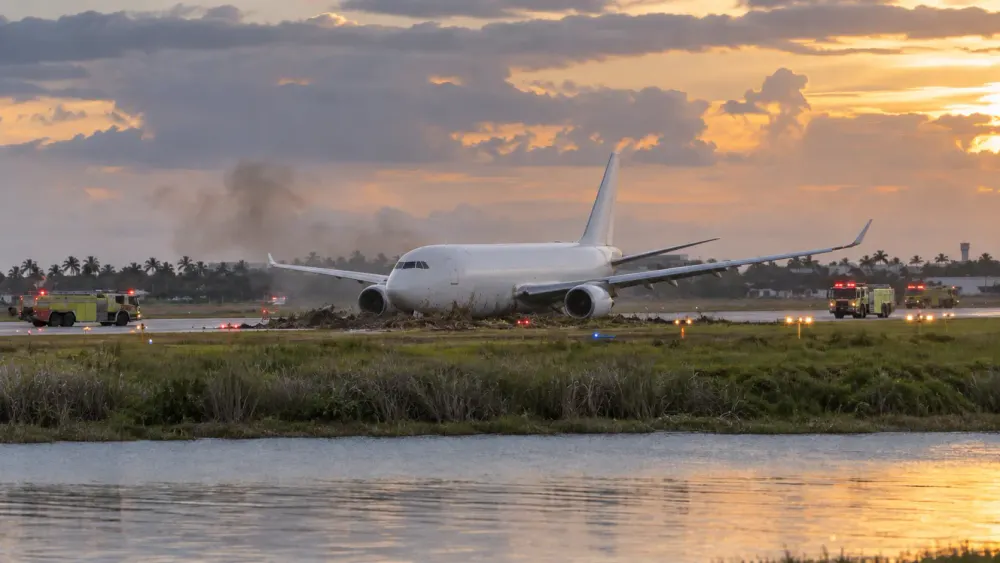
All four runways at Miami International Airport closed Sunday afternoon after an Amazon Air cargo jet overran a runway, struck multiple vehicles and caught fire, temporarily halting one of the nation’s largest passenger and freight gateways during Labor Day weekend.
The Boeing 767-300, operated by 21 Air as Prime Air Flight 7598, left the airport’s diagonal runway at about 2 p.m. Eastern after arriving from San Juan, Puerto Rico, according to the Associated Press and the Reuters account. Miami-Dade Fire Rescue sent more than 60 units to an aircraft that was burning after it left the runway. Officials had not released a confirmed count of injuries or deaths by late afternoon.
The airport later said one runway had reopened, but warned passengers to expect continuing effects and check directly with their airlines before traveling to the terminal. That distinction matters: the immediate airport-wide stop had ended, but the constrained airfield, disabled widebody aircraft and accumulated delays meant recovery would take longer than the initial closure.
A runway overrun became an airport-wide emergency
The confirmed sequence remains short. Flight 7598 traveled from Luis Muñoz Marín International Airport in San Juan to Miami, then overran Miami’s Runway 12/30 after landing. The aircraft came to rest near the airport’s northwest perimeter, beside a roadway and near two semi-trucks, with photographs showing the airplane largely intact but resting low after the fire. Public flight data identify the service under 21 Air’s CSB operating code.
Fire-rescue officials said the airplane struck multiple vehicles after leaving the paved runway area. That fact sharply increased the potential consequences beyond the crew and aircraft, but authorities had not said how many people were aboard, whether the vehicles were occupied or how many patients were being assessed. Reports circulating online about casualties therefore remained unverified and should not be treated as established.
The Federal Aviation Administration imposed a ground stop while emergency crews responded, and all runways and taxiways were closed as of 3 p.m. The stoppage prevented normal arrivals, departures and aircraft movement across the field. Transportation Secretary Sean Duffy said FAA investigators were traveling to Miami, while the National Transportation Safety Board said it was gathering information to determine the scope of its response.
Hundreds of flights absorb the disruption
By late afternoon, 144 departing flights and 113 arriving flights had been delayed, while 45 departures and 34 arrivals had been canceled, according to figures attributed to FlightAware by Barron’s. Those totals represented 257 delays and 79 cancellations, and they remained a moving snapshot rather than a final count. Reduced operations on one reopened runway could continue to increase those figures even without another closure.
Miami is unusually exposed to cascading disruption because of its scale and its role as a bridge between the United States, Latin America and the Caribbean. The airport handled 55.3 million passengers and nearly 499,000 commercial aircraft movements in 2025, according to its official airport data. Its four runways range from 8,600 feet to 13,016 feet, so losing three after the initial complete shutdown substantially limits the airport’s ability to absorb delayed traffic.
Airlines must now decide whether to hold aircraft at their origins, divert inbound flights, cancel later trips or rebuild schedules around the runway that remains available. Crews and aircraft can also fall out of position, extending the effects to Monday even after the wreckage area is secured. The airport’s advice to contact airlines directly reflects that operational reality: reopening a runway does not automatically restore every scheduled flight.
The crash reaches a major U.S. cargo hub
The accident also struck at the center of Miami’s freight system. Miami International describes itself as the nation’s leading airport for total freight and international freight, handling a record 3.4 million tons in 2025. About 85% of that volume was international, and the airport supports more than 35 all-cargo carriers, according to its cargo office. A disabled freighter at the field therefore affects a network carrying perishables, pharmaceuticals, e-commerce goods and high-value manufactured products, even if the direct interruption proves brief.
Amazon spokesperson Kelly Nantel confirmed that an Amazon Air aircraft operated by 21 Air was involved and said the company was working with local authorities while prioritizing the people affected. That statement confirms the commercial relationship but does not establish why the aircraft left the runway or which organization, if any, bears responsibility.
21 Air is a U.S.-certificated Part 121 cargo carrier that provides aircraft, crew, maintenance and insurance services and other cargo operations. The carrier says its 767 fleet is designed for e-commerce and Latin American markets, with the 767-200 freighter capable of carrying 42 tons. The FAA identified Sunday’s aircraft as a 767-300, however, and authorities had not released its registration, load, maintenance status or weight-and-balance records.
Cause and human toll remain unresolved
No authoritative source had identified a cause by the source cutoff. It would be premature to attribute the overrun to weather, braking action, mechanical failure, runway conditions, crew decisions, aircraft loading or any other factor. Investigators will need evidence from the flight crew, air traffic control recordings, aircraft systems, maintenance and dispatch records, the runway environment, wreckage and any available cockpit or flight-data recorders.
The division of investigative responsibility is also important. The FAA has said it will investigate, but in major U.S. civil aviation accidents the NTSB generally leads the safety investigation while the FAA supports it and evaluates whether regulatory action is needed. The FAA’s own accident guidance describes that arrangement, and the NTSB’s published investigation process shows that factual collection precedes analysis, probable-cause findings and any safety recommendations.
That process means early visual evidence can establish that an overrun and fire occurred without explaining the chain of events that produced them. Even apparently obvious physical damage may have several possible origins. The same caution applies to the human toll: until fire-rescue, hospital or law-enforcement officials release confirmed information, the number and severity of injuries remain unknown.
What happens next
The immediate priorities are patient accountability, fire suppression, fuel and hazardous-material control, preservation of evidence, and a safe expansion of airport operations. Officials must determine whether the aircraft or damaged vehicles interfere with protected runway areas and whether pavement, lighting, navigational equipment or perimeter infrastructure require inspection or repair before more runways reopen.
For travelers, the most consequential near-term update will be the number of usable runways and the resulting airline schedule. For investigators, the first substantive milestones will be confirmation of who was aboard, recovery of recorded data, documentation of the aircraft and runway, and a preliminary factual account. A preliminary report will not necessarily identify probable cause; the final explanation normally depends on a longer examination of technical and operational evidence.
Sunday’s verified facts establish a serious transportation emergency: a widebody cargo jet left a runway, hit vehicles, burned and forced a four-runway shutdown at a U.S. airport that moves more than 55 million passengers and 3.4 million tons of freight annually. One runway’s reopening reduced the immediate national travel threat, but the injury count, cause, infrastructure damage and duration of the disruption remained unsettled. Those are the next facts that will determine whether the event becomes primarily a major operational failure or a larger aviation disaster.