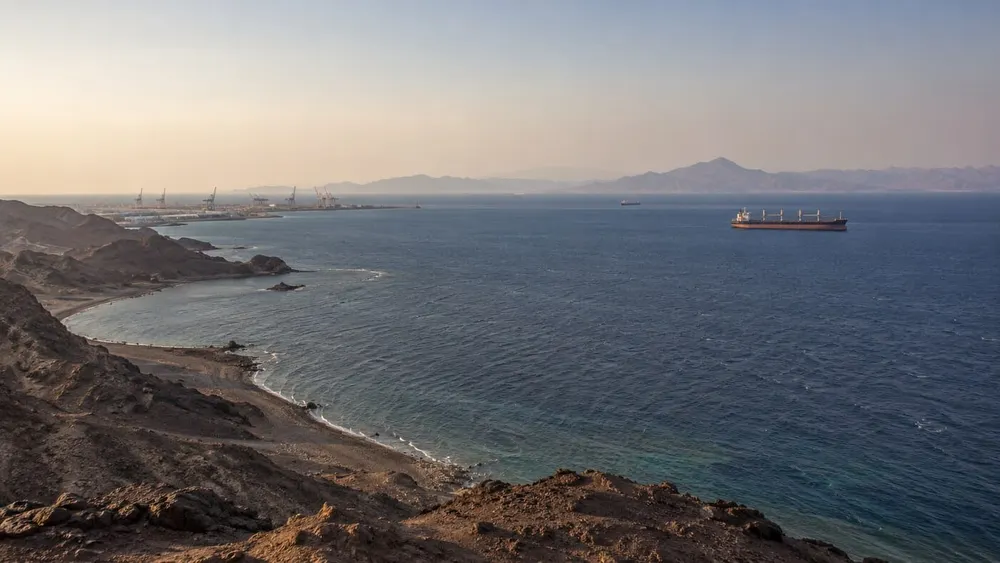
Houthi forces have seized Yemen’s Red Sea port of Mocha after a rapid coastal offensive, moving the Iran-aligned movement closer to the Bab el-Mandeb strait at a moment when the region’s other great energy chokepoint, the Strait of Hormuz, is already under severe pressure. Reuters reported that the advance followed fighting across western Yemen and placed the Houthis in a stronger position along the coast opposite the Horn of Africa. The capture does not by itself give the group physical control of the strait, and commercial traffic was still moving through the waterway, but it materially changes the military geography around a passage central to trade between Asia, the Middle East and Europe.
The development is consequential because Mocha sits north of the narrow southern entrance to the Red Sea and near routes used by tankers and container ships bound for the Suez Canal. Residents and regional officials told the Associated Press that Houthi fighters entered the city after advances through Taiz province and the withdrawal of forces aligned with Yemen’s internationally recognized government. Competing accounts of front-line movements remain difficult to verify independently, but several major news organizations reported the loss of the port, making it the clearest shift in Yemen’s western front since fighting intensified this summer.
A port changes the map, not the strait
Mocha’s value is primarily geographic and logistical. The port lies on Yemen’s western shoreline above the Bab el-Mandeb, where the Red Sea narrows between Yemen, Djibouti and Eritrea before opening into the Gulf of Aden. Control of the city can support coastal surveillance, resupply and pressure on remaining government-held positions farther south. It also narrows the buffer between Houthi-controlled territory and Perim Island, which divides the strait into two channels, although possession of Mocha alone does not establish an enforceable blockade or guarantee the ability to stop ships.
That distinction matters because military presence near a chokepoint and actual command of maritime traffic are not the same. Ships can alter routes, naval forces can escort or monitor traffic, and coastal weapons must be detected, positioned and operated effectively to sustain a closure. Yet the cost of uncertainty can arrive before a passage is physically blocked: insurers can raise war-risk premiums, shipowners can suspend voyages, and charterers can redirect cargoes. The Guardian reported that the advance followed the fiercest fighting since the 2022 truce and prompted a renewed Saudi aerial response, reinforcing the risk that Yemen’s largely frozen interstate front could reopen.
Why Bab el-Mandeb matters to energy and trade
The Bab el-Mandeb is one of the world’s most important maritime bottlenecks. The U.S. Energy Information Administration estimated that about 4.2 million barrels a day of crude oil and petroleum products passed through the strait in the first half of 2025, roughly half the 2023 flow after earlier Houthi attacks pushed vessels toward the Cape of Good Hope. The same EIA analysis found that liquefied-natural-gas traffic through Bab el-Mandeb was near zero in 2024 and the first half of 2025 because operators avoided the security risk and high insurance costs.
Around-the-cape diversions provide resilience but impose a measurable penalty. For voyages linking the Arabian Sea with Europe, bypassing the Red Sea can add about 15 days, according to the EIA, consuming more fuel and vessel capacity while lengthening delivery times. Those costs flow through freight contracts and inventories even when the cargo itself arrives safely. The immediate risk from Mocha is therefore not that every ship will suddenly stop, but that an already fragile route becomes harder for carriers and insurers to treat as dependable.
The timing compounds the exposure. Saudi Arabia has increasingly used its East-West Pipeline and the Red Sea port of Yanbu to route exports around Hormuz, while conflict with Iran has sharply constrained traffic through that strait. Reporting on the latest escalation found that crude markets moved above $100 a barrel as traders assessed threats to both exits from the Arabian Peninsula. The Financial Times reported that Saudi production and exports had already been affected by Houthi threats and disruption around its western shipping corridor, making security near Bab el-Mandeb more consequential than it would be in isolation.
A renewed war after years of uneasy restraint
Yemen’s conflict began long before the current maritime crisis. The Houthis seized the capital, Sana’a, in 2014, and a Saudi-led coalition intervened the following year in support of the government. A United Nations-mediated truce in 2022 reduced cross-border attacks and large-scale front-line combat even after its formal term expired. It did not resolve the country’s political division, disarm the parties or produce a comprehensive peace agreement, leaving military forces in place and institutions split.
The latest advance shows how quickly that equilibrium can erode. Houthi missile and drone attacks on southern Saudi Arabia wounded scores of people and struck oil and economic sites earlier this week, according to regional authorities cited by major news organizations. Saudi aircraft then intensified strikes inside Yemen. Pakistan also carried a Saudi warning to Iran urging restraint of the Houthis, while Tehran continued to deny that it controls the movement; a separate Reuters account described the diplomatic exchange and the limits Pakistan placed on any role under its defense arrangements with Saudi Arabia.
Attribution requires care. Iran has armed and supported the Houthis, but the movement has its own leadership, domestic constituency and objectives shaped by Yemen’s civil war. Evidence of Iranian support does not establish that every operational decision is directed from Tehran. Likewise, Saudi and Yemeni-government assertions about particular strikes or Houthi intentions should be understood as claims by parties to the conflict unless independently verified. The strategic alignment is real, but treating the Houthis as merely an external proxy can obscure the local grievances and power structures that have made the war so durable.
Shipping has already absorbed years of attacks
The danger to merchant crews is not theoretical. The International Maritime Organization says it has confirmed 61 incidents affecting international shipping in the Red Sea since January 2024, after an earlier wave of attacks began in late 2023. Its incident record is narrower than the universe of warnings and suspected events because it counts verified notifications used for United Nations reporting. The total nevertheless documents a sustained security problem that has killed seafarers, damaged vessels and changed route planning across global fleets.
In August, a projectile struck the cargo ship Tihamah off Mocha and killed several crew members. The IMO’s formal statement condemned the attack, urged operators to assess risks and said assaults on shipping threatened supply chains. That incident gives the port’s change of control added significance: it occurred in the same maritime area where the organization has already documented lethal violence, not in a previously insulated part of the coast.
Even so, the best current evidence does not support declaring Bab el-Mandeb closed. Ship-tracking data reported Thursday showed commodity vessels still passing through the strait at roughly the recent average, while Hormuz traffic had fallen to single digits. Transponders can be turned off and preliminary tracking counts are imperfect, but the contrast underscores the difference between heightened risk and actual cessation of traffic. Markets and policymakers now have to judge whether the Mocha advance will produce new attacks, a negotiated restraint or a broader Saudi-Houthi confrontation.
What the next phase will reveal
Several indicators will determine whether the capture becomes a global economic shock or remains a serious but contained military development. The first is whether Houthi forces move farther south toward Dhubab and Perim Island or establish new coastal launch and surveillance positions. The second is the behavior of major carriers and marine insurers: route suspensions and sharply higher premiums would signal that commercial risk assessments are deteriorating even without a formal blockade. The third is Saudi Arabia’s response, particularly whether air operations remain limited or expand into a sustained campaign that unravels the restraint established after 2022.
Diplomacy will be equally important. Pakistan’s message to Iran, Saudi consultations with regional partners and any renewed United Nations engagement could create channels for de-escalation, but none has yet produced a verified settlement. A durable solution would have to address both the immediate threat to shipping and the underlying Yemeni conflict; suppressing maritime attacks without a political framework would leave the coastal front capable of reigniting.
The evidence available Thursday establishes that the Houthis have gained a strategically valuable port and that the surrounding shipping corridor was already operating under extraordinary strain. It does not establish that the group controls Bab el-Mandeb or that a closure is imminent. The practical consequence is a sharper concentration of risk: with Hormuz impaired and Saudi exports increasingly dependent on Red Sea routes, even incremental instability around Mocha now carries consequences far beyond Yemen.