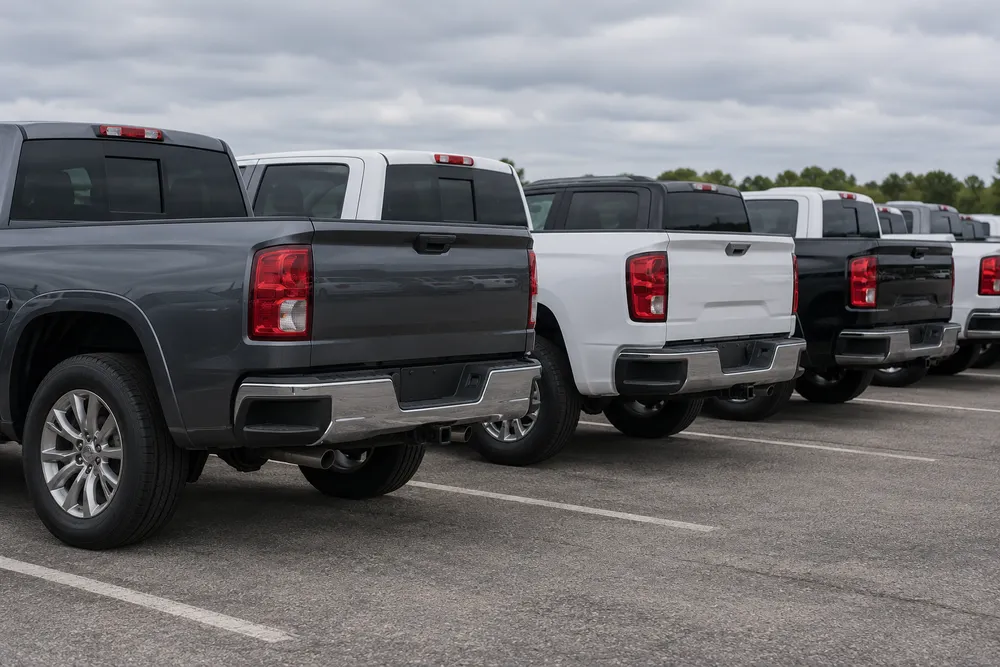
General Motors authorized a $20 billion multiyear share buyback on October 20 while narrowing its full-year earnings outlook, pairing stronger third-quarter results with a more cautious forecast. Its financial release showed $50.0 billion in revenue, $3.3 billion in net income attributable to stockholders and $4.1 billion in adjusted earnings before interest and taxes.
The tension is between profitable trucks and increasingly expensive production. Reuters reported that a greater share of large pickups and fewer electric vehicles helped earnings. North America's adjusted profit margin reached 8.7%, compared with 6.2% a year earlier. But GM's revised annual adjusted earnings-per-share midpoint fell below the Wall Street estimate cited by Reuters.
Shares fell more than 5% in Tuesday morning trading, according to Investopedia. That response distinguished the company's completed quarter from expectations for what comes next: an earnings beat and a large repurchase authorization did not remove concerns about costs and pricing.
A narrower profit range, a higher cash forecast
GM now expects full-year adjusted EBIT of $14.5 billion to $15.5 billion, versus $14 billion to $16 billion previously. The midpoint remains $15 billion; this is a narrower range, not an increase in the central operating-profit forecast. Adjusted diluted earnings per share are projected at $12.75 to $13.75, compared with $12 to $14.
The cash outlook improved more clearly. GM raised expected adjusted automotive free cash flow to $11.5 billion–$12.5 billion from $9.5 billion–$11.5 billion. These adjusted measures are distinct from net income and operating cash flow; GM provides reconciliations in its release.
On the earnings call, Chief Financial Officer Paul Jacobson attributed the improved cash outlook partly to lower capital spending and progress receiving tariff refunds. Those are management's explanations, not evidence that vehicle demand alone accounts for the increase. Timing matters when comparing cash generation with operating profitability.
Jacobson also said production of the redesigned pickups would increase gradually, with initial deliveries expected late in the fourth quarter. In management's account, the changeover therefore creates a near-term production constraint even as the new vehicles support its argument for stronger performance next year.
Cost pressure reaches beyond the latest quarter
The Wall Street Journal reported that commodity and logistics expenses linked to the Iran conflict were weighing on GM's outlook despite higher quarterly profit and revenue. The distinction matters: selling a more profitable combination of vehicles can strengthen reported margins while rising input expenses make that performance harder to sustain.
Jacobson said commodity, logistics and memory-chip inflation was now expected to cost about $2 billion for the full year. He described roughly $400 million in additional annual costs since the prior outlook, mostly affecting the fourth quarter. These are GM's estimates, and they depend on the prices the company ultimately pays.
For 2027, Jacobson offered a conditional calculation rather than formal guidance. Annualizing recent commodity increases could bring next year's total headwind to roughly $2 billion. Management said it was still preparing its budget and would provide the annual outlook in January. Treating that scenario as an established profit forecast would overstate what executives disclosed.
It also complicates comparisons across reporting periods. A strong quarter captures the costs and vehicle mix already realized; an outlook must incorporate expenses still arriving. The two can move in different directions without contradicting each other.
Buybacks do not settle the operating questions
The repurchase authorization has no expiration date and may be suspended or discontinued. It is permission to buy shares, not a completed $20 billion expenditure or a promise about its timing.
Reuters reported that GM had repurchased about $29.5 billion of stock since 2023, reducing the share count and supporting per-share earnings. That financial effect is separate from increasing total operating profit.
JPMorgan analysts, whose assessment Investopedia summarized, saw buybacks as supportive but questioned confidence in next year's improvement amid higher costs and uncertain pricing. Their view is an interpretation, not a forecast GM has adopted. It underscores why investors can welcome capital returns while remaining cautious about the business funding them.
New trucks and software underpin management's case
In her shareholder letter, Chief Executive Mary Barra emphasized the forthcoming Chevrolet Silverado and GMC Sierra light-duty pickups, followed by new heavy-duty pickups and full-size sport utility vehicles. GM is also seeking more revenue from services attached to those vehicles, rather than relying solely on the original sale.
Barra said Super Cruise would become standard on high-end Silverado and Sierra trims and optional on most others. GM expects penetration of that driver-assistance technology within its truck portfolio to increase fourfold to fivefold next year. This is a company adoption target, not an achieved result or proof of a particular profit contribution.
Her letter also projected approximately $7.5 billion in deferred revenue from software and services for the full year. Deferred revenue should not be confused with revenue already recognized in the quarter or with net profit.
Those plans explain management's confidence, but do not resolve the cost question. New products and greater service adoption remain prospective sources of improvement. The completed quarter establishes stronger earnings; whether the next product cycle can preserve that strength will depend on launch execution, customer demand and the expenses incurred to deliver it.