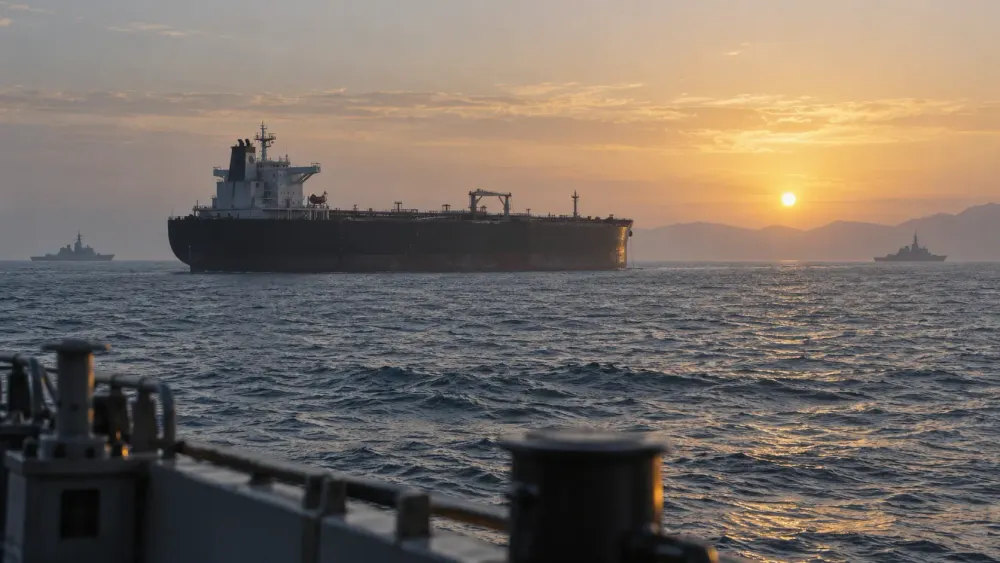
The U.S. military struck three Iranian oil tankers on Saturday after it said Iranian forces fired missiles at an American aircraft carrier and a destroyer in the Persian Gulf, a direct exchange that raises the risk to U.S. personnel and to energy traffic through the region’s most important shipping corridor.
The carrier and destroyer evaded the attacks, and no American personnel were injured, according to a U.S. military account reported by the Associated Press. The military said two Iranian tankers were permanently disabled and a third, which was not carrying cargo, was destroyed. It described all three vessels as part of a covert network that finances Iran’s Islamic Revolutionary Guard Corps. Those are official U.S. assertions; the publicly available reporting reviewed by The American Quorum did not independently establish the tankers’ ownership, financing role or the precise sequence of the Iranian missile launches.
Iran’s account overlaps with only part of the American description. The semi-official Tasnim news agency said a tanker at an anchorage near Kharg Island was hit by four U.S. missiles, that no casualties were reported and that the crew was being evacuated. Reuters reported that neither Iranian authorities nor U.S. Central Command had immediately confirmed that specific Kharg Island account. The differences matter: Washington says it acted after attacks on warships and targeted three financing-linked vessels; Tehran’s public narrative centers on an American strike on one tanker near its principal crude-export hub.
What changed Saturday
The immediate change is the target set. Recent U.S.-Iran exchanges have concentrated on coastal missile batteries, radars, mine-laying forces, bases and commercial shipping. Saturday’s episode, as described by the U.S. military, placed an American carrier and a destroyer under direct missile threat and produced retaliatory attacks on three oil tankers. That combination links naval force protection, economic pressure and energy security in a single confrontation.
It also extends an escalation that resumed at the end of August after roughly a month without major U.S.-Iran strikes. In the earlier exchange, U.S. forces attacked Iranian rocket launchers that Central Command said were being prepared to deploy sea mines. Iran then fired missiles toward American bases in Jordan, while Kuwait and Bahrain reported subsequent attacks without casualties. The AP reported that Tuesday’s U.S. strikes included air-defense, radar and maritime targets. The American Quorum covered the restart of direct hostilities in an earlier report.
U.S. officials had already signaled a broader effort to punish attacks on maritime traffic. On Thursday, Vice President JD Vance said Washington would not resume talks until Iran stopped attacking commercial ships in the Strait of Hormuz, according to Reuters video. The administration has portrayed the military campaign as a limited effort to prevent attacks and protect navigation. Iran has characterized U.S. strikes and the American blockade of its exports as aggression. Those positions are political and legal claims by the parties, not settled findings by an independent tribunal.
Why the tankers matter
Oil tankers are economic infrastructure, but in this conflict they are also being treated as instruments of state finance and retaliation. The U.S. military’s contention that Saturday’s ships supported the Revolutionary Guard supplies its stated operational rationale. Iran’s reported location for one strike makes the economic stakes unusually visible: Kharg Island has historically handled about 90% of the country’s crude exports, Reuters reported.
The new strikes do not establish that Kharg Island’s terminal infrastructure was attacked. No such conclusion should be drawn from a report about a tanker at an anchorage. Even without damage to shore facilities, however, repeated attacks on vessels near an export hub can affect crew availability, insurance, routing and buyers’ willingness to lift cargo. Those second-order effects are reasonable risks, not confirmed outcomes of Saturday’s action.
The broader oil system entered the weekend with little cushion. Brent crude settled at $95.63 a barrel on Wednesday after the largest U.S.-Iran exchange in weeks, while West Texas Intermediate closed at $91.01, market data showed. By Saturday, Reuters reported that the national gasoline average for Labor Day weekend was expected to exceed $4.03 a gallon, above the prior holiday record of $3.83 set in 2012. Refinery utilization was near 98%, leaving limited near-term capacity to offset supply pressure.
A constrained global chokepoint
The Strait of Hormuz was carrying an average of nearly 20 million barrels a day of crude and petroleum products in 2025, about one-quarter of global seaborne oil trade, according to the IEA. The same route carries almost one-fifth of global liquefied-natural-gas exports, overwhelmingly from Qatar and the United Arab Emirates. At its narrowest, the strait is 29 nautical miles wide, with two-mile navigation channels in each direction.
There are bypasses, but not enough to replace normal traffic. The U.S. Energy Information Administration estimated that Saudi and Emirati pipelines offered about 2.6 million barrels a day of spare capacity before the current conflict. In its August outlook, the EIA estimated that petroleum flows through Hormuz averaged 4.9 million barrels a day in the second quarter of 2026, down from 21.6 million in the final quarter of 2025. It forecast Brent at about $85 a barrel for the third quarter, an estimate made before the latest escalation.
That disparity explains why a military exchange involving even a small number of tankers can carry consequences beyond the vessels themselves. The question for markets is not only how much cargo was lost Saturday. It is whether the episode reduces the frequency of transits, adds to insurance and security costs, or prompts further attacks on ships and export infrastructure. A three-vessel strike is not, by itself, proof of a lasting supply shock. It increases the probability of one.
The military context
The United States has spent months building an escort-and-strike framework around the strait. In May, the Pentagon announced “Project Freedom,” a mission intended to move thousands of stranded commercial vessels through the passage under military protection. In July, Central Command said U.S. forces had facilitated the movement of more than 800 commercial vessels carrying about 400 million barrels of oil since early May. Those official totals describe the U.S. mission; they do not resolve the competing claims to control the waterway or the legal dispute surrounding the blockade.
Saturday’s reported attack on Navy ships tests whether that framework can protect the warships serving as its backbone. The absence of U.S. casualties is consequential, but evasion is not the same as de-escalation. A successful hit on a carrier, destroyer or escorted commercial ship could sharply widen the conflict and increase pressure for a larger American response. Likewise, attacks on Iranian commercial vessels risk retaliation against U.S. bases, partner countries or shipping.
What happens next
The first questions are factual. Central Command may provide the locations, timing and methods of the Iranian attacks, identify the American ships, name the tankers and release imagery or battle-damage assessments. Iran may issue a formal military account beyond Tasnim’s report. Independent satellite imagery and maritime data could clarify whether the tanker near Kharg was one of the three vessels in the U.S. account and whether any cargo or shore infrastructure was affected.
The second question is whether Saturday’s action ends this exchange or begins another cycle. Officials in Washington have conditioned diplomacy on an end to attacks on shipping. Tehran has shown that it can retaliate across the Gulf and has repeatedly used the strait as leverage. Neither position offers a visible off-ramp while missiles are being exchanged.
For Americans, the near-term effects are most likely to appear first in fuel prices, shipping costs and the security demands placed on deployed forces. The larger danger is strategic: direct attacks on Navy warships and retaliatory strikes on oil tankers narrow the distance between a contained maritime confrontation and a broader campaign against military and energy targets. Saturday’s confirmed facts stop short of that outcome. They make it more plausible, and they leave the next military move carrying more weight than the last.