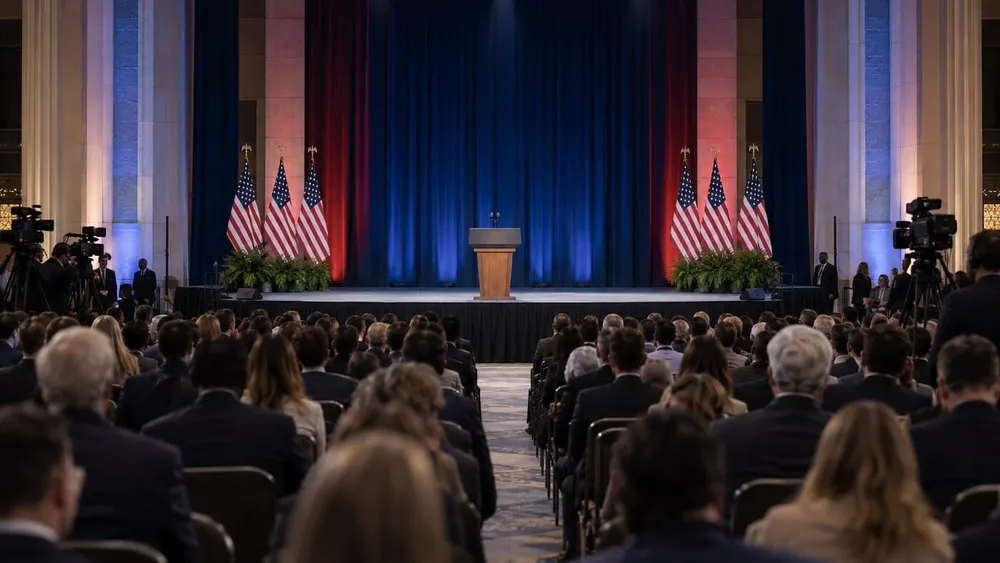
President Donald Trump promised $5,000 to every adult U.S. citizen if Republicans retain both chambers of Congress in November, attaching a potentially trillion-dollar federal payment to the outcome of the midterm elections without presenting a bill, funding source or eligibility rules. The announcement at a Republican convention in Dallas immediately made the proposed “dividend” a central campaign issue, but it remains a political pledge rather than an enacted benefit.
Trump said the payment would reflect the country’s economic strength and required only that recipients spend it in the United States. The initial announcement offered no timetable, administrative mechanism or explanation of how domestic spending would be tracked. Those omissions are substantial because any nationwide payment would need congressional authorization and detailed rules before federal agencies could distribute money.
A campaign promise with an unusually large price
The proposal’s scale distinguishes it from the tax credits, rebates and targeted benefit expansions that normally populate midterm platforms. The Associated Press estimated that sending $5,000 to every adult citizen would probably cost more than $1 trillion. Vice President JD Vance later suggested wealthy Americans might be excluded and that tariff revenue could help fund the payments, but neither statement produced an income threshold or a legislative framework.
Design choices would determine both the price and who benefits. Congress would have to decide whether eligibility depends on citizenship on a particular date, tax-filing status, Social Security records, income or residency. Lawmakers would also need to settle whether married couples receive separate payments, how non-filers apply, whether the money is taxable and what happens when a recipient cannot document that every dollar was spent domestically.
Previous federal economic-impact payments illustrate the administrative task. Pandemic-era checks were based largely on tax records and phased out at specified incomes. Trump’s announcement described a broader adult-citizen benefit but did not say whether similar phaseouts would apply. The lack of detail means estimates are necessarily provisional; a universal benefit would cost more than a means-tested one, while an enforceable domestic-purchase condition could add complexity and delay.
Congress controls the money
A president cannot create a program of this size through a speech. The Constitution’s Appropriations Clause provides that money may be drawn from the Treasury only under appropriations made by law. In practice, the House and Senate would need to pass legislation establishing the benefit and funding it, and the president would then sign that measure.
That requirement explains why the election condition has practical force beyond campaign rhetoric. If Republicans controlled both chambers, the administration could try to move a dividend through tax or spending legislation, potentially using budget reconciliation if Senate rules permitted. Yet unified party control would not guarantee passage. Fiscal conservatives, members from competitive districts and senators concerned about inflation or debt could demand a smaller payment, narrower eligibility or offsetting spending cuts.
The party has encountered those tensions before. Trump proposed a $2,000 tariff dividend in 2025, but the idea did not gain enough congressional support to become law. An earlier cost analysis of the new pledge placed a universal adult payment near $1.35 trillion and a version excluding wealthier households near $1.15 trillion. Those estimates are not official scores, but they show why even a Republican Congress would face difficult budget choices.
Tariff revenue is unlikely to settle the question
Vance’s reference to tariffs revives a financing argument the administration has used before: import taxes produce federal revenue that can be returned to households. Tariffs do bring money into the Treasury, but the amount depends on rates, import volumes, legal authority and the broader economic response. They are also collected from U.S. importers, which can pass some costs to consumers or absorb them through lower margins.
Analysis of the prior $2,000 concept provides a useful benchmark. The nonpartisan Committee for a Responsible Federal Budget estimated that a broadly designed round of those payments could cost about $600 billion, roughly twice the projected annual revenue from the tariffs then in effect. Its fiscal estimate warned that using customs revenue for checks would also prevent the same money from reducing deficits.
The Tax Foundation reached a similar conclusion using several eligibility designs. Its modeling placed the cost of a $2,000 dividend between $279.8 billion and $606.8 billion, compared with $207.5 billion in projected tariff revenue for 2026. A $5,000 payment would be materially larger unless eligibility were narrowed substantially. Congress could borrow the difference, raise other taxes or cut spending, but the campaign announcement did not specify any of those options.
The politics of a conditional benefit
The pledge gives Republicans a simple economic message at a difficult point in the midterm campaign: continued congressional control would produce a large direct payment. Trump urged voters to treat him as if he were on the ballot, linking the dividend to the broader case for preserving his governing majority. The Dallas address also defended the Iran war and warned that Democratic control would reverse administration policies.
Democrats are likely to focus on cost, inflation and the absence of legislation, while Republicans must decide whether to embrace a popular cash benefit or distance themselves from an unfunded commitment. Candidates in competitive races may be pressed to say whether they would vote for the plan, what income limit they favor and how they would pay for it. That could turn a presidential promise into a district-by-district test of party discipline.
The election contingency also raises an ethical debate, though legal analysis must distinguish political incentives from prohibited vote buying. Candidates routinely promise tax cuts, benefits and public investments if elected. The unusual feature here is the direct, fixed payment presented in explicit connection with one party winning both chambers. The political reaction has therefore centered not only on feasibility but also on whether the framing erodes the boundary between policy advocacy and a personal electoral inducement.
Economic effects would depend on timing
If enacted, a payment exceeding $1 trillion would increase household purchasing power quickly. That could support retail sales and other consumer activity, especially among recipients likely to spend rather than save the money. But a large deficit-financed transfer could also add demand when supply constraints or energy costs are already putting pressure on prices. The effect would depend on when checks arrive, whether the program is offset elsewhere in the budget and how the Federal Reserve responds.
A domestic-spending requirement might redirect some purchases toward U.S. businesses, yet it would be difficult to administer cleanly. Many goods combine domestic labor with imported components, online merchants process mixed inventories and services can cross borders digitally. Congress would need a workable definition of domestic spending, or it could treat the condition as political guidance rather than a legally enforced restriction.
The distributional effect is equally unresolved. A flat $5,000 payment represents a larger share of income for lower-paid households, but a universal design also sends substantial public money to people who may not need assistance. An income cap reduces cost but creates phaseout questions and potential work or filing incentives. These are policy decisions, not details an agency can safely improvise after passage.
What would make the promise concrete
The next meaningful step would be legislative text. A credible proposal would identify eligible recipients, payment timing, the agency responsible, tax treatment, a funding source and enforcement of the domestic-spending condition. It would then receive an official budget estimate and proceed through House and Senate committees or an expedited budget process. Until that occurs, no voter can know whether the eventual plan would match the universal $5,000 promise delivered in Dallas.
The announcement nevertheless matters now because it changes the campaign agenda. Republican candidates must decide whether to campaign on the dividend, Democrats gain a prominent target for fiscal criticism and voters receive a clear material promise tied to congressional control. What has been established is narrow but consequential: the president has proposed a direct payment and made a Republican sweep its condition. Whether that pledge can survive budget arithmetic, legislative bargaining and legal implementation remains unproven.