The U.S. Air Force has added $46.1 million to its assessment of a long-endurance uncrewed reconnaissance aircraft, more than doubling the disclosed value of the contract and extending the work into 2031. The award signals continued interest in relatively inexpensive aircraft that can remain airborne for days, filling surveillance gaps without relying exclusively on larger, costlier military drones.
The Department of War’s contract notice said DZYNE Technologies received a $46,087,217 modification to an earlier Air Force agreement for the Operational Assessment of Uncrewed Long-Endurance Tactical Reconnaissance Aircraft. The action raises the contract’s cumulative face value from $39,555,840 to $85,643,057. Work is scheduled at U.S. and overseas locations through March 26, 2031.
The notice does not specify how many aircraft, sensors or support packages the modification covers. It also does not identify deployment sites, operational units or evaluation criteria. That makes the award an expansion of an assessment—not proof that the Air Force has approved a fleet-wide acquisition or declared the aircraft fully operational.
Persistence at a lower operating cost
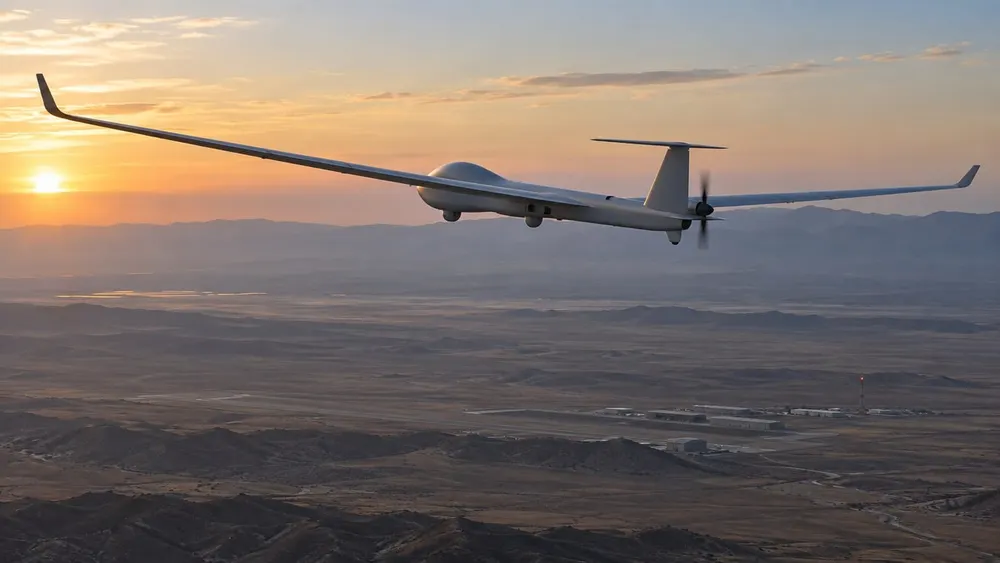
DZYNE’s ULTRA aircraft is built around a high-efficiency, glider-like airframe designed to carry intelligence, surveillance and reconnaissance payloads for unusually long missions. Public descriptions put its endurance at more than 80 hours, allowing one aircraft to watch a broad area across several day-night cycles. The design trades the speed and payload of larger combat drones for persistence and a lighter logistics footprint.
That endurance can change how commanders schedule surveillance. A platform remaining aloft for more than three days requires fewer takeoffs, landings and crew handoffs than aircraft limited to shorter sorties. It can also reduce gaps between coverage windows, particularly over large areas where available runways, tankers or maintenance crews are limited. Earlier reporting on the system’s Middle East deployment described the aircraft as a joint development between DZYNE and the Air Force Research Laboratory, with the Air Force using it for persistent intelligence collection.
The approach reflects a broader Pentagon effort to field systems that are effective enough for routine missions without consuming the flying-hour costs of higher-end aircraft. The ULTRA is derived from a commercial motor-glider lineage, an adaptation that can lower development and sustainment burdens. A 2023 Defense Post account said DZYNE’s long-endurance aircraft family had accumulated about 50,000 operational flight hours, though that figure covered more than one model and was supplied in the context of the company’s expansion plans.
What operational assessment must establish
Endurance alone does not determine military value. The Air Force will need to evaluate whether the aircraft can deliver reliable sensor data in difficult weather, maintain secure satellite or line-of-sight communications and operate from austere locations with limited maintenance. Analysts will also assess how many personnel are required to launch, recover and monitor each mission, because low aircraft costs can be offset by labor-intensive operations.
Survivability is another constraint. A slow, non-stealthy reconnaissance aircraft may be useful where air defenses are limited or where it can remain outside threat ranges, but it would face greater risk in contested airspace. The operational concept therefore matters as much as the airframe: the aircraft could provide persistent coverage over permissive regions, maritime approaches or border areas while freeing more sophisticated systems for missions requiring speed, stealth or electronic protection.
Payload integration will also shape the result. Long-endurance aircraft can carry electro-optical cameras, communications relays and other sensors, but performance depends on power, cooling, bandwidth and weight. The contract notice does not identify the payloads being assessed, so claims about specific intelligence capabilities would go beyond the public record.
A program with a new corporate owner
The contract expansion comes after Ondas Holdings announced an agreement to acquire DZYNE. In describing the transaction, the company said ULTRA was intended to deliver multi-day surveillance across large operating areas at lower cost and with less logistical burden than traditional intelligence aircraft. The deal and product description were summarized in an investor filing tied to the acquisition. Corporate claims about cost and performance still require government testing, but the Air Force’s extended assessment provides a venue for that validation.
The added funding is therefore consequential without being conclusive. It shows the Air Force is willing to sustain a multi-year evaluation of ultra-long-endurance reconnaissance, but the public notice leaves key acquisition questions unanswered: how many systems will be tested, which missions they will support, what readiness standards must be met and whether the service will proceed to a larger production decision.
By 2031, the Air Force should have enough operational evidence to judge whether a commercial-derived, multi-day aircraft can deliver dependable intelligence at scale. Congress and acquisition officials will still need transparent cost, availability and mission-effectiveness data before comparing it with crewed aircraft, satellites and other drones. Until then, the $46.1 million modification is best read as a larger test of the concept—not a final endorsement of the platform.