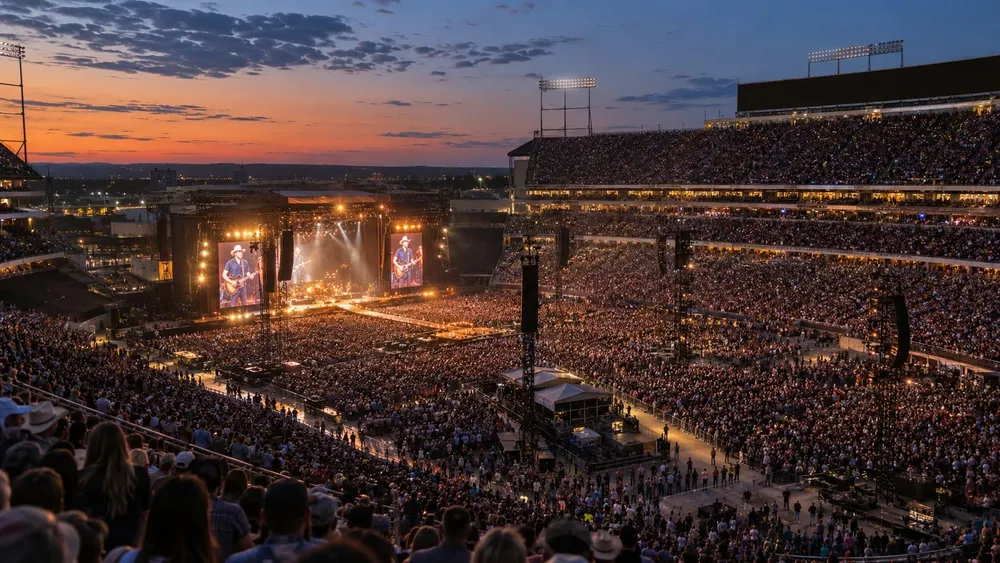
Zach Bryan drew 73,538 people to Gillette Stadium on Saturday, the largest crowd in the venue’s history, one night after he and members of his band wore pro-Palestinian clothing on the same stage. The attendance figure was attributed to the stadium by CBS Boston and separately reported by Variety, giving the country singer a new live-entertainment benchmark at a venue already entangled in a dispute over political expression.
The two-night Foxborough, Massachusetts, engagement closed the penultimate stop of Bryan’s With Heaven on Tour. During Friday’s concert, Bryan wore a black shirt bearing the words “Free Palestine” and “An Appeal to Heaven,” while several band members wore Palestinian-themed jerseys. Bryan did not address the clothing from the stage, according to local reporting, leaving the message visible but unexplained.
The setting made the gesture consequential beyond the concert. Gillette owner Robert Kraft had recently told Ed Sheeran that rapper Macklemore would not be allowed to appear there after pro-Palestinian remarks at earlier tour dates. Bryan’s shows proceeded, and the second night’s record crowd demonstrated that controversy did not suppress demand for one of live music’s largest current stadium acts.
A record built on stadium-scale demand
Gillette’s event listing scheduled Bryan for Oct. 2 and 3 with Gregory Alan Isakov and Gabriella Rose. The venue described the 2026 itinerary as Bryan’s biggest international tour and noted that the dates were his third and fourth career appearances at the home of the New England Patriots and Revolution.
Bryan’s official site confirms that Foxborough came near the end of a run built around football stadiums in the United States and large venues in Europe. That scale followed his 2025 concert at Michigan Stadium, where 112,408 attendees set what the promoter described as the largest U.S. ticketed-concert crowd. The Gillette record is narrower, applying to a single venue, but it reinforces the commercial reach of a performer whose audience has expanded beyond conventional country arenas.
The shirt carried a specific local context
The Boston Globe reported that Bryan and band members wore the shirts during Friday’s show and that he did not call attention to them. Images shared by concertgoers amplified the gesture before Saturday’s record-setting performance and placed it in the context of Macklemore’s removal from Sheeran’s U.S. tour.
The phrase “Free Palestine” is used by advocates for Palestinian rights and statehood, but it has also become a flashpoint when paired with rhetoric that Jewish organizations or venue operators consider antisemitic. Bryan’s clothing did not include a spoken explanation, policy demand or statement about Israel, Hamas or the war. Reporting therefore establishes the message he displayed, but not a fuller political position that he did not articulate at the concerts.
The Macklemore dispute changed the meaning of the venue
Macklemore had said “Free Palestine” and criticized Israeli government actions while opening for Sheeran at MetLife Stadium in September. Kraft later said Gillette would not host him, arguing that the performer’s broader rhetoric and imagery had crossed a line into speech harmful to the Jewish community. Macklemore rejected that characterization and said criticism of Israel should not be conflated with hatred of Jewish people.
The dispute spread across Sheeran’s U.S. tour. A Reuters report said Finneas, Lukas Graham, Aaron Rowe and members of Beoga withdrew after Macklemore was removed. Sheeran said the decision was not his and described unsuccessful efforts to mediate with promoters and venue owners. His Gillette dates were later canceled because of severe weather, not the lineup dispute.
Venue control and artist expression are different questions
The controversy is often described as a free-speech fight, but the legal and business questions are not identical. The First Amendment restrains government action; a privately controlled stadium and a tour promoter generally retain contractual authority over performers and event conditions. Artists, meanwhile, can reject those terms, withdraw from appearances or use clothing, music and speech to communicate with audiences.
That structure gives large venue owners meaningful influence over national tours. Stadium acts depend on a limited network of buildings capable of holding tens of thousands of people, and losing multiple venues can make an itinerary financially or logistically unworkable. The Macklemore episode showed that owners can coordinate around reputational concerns, while Bryan’s appearance showed that the same venue may allow a comparable slogan when it is presented without an accompanying speech.
What the record does and does not show
The 73,538-person crowd establishes demand for Bryan and a new capacity benchmark for Gillette. It does not measure audience agreement with his shirt, because tickets were purchased before the gesture became public and attendance data do not reveal political views. Nor does the performance resolve the venue’s standards for future artists, which remain subject to contracts and case-by-case decisions.
The weekend nevertheless joins two consequential facts: Bryan can fill stadiums at record scale, and performers’ political expression has become an operational issue for the companies that control those stages. The next test is whether Gillette or other major venues clarify consistent rules for artist speech, or continue relying on individual judgments that can produce sharply different outcomes from one tour to the next.