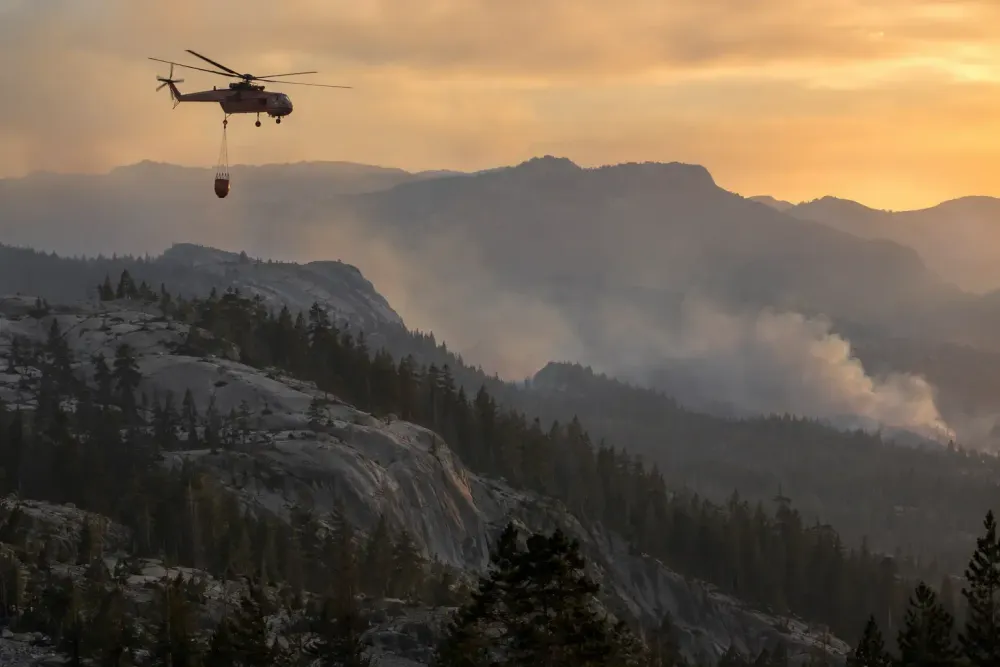
Two contract pilots were killed when a heavy-lift firefighting helicopter crashed during water-drop operations on the Dome Fire in Yosemite National Park, turning an expanding wildfire response into a federal aviation investigation. The aircraft went down Sunday afternoon southeast of Ostrander Lake while supporting crews in steep, roadless terrain, according to accounts compiled by the Associated Press and Reuters. The pilots were the only people aboard.
A Water-Drop Mission Ends in Tragedy
The helicopter was a Super Puma operated by the contract company Precision and was carrying a suspended water bucket, officials told news organizations. Aviation outlet AVweb identified the aircraft as a Eurocopter AS332L1 and placed the crash shortly before 3 p.m. The Federal Aviation Administration's preliminary information, quoted by local station KMPH, said it occurred under unknown circumstances at 2:55 p.m. during water-bucket drops.
The FAA and National Transportation Safety Board are investigating. Neither agency had announced a probable cause, and early reports provided no verified evidence that smoke, weather, mechanical failure or pilot action caused the crash. That distinction matters: wildfire aviation often occurs in changing visibility, winds and terrain, but those operating conditions do not by themselves explain an accident.
Two Pilots With Wildfire Experience
The Dome Fire incident team identified the pilots as Greg King, 56, and Ryan Cutter. King had flown on wildland fires in Alaska and had longstanding ties to the Alaska Division of Forestry and Fire Protection. In a statement reproduced by KMPH, the Alaska agency described him as a dedicated aviator and said close relatives still work for the division.
Precision said it had lost two members of its team and asked for privacy for their families. The company did not offer an account of what caused the crash. The decision to separate expressions of grief from factual findings is appropriate while investigators collect aircraft records, witness accounts, maintenance information, weather data and evidence from a remote site.
The Fire Was Growing in Difficult Country
The official record showed the Dome Fire at 3,420 acres and 15% contained Monday evening, up from 3,047 acres the prior night. The fire began Sept. 15 north of Wawona Dome. The National Park Service is the agency with jurisdiction, and California Interagency Incident Management Team 3 is managing the response.
Before the accident, the Park Service said helicopters were dropping water, moving supplies and transporting hotshot crews into areas without easy ground access. Crews were building direct hand line in steep drainages and using granite outcrops and other natural barriers where possible. Heavy fuels and spotting in red fir forest complicated suppression work.
The park remained open, but the Chilnualna Falls Trail and nearby backcountry routes were closed. Officials reported no evacuation orders and no immediate threat to developed areas as of Sunday morning. Smoke affected parts of Yosemite, with poorer air quality expected around Wawona and Yosemite Valley. Those conditions explain why aviation was central to the response, but investigators have not tied them to the crash.
A Broader Risk for Wildfire Aviation
The deaths add to a difficult year for aviation crews supporting wildfires. Reuters reported that five helicopter pilots had died in wildfire-related crashes in Colorado, Utah and California during 2026. The Associated Press separately documented a wider toll among firefighters and support personnel, including deaths caused by aircraft accidents, medical emergencies, falling trees and burnovers.
Helicopters perform jobs that ground crews cannot do quickly in remote country: placing personnel, carrying cargo and delivering water with precision. They also operate close to terrain, often in heat, turbulence and smoke. That combination makes disciplined risk management essential, but it does not make a particular loss inevitable. The NTSB investigation will be responsible for distinguishing the routine hazards of the mission from the specific chain of events that brought this aircraft down.
The accident also underscores how public wildfire response depends on specialized private operators. Precision supplied the aircraft and pilots under contract, while an interagency team directed work across a fire under National Park Service jurisdiction. That layered structure is common in large incidents, where local, state and federal agencies may share crews, aviation assets and safety responsibilities. Investigators will therefore need to reconstruct not only the aircraft's final flight but also the mission assignment, briefing, communications and oversight surrounding it. The inquiry's value will extend beyond identifying a technical failure or human decision: it can test whether operating procedures adequately managed the hazards crews faced that afternoon.
What the Investigation Must Establish
The immediate public record leaves several central questions unanswered: the aircraft's altitude and speed before impact, the condition of the external-load system, whether visibility changed during the drop cycle, and whether investigators find any mechanical or operational anomalies. Preliminary findings may clarify the sequence, but a final NTSB probable-cause report can take much longer.
For now, the verified facts are narrow. Two pilots died while performing a water-drop mission on an active federal wildfire. The fire continued to grow, and crews remained deployed across rugged terrain. The cause of the crash is unknown. Keeping those boundaries clear honors the pilots and protects the integrity of an investigation whose conclusions could shape future wildfire aviation practices.