
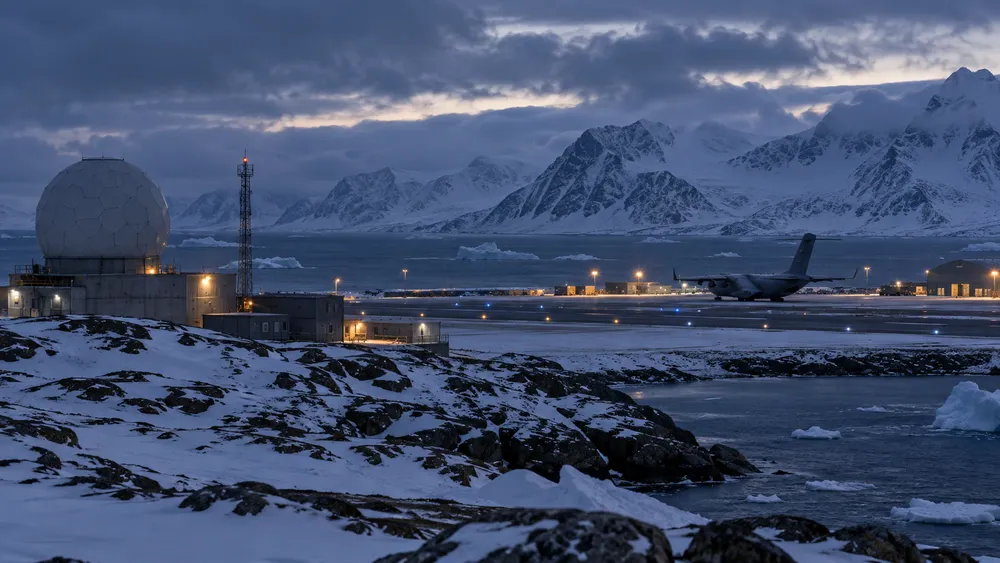
The United States, Denmark and Greenland signed an open-ended Arctic security agreement Tuesday that authorizes two new U.S. defense areas, expands American access across Greenland and bars non-NATO states from maintaining a persistent military presence there. The accord, signed at the United Nations in New York, also preserves Danish sovereignty and Greenlanders’ right to self-determination, according to the published treaty text and reporting by the Associated Press.
The signature converts last week’s political announcement into an executed agreement with direct consequences for U.S. missile warning, space surveillance and Arctic defense. It does not make Greenland American territory, despite President Donald Trump’s earlier demands and his description of the pact as giving Washington permanent control over security. Danish Prime Minister Mette Frederiksen and Greenland Prime Minister Jens-Frederik Nielsen signed alongside Trump while emphasizing sovereignty, alliance cooperation and Greenlandic participation, as Reuters and AP reported.
What the agreement changes
The pact permits the United States to modernize and expand operations at Pituffik Space Base in northwestern Greenland. It separately authorizes defense areas at Narsarsuaq in the south and Mestersvig in the east, with technical details still to be negotiated. Additional defense areas can be proposed later, but the parties must consult through a permanent committee and agree on implementation. Trump called the planned facilities two major bases; the legal text uses the more precise term “Defense Area,” defined as a place where the United States establishes or operates a military base.
American public vessels, aircraft, forces and vehicles receive free access between defense areas by land, air and sea. U.S. aircraft may fly over and land anywhere in Greenland, while American public vessels may receive undersea access within Greenlandic territorial waters, subject to mutually agreed limits. The agreement also provides accelerated review of requests for unmanned military installations outside designated defense areas. Those provisions appear in the primary text and were independently summarized by AP and the Guardian’s live coverage.
The accord seeks to direct construction and support work toward Greenland’s economy. It says the United States will award contracts connected to establishing, maintaining and dismantling defense areas to Greenlandic sources “to the maximum extent possible,” taking feasibility and local capacity into account. That language creates an opportunity for local businesses but is not a guaranteed spending figure, hiring target or construction timetable.
Sovereignty and security
The agreement draws a line between expanded U.S. military access and ownership. Its preamble reaffirms the sovereignty and territorial integrity of the Kingdom of Denmark and recognizes Greenlanders as a people with a right to self-determination. The Danish government’s earlier official statement used the same formulation, while Reuters reported that the signed deal stops short of Trump’s demand that Greenland become U.S. territory.
At the same time, the pact gives Washington durable strategic protections. A non-NATO state cannot establish manned or unmanned military installations or keep a persistent military force in Greenland unless all parties agree. Investors from countries outside NATO, NATO partnerships or the European Union can be blocked from controlling sensitive sectors, exercising significant influence or accessing nonpublic information when that activity poses a national-security or public-order threat. Critical infrastructure and resource extraction are specifically identified as sensitive areas.
Those restrictions are aimed at the growing Arctic presence and investment ambitions of Russia and China, although the treaty does not name either country in its operative clauses. It also commits the parties to stronger NATO planning, exercises, intelligence gathering and Arctic presence. NATO Secretary General Mark Rutte said the agreement improves collective security in the Arctic and North Atlantic, while Frederiksen described it as compatible with Greenlandic self-determination and Denmark’s territorial integrity.
What happens next
The pact has no expiration date and can be amended only by mutual consent. It also anticipates possible Greenlandic independence: an independent Greenland would be expected to remain in NATO and assume Denmark’s rights and obligations under the defense arrangements. That provision gives the United States continuity while leaving Greenland’s constitutional choice formally intact.
Signing does not by itself complete implementation. The agreement says it enters into force only after Denmark and Greenland complete required parliamentary procedures and Denmark sends the United States a diplomatic note confirming that process. The parties must then settle the size, scope, activities and mitigation measures for the two new defense areas. Until those steps occur, precise troop levels, costs, construction schedules and environmental conditions remain unresolved.
The immediate change is therefore political and legal rather than operational: three governments have accepted a framework that can substantially enlarge the U.S. military footprint in the Arctic while avoiding a transfer of sovereignty. The next consequential evidence will come from legislative approval, detailed basing arrangements and budget decisions—not from the leaders’ competing descriptions of who gained the most.