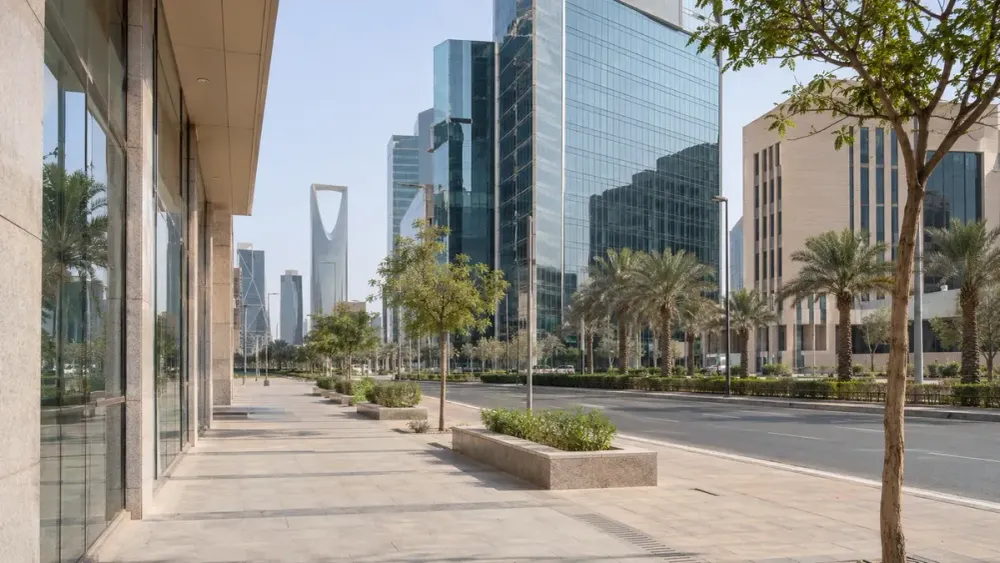
Falling debris damaged a Saudi Aramco administrative building in Riyadh on Sunday, November 8, Saudi Arabia’s Energy Ministry said, as the Saudi-led coalition reported intercepting missiles aimed at the capital and other regions. The ministry reported no injuries or deaths. Independent accounts from Reuters and the Associated Press described visible damage at the Aramco tower in the King Abdullah Financial District.
The incident brought the effects of the Saudi-Houthi conflict into a prominent commercial district, following deadly reported airstrikes near Yemen’s capital. It also exposed an important distinction in the available evidence: damage to an oil company’s office building does not establish damage to oil-production facilities or a loss of supply. The initial accounts documented physical damage and official interception claims, rather than a measured interruption to energy operations.
Interceptions did not prevent debris damage
The coalition said its air defenses destroyed two ballistic missiles heading toward Riyadh and two cruise missiles targeting the capital and southern regions. It attributed the ballistic launches to Yemen’s Iran-aligned Houthis. Both AP and Reuters reported those official accounts; neither independently established the full flight paths or interception sequence.
Reuters’ witness saw broken windows across several floors of the Aramco tower. AP’s witnesses also described damage on multiple floors, including exterior glass, although they spoke anonymously because of security concerns. The Energy Ministry characterized the damage as limited and said authorities were responding. These accounts support the occurrence of damage while leaving its full extent and repair requirements unresolved.
The official claim of successful interception and the damaged building are therefore not mutually exclusive. Saudi authorities specifically attributed the damage to falling shrapnel. That explanation remains the government’s account of the mechanism; witness observations establish damage, but cannot by themselves determine which projectile or interception produced it.
A widening cycle of attacks
The Riyadh incident followed reported strikes near Sanaa on Saturday. Reuters reported that Houthi-run authorities put the toll at 33 people killed and 39 wounded. The news agency said it could not independently verify that account, while Saudi Arabia’s Center for International Communication said it was investigating the report.
Earlier AP reporting carried a lower preliminary toll of at least 27 killed and 36 injured, also attributed to Houthi authorities and not independently verified. The differing figures underline the provisional nature of casualty reporting during rescue operations. They should not be treated as separate incidents or combined into a larger total.
The Houthis have presented their attacks as retaliation. The National reported that military spokesman Yahya Saree said on Saturday that the group conducted six missile and drone operations against targets in Saudi Arabia and Yemen. His list included airports and energy facilities. A declared target or claimed successful operation, however, does not independently establish that the named facility was hit.
The exchanges also mark the erosion of an earlier period of relative restraint. Reuters and The National describe renewed fighting as breaking the calm associated with a UN-brokered 2022 truce. Saudi Arabia originally intervened with a coalition in 2015 to support Yemen’s internationally recognized government after the Houthis seized Sanaa. This weekend’s strikes belong to that longer conflict, alongside the wider regional confrontation.
The civilian burden extends beyond individual strikes
The renewed exchanges are unfolding against a humanitarian emergency that predates this weekend. The United Nations’ 2026 plan estimated that 22.3 million people in Yemen would require assistance and protection, including 5.2 million internally displaced people. It identified conflict, economic deterioration, disrupted services and access constraints as overlapping drivers of need.
Those figures describe the broader crisis, not people newly affected by Saturday’s reported strikes. The distinction matters because neither a national needs estimate nor a local casualty report measures the additional humanitarian damage from the latest exchange. Establishing that would require assessments of displacement, damaged homes, service interruptions and access for relief teams.
The European Commission likewise cites 22.3 million people needing assistance and 18.3 million facing acute food insecurity. Its humanitarian assessment warns that fighting and airstrikes disrupt civilian infrastructure while front lines impede aid delivery. These are conditions that can compound the consequences of another attack even when the immediate death toll remains uncertain.
What the evidence establishes
The strongest independently corroborated finding from Sunday is that an Aramco building in Riyadh sustained damage. The no-casualty assessment and explanation involving shrapnel come from Saudi authorities. The coalition’s interception totals and attribution identify its account of the attack, while the reported toll near Sanaa comes from authorities on the opposing side.
For energy markets, the relevant unanswered question is whether any operational infrastructure was affected. Neither visible office damage nor a list of claimed targets answers that question. Verified assessments from Aramco or the relevant authorities would be needed before assigning a production loss, export disruption or repair timetable to this incident.
For civilians, the next evidentiary tests are clearer casualty accounting, access to affected sites and documentation of damage to essential services. Sunday’s Riyadh damage and the reported deaths near Sanaa show the conflict’s reach across the border. They do not yet provide a complete, independently verified measure of this weekend’s military or humanitarian consequences.