
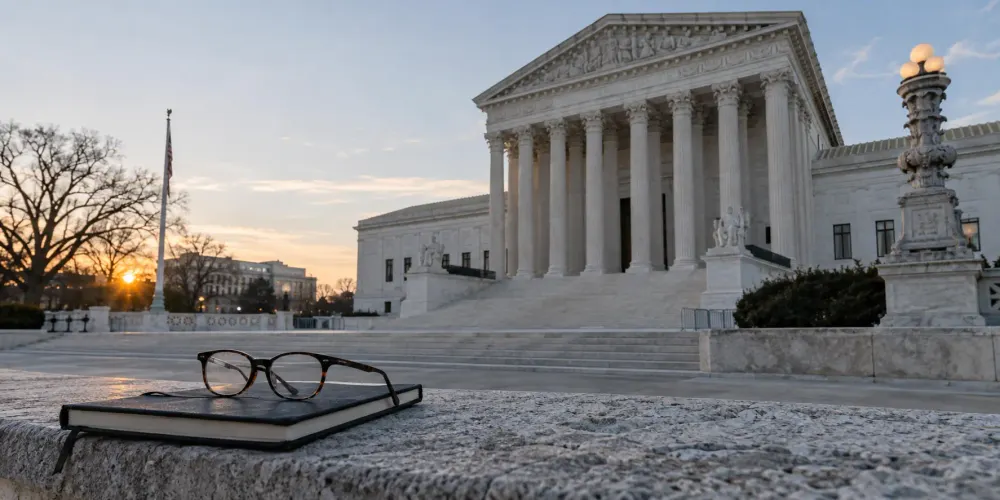
The Trump administration has asked the Supreme Court to overturn a 2-1 appellate ruling that kept Georgetown University scholar Badar Khan Suri free while he challenges his immigration detention, placing a campus free-speech dispute inside a broader test of federal judges’ power to review immigration custody. The Justice Department’s petition, filed Monday in case No. 26-380, argues that Congress channeled review of deportation-related claims into the immigration system and barred a district judge from ordering Suri’s release.
The filing does not ask the justices to decide whether Suri’s political speech was protected or whether the government may ultimately deport him. It asks a narrower but consequential question: whether federal immigration statutes prevented a Virginia court from hearing his habeas challenge and releasing him while separate removal proceedings continued. The new filing matters to universities because foreign students and scholars often depend on temporary visas, and the answer will help determine how quickly they can obtain ordinary federal-court review when detention is alleged to punish protected campus expression.
What the government wants the court to decide
Suri, an Indian citizen, entered the United States in 2022 on a J-1 exchange visa for a Georgetown postdoctoral fellowship. The Fourth Circuit record says he taught a course on majoritarianism and minority rights in South Asia and lived in Virginia with his U.S.-citizen wife and their three children. Immigration officers arrested him in March 2025, moved him through several facilities and ultimately held him in Texas, where removal proceedings remain separate from his constitutional case.
A Virginia federal judge ordered Suri released in May 2025 after concluding that he had substantial First Amendment and due-process claims and did not pose a danger to the community. Contemporary AP reporting said the judge viewed his speech opposing Israel’s military campaign in Gaza as likely protected political expression. The government has disputed that the district court could intervene, maintaining that immigration law requires challenges intertwined with removal to proceed through immigration courts and, after a final order, through the designated federal appellate process.
The Fourth Circuit drew a line between detention and removal
The appellate majority affirmed the district court “in full,” holding that the court possessed habeas jurisdiction and that no cited immigration provision stripped its subject-matter jurisdiction. Its reasoning distinguished a challenge to allegedly retaliatory detention from a direct request to cancel or review a removal order. On that view, Suri could contest the legality of confinement without asking the district judge to decide whether he was deportable.
The government’s petition rejects that separation. It contends that Suri’s detention claim cannot realistically be severed from the enforcement process that produced it and warns that the Fourth Circuit’s rule could invite parallel district-court litigation around the country. The petition emphasizes statutory channeling provisions rather than a broad claim that foreign scholars lack constitutional protections. That distinction is important: even a ruling for the government could turn on where and when a claim must be heard, rather than resolving the underlying speech question.
Why the dispute reaches beyond one scholar
Suri’s lawyers say his arrest was retaliation for his and his wife’s pro-Palestinian views and associations. The government has cited foreign-policy and national-security concerns, including alleged connections through his wife’s family, while Suri denies wrongdoing. The ACLU record identifies his case alongside challenges brought for other foreign students and scholars detained after campus-related advocacy, making the jurisdictional issue operationally significant for colleges hosting international academics.
Universities do not control visa enforcement, but they manage exchange programs, faculty appointments, student support and academic-freedom policies that can be disrupted by detention. If habeas review remains available in district court before removal proceedings conclude, affected scholars may seek faster judicial scrutiny of custody alleged to be unconstitutional. If the Supreme Court adopts the government’s position, those claims could be delayed or redirected into the immigration-review structure, even when the requested remedy is release rather than cancellation of deportation.
A circuit conflict raises the stakes
The petition says the Fourth Circuit’s approach conflicts with decisions from other federal appeals courts. It points especially to litigation involving Mahmoud Khalil, a former Columbia University student activist, in which another appellate court took a more restrictive view of district-court jurisdiction. The Justice Department has urged the justices to consider both disputes so that one national rule governs how detention challenges tied to removal proceedings move through the courts.
A split among appellate courts can make Supreme Court review more likely, but the filing itself does not mean the justices will hear the case. Suri’s lawyers will have an opportunity to respond before the court decides whether to grant review. Until then, the Fourth Circuit judgment remains the controlling ruling in his case, and Suri remains outside immigration custody under the lower-court orders summarized in the government’s filing.
What colleges should watch next
The immediate milestones are procedural: Suri’s response, any reply from the government and the justices’ decision on whether to add the case to their docket for full briefing and argument. A grant would signal that the court is prepared to clarify the boundary between the immigration-review system and habeas corpus, a longstanding judicial mechanism for testing the legality of detention.
For higher education, the durable question is not whether universities can immunize foreign scholars from immigration law; they cannot. It is whether scholars who allege that custody punishes protected academic or political expression may obtain prompt review from a federal trial judge. The record establishes that Suri’s release and deportation cases remain distinct for now. Supreme Court review could preserve that distinction, narrow it or replace it with a single national rule affecting international students and researchers well beyond Georgetown.