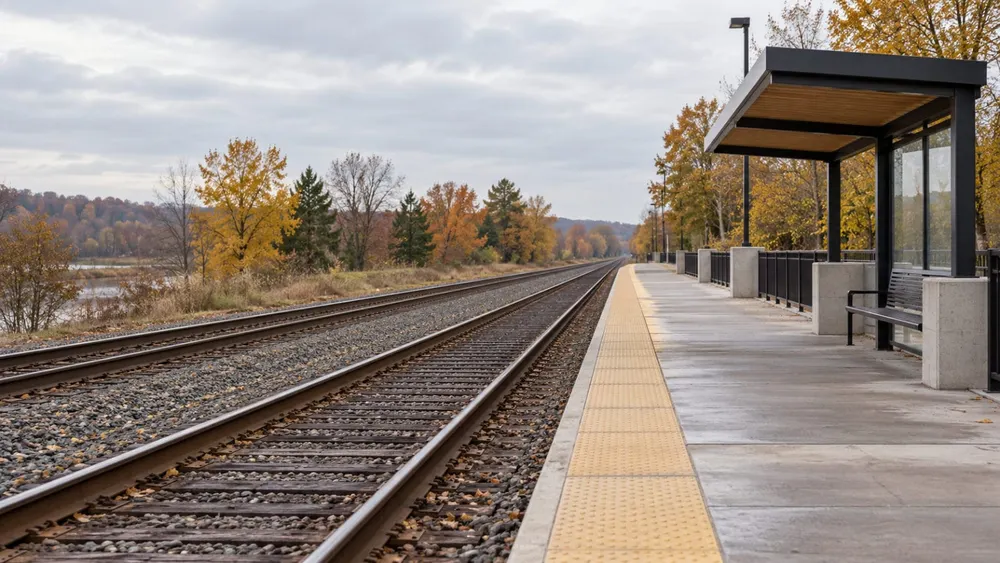
Wisconsin’s proposed Hiawatha West passenger rail extension has secured more than $218 million in federal funding for final design and construction, bringing a Chicago–Milwaukee–Madison connection closer while leaving important state funding decisions unresolved. U.S. Sen. Tammy Baldwin and Gov. Tony Evers announced the award on October 16, according to Baldwin’s office and Wisconsin Public Radio.
The project would extend existing Amtrak service west from Milwaukee, adding stops in Pewaukee, Watertown and Madison. Both WPR’s reporting and Madison’s announcement describe the route as a proposed expansion, not an operating service. For prospective passengers, the funding news does not establish a date when they can board a train in Madison.
Federal award leaves a state decision
The money comes through the Federal Railroad Administration’s Consolidated Rail Infrastructure and Safety Improvements program. It will support tracks, bridges, crossings, added rail capacity and passenger stations, according to the federal senator’s announcement and Urban Milwaukee’s reporting. The corridor also carries freight, so the planned investment is not solely a passenger-station project.
Madison says Wisconsin still needs to commit its 20 percent share of design and construction costs, plus annual operating funds. Urban Milwaukee reports a $54.5 million state contribution for a $273 million project. WPR cites an earlier Amtrak estimate of up to $275 million and the same 80–20 federal/nonfederal funding structure. Those figures describe capital costs; recurring support to run trains is a separate obligation.
That distinction makes the next state budget decisions consequential. As the city’s release and Urban Milwaukee explain, the federal award does not remove the need for a state match and ongoing operating support. The award advances the project, but does not by itself settle how Wisconsin will pay its remaining share.
Baldwin and Evers also describe expected economic gains: 200 permanent jobs and roughly $46 million in annual benefits. Those figures are forecasts in the announcement, also reported by WMTV. They should not be read as jobs already filled or benefits already realized. Their relevance depends on completing the infrastructure and running the service; the funding award and the eventual economic result are different milestones.
Construction and service remain ahead
Madison has conducted a passenger rail station study and coordinated with Amtrak and the Wisconsin Department of Transportation. Its proposed capital budget includes station-construction support, the city says. Separately, Urban Milwaukee reports that environmental review, engineering, design and coordination with the railroads remain necessary before service begins.
The city describes service as possible as soon as 2030; Urban Milwaukee notes an earlier best-case 2029 scenario and emphasizes remaining approvals and construction. These are planning expectations, not guaranteed opening dates. The practical milestone to watch is whether state funding, final design and construction commitments follow the federal announcement, turning an award into a funded path to operation.