
Utah's unemployment rate edged down to 3.5% in August as employers added an estimated 3,600 payroll jobs during the month, according to federal data released Friday. The state rate remained below the 4.1% national rate, while total nonfarm employment was 1.0% higher than a year earlier.
The labor force grew by about 3,800 people in August to 1.83 million, and household employment increased by roughly 4,500. The estimated number of unemployed residents fell by about 700 to 64,100, the Bureau of Labor Statistics' Utah profile shows. The rate was 3.6% in July and 3.8% in August 2025, though BLS did not identify either the monthly or annual change as statistically significant.
Utah's 3.5% rate placed it at rank 18 in the agency's state unemployment-rate table, which orders states from lowest rate to highest and includes ties. That ranking supplies useful context, but it is not a scorecard for job quality, wages or affordability, and small differences between states may not be statistically meaningful.
Total nonfarm payroll employment reached 1.79 million in August. The monthly gain of 3,600 jobs followed an upwardly revised July level of 1.788 million. Compared with August 2025, Utah had about 16,600 more payroll jobs. The annual increase was positive, but the state was not among the seven that BLS identified as having statistically significant payroll gains over the year.
That distinction matters: a positive estimate is the agency's best measure, while a statistical-significance test addresses whether the observed change is large enough to distinguish from normal survey variability. It does not mean the estimated jobs were unreal or unimportant.
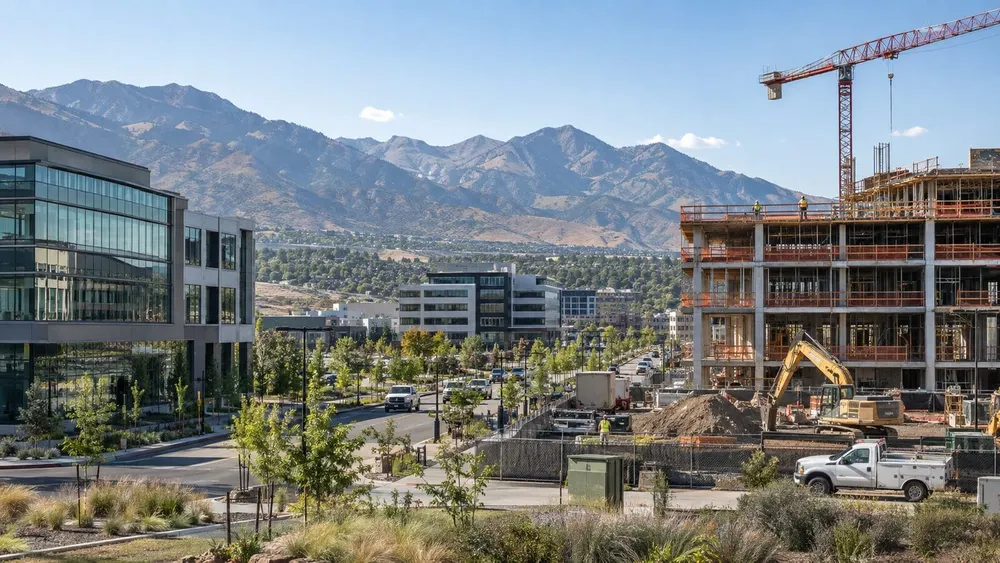
Construction was one of the stronger sectors, adding 600 jobs in August and 4,300 over the year, a 3.0% increase. Professional and business services grew by 7,900 jobs from a year earlier, or 3.1%, while education and health services added 4,900, or 1.9%. Manufacturing added 1,700 jobs over the year.
Other sectors moved in the opposite direction. Government employment was down 3,600 from August 2025, a 1.3% decline. Information employment fell by 1,700, or 4.0%. Trade, transportation and utilities—the state's largest private-sector grouping by employment—rose by 1,300 over the year, a comparatively modest 0.4%, according to the seasonally adjusted industry series.
The unemployment and payroll figures come from separate surveys. The household survey estimates the number of people working or looking for work, while the employer survey counts jobs. Monthly state estimates are subject to sampling error and subsequent revision, so the direction across several releases is generally more informative than a single month's change.
For job seekers, the latest report points to continued employment growth without a statistically confirmed shift in the unemployment rate. For employers and policymakers, it highlights a labor market in which construction and professional services are expanding faster than several other major sectors. The next state report, covering September, is scheduled for October 20 under the federal release calendar.