
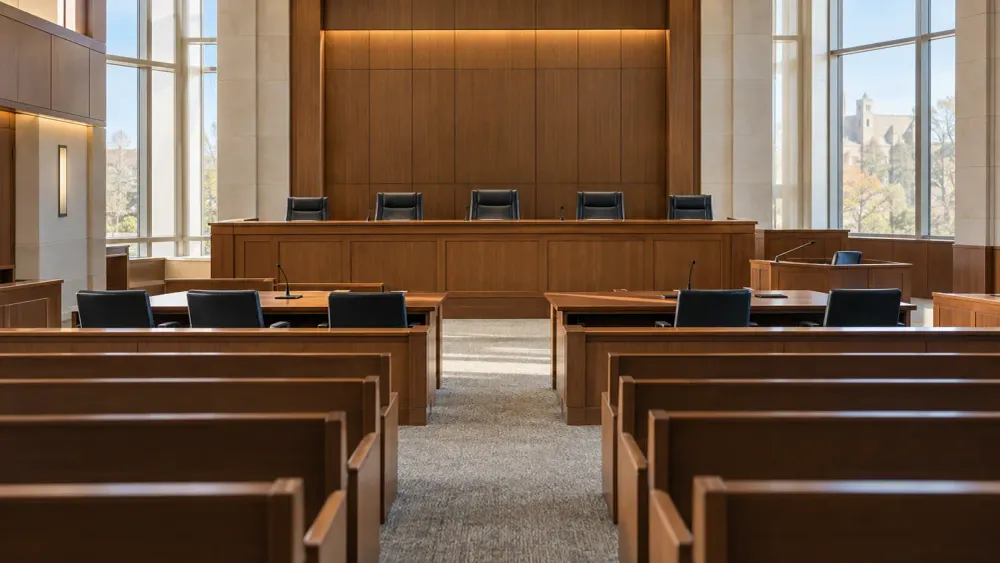
The South Dakota Supreme Court will take its full October argument calendar to the University of South Dakota in Vermillion, opening seven cases to public observation over two mornings. The court’s announcement says arguments begin at 9 a.m. CDT on Oct. 7 and Oct. 8 in the Knudson School of Law courtroom at 414 E. Clark St.
The traveling session matters beyond the law school because it puts a statewide institution—and several disputes with consequences for criminal procedure, taxation, workers’ compensation and professional liability—before residents outside the Capitol. Three cases are scheduled Wednesday and four Thursday, according to the court’s calendar. Chief Justice Steven R. Jensen said the format is intended to let South Dakotans see how appellate decisions are made. Area high school government classes are also invited, making the session both a working court calendar and a civic-education event.
The docket illustrates the reach of those decisions. One appeal asks whether an injured retail worker qualified for permanent total disability benefits under the “odd-lot” standard. Another concerns what evidence jurors may hear in an aggravated-assault prosecution involving alleged strangulation. A civil case tests South Dakota’s three-year statute of repose for legal-malpractice claims, while a consolidated tax appeal pits Midcontinent Communications against the Department of Revenue. The official booklet summarizes each case and identifies the legal questions, but those summaries are not decisions and do not indicate how the justices will rule.
South Dakota’s high court is primarily an appellate court. It reviews claimed legal errors from the circuit courts rather than retrying cases or hearing new witnesses. The booklet explains that lawyers generally receive 15 minutes to emphasize their arguments while the justices question them. Afterward, the court deliberates and assigns a justice to prepare an opinion; concurring or dissenting opinions may accompany the majority. That sequence can clarify why oral argument focuses narrowly on statutes, precedent and the trial record.
The public may attend any of the seven arguments without registering, but the court has set security and conduct rules. Attendees will pass through a metal detector; backpacks and book bags should not be brought, and other bags may be inspected. The court asks visitors to arrive before an argument begins, silence phones and avoid entering or leaving while lawyers are speaking. Food, drinks, cameras and recording equipment are prohibited, the visitor guidance says.
The justices travel to public institutions twice each year as part of a broader transparency and civic-education effort. This session gives residents a direct view of a process that is usually described through written briefs and later opinions. It also carries a practical limit: observers will hear each side’s legal presentation, not testimony or a verdict announced from the bench. Decisions will follow after deliberation and will be published by the Unified Judicial System.